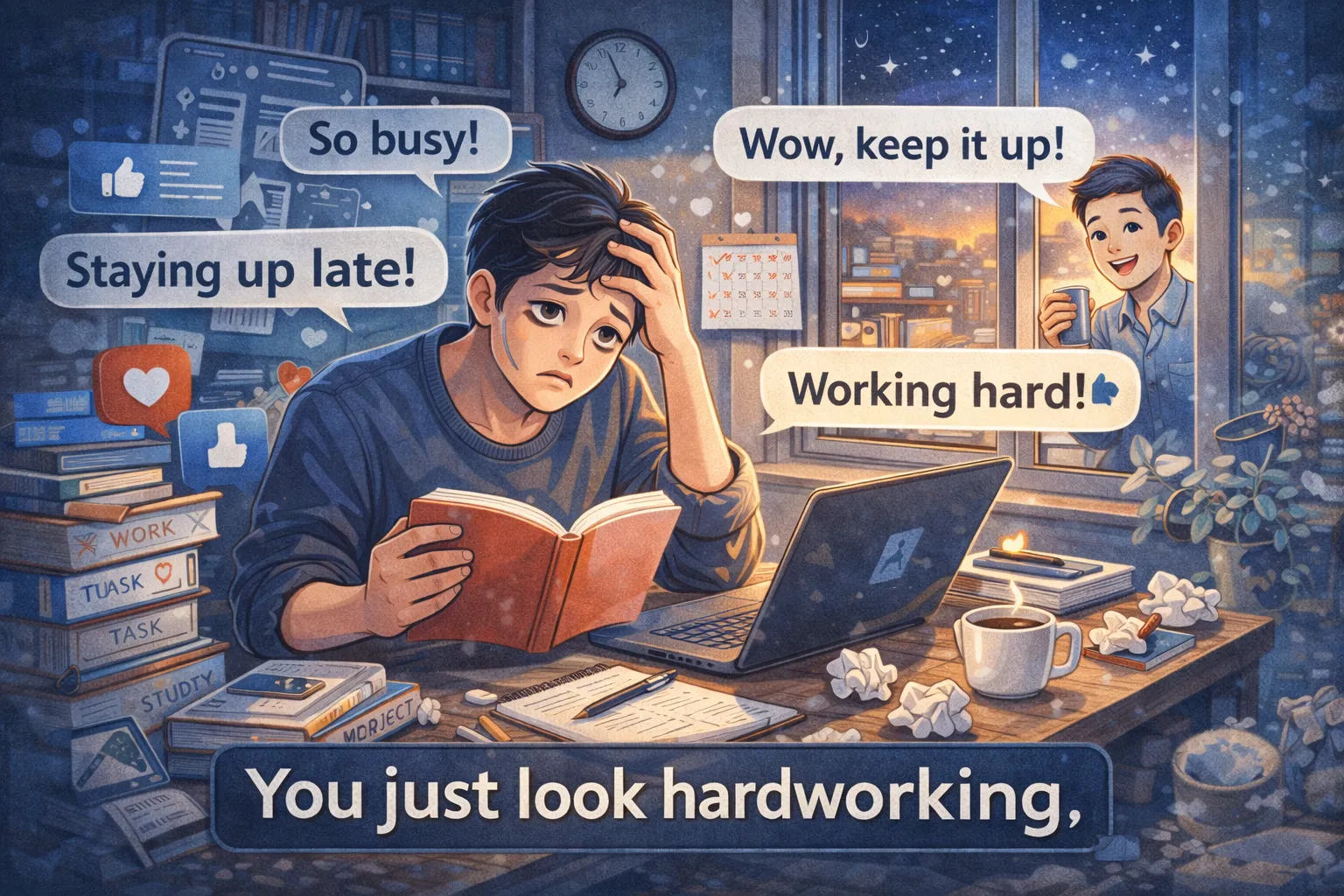
Reading experience of "You Just Look Hard": In the AI era, don't let fake efforts swallow up your energy
In recent years, I have used “effort” less and less to evaluate a person.
It’s not because hard work is not important, but because I’ve seen too many people live their lives as if they are working very hard: their schedules are full, they take a lot of notes, they post frequently on social media, they hold long meetings, they buy a lot of books, they take a lot of classes, and their mantra is always “I’m really busy lately.”
But in the end, looking back, life has not really moved forward much.
I gradually understood that some efforts were actually just a kind of psychological comfort. It makes you feel like you’re doing something, but you’re not necessarily doing the right thing.
It’s not like I’ve never fallen into this trap before.
I used to be a person who seemed to work hard
There was a time when I squeezed myself into an extremely high-density work rhythm. Writing articles, preparing lessons, giving speeches, attending meetings, answering messages, making plans, and handling administrative chores all seemed to go on from morning to night.
表面上看起来,我是一个非常勤奋的人。 What others see is a lot of output, a lot of activities, and a lot of cooperation. But only I know that sometimes, that kind of busyness is not really strategic busyness, but a kind of busyness that is pushed by things.
These two kinds of busyness are very different.
Truly valuable efforts must have a sense of direction behind them. You know what capabilities you are doing now to accumulate, what position you are near, and what assets you are building. But busyness that seems very hard often just cuts up time and uses up all the energy. In the end, what you get in return is not growth, but exhaustion and self-impression.
I reminded myself more and more often:
Don’t use hard work to deceive yourself, and don’t use busyness to cover up anxiety.
Some people have been learning, but have not really upgraded; some have been doing it, but have not accumulated leverage; some people have been supporting, but have not established irreplaceability.
This is why some people are always spinning around in circles even though they work hard.
The cruel truth revealed by Li Shanglong
Recently I re-read Li Shanglong’s “You just look like you are working hard”, and there is a sentence in the book that is particularly harsh:
Learning without seeking purpose is just a show, and hard work without seeking results is just a waste of time.
This sounds cruel, but it is true.
Li Shanglong used 47 essays to record the stories of him and his friends, and dismantle the traps that make people look like they are working hard. After the book was published, it was reprinted by the People’s Daily and went viral on the Internet tens of millions of times - obviously, it hit the pain points of countless people.
Many times, the cruelest truth is not that you don’t work hard, but that you obviously work hard, but spend your efforts on things that will not change your destiny.
Fake efforts in the AI era are more hidden and more consuming
This problem has become more serious in the AI era.
Now fake efforts have a new look:
Busy chasing tools: ChatGPT came out to learn ChatGPT, Claude came out to learn Claude, Midjourney, Sora, Cursor… I touched each one, but I didn’t learn them thoroughly.
Busy chasing information: Subscribe to dozens of e-newsletters, follow countless KOLs, spend three hours a day “learning”, but forget after learning and never apply it in practice.
Busy chasing anxiety: I became nervous when I saw the news that “such and such a profession is going to be replaced.” I signed up for a bunch of transformation courses, but none of them were completed.
These behaviors have a common characteristic: they make you feel like you’re making progress, but in reality they’re just expending energy.
Psychologists call this phenomenon “false effort”—behavior that appears to be efficient but is actually unproductive. You are busy answering letters, making lists, attending meetings, and clocking in, but you have overlooked a key question: Can these behaviors really promote the results you want?
Worse yet, false effort will make you increasingly exhausted. Because you put in time and effort but don’t see results, you start to doubt yourself and fall into deeper anxiety.
Real efforts have three characteristics
So, what is real effort?
First, have a clear direction
It’s not “I want to learn AI”, but “I want to use AI to improve the efficiency of my content production”. It’s not “I want to grow”, but “I want to establish a stable writing habit within three months.”
The more specific the direction, the more effective the effort will be.
Second, there is visible feedback
You know whether you are making progress or staying still. This feedback can come from data (how many words have been written, how many articles have been published, how many responses have been received), or from others (readers’ responses, supervisors’ evaluations, market reactions).
Effort without feedback is like running in the dark - you don’t know where you are going or how far you have run.
Third, there is continuous iteration
Real growth is not about getting there all at once, but about constant adjustments. You try a method, observe the results, revise based on the results, and try again. The faster this cycle, the faster the growth.
The problem with many people is that they only “try” and do not “observe” and “correct”. So the same mistakes are made repeatedly, and the same bottlenecks are stuck again and again.
Stop Anxiety and Cultivate Inner Strength
The AI era makes many people anxious. According to the World Economic Forum, automation could impact 85 million jobs worldwide. This number is scary, but anxiety won’t help you.
The reason why I have paid more and more attention to AI, content systems, personal brand and intellectual assets in recent years is not because I am superstitious about tools, but because I know very well: when people reach a certain stage, they can no longer just use physical effort to survive.
You can’t always rely on “I’m serious” and “I’m willing to do it” in exchange for opportunities. You must find a way to make your efforts amplified, replicated, and precipitated.
💡 Turn your efforts into leverage instead of consumption
If you also want to get rid of the cycle of “busy chasing tools but not learning them thoroughly”, welcome to join my [Vibe Coding Practical Workshop] (https://www.vista.tw/workshop/vibe-coding). This is not about teaching you to write programs, but about using AI to turn ideas into truly usable tools - so that every effort can be accumulated into an asset, rather than disappearing after being consumed.
Here are a few ways that help me maintain inner stability:
1. Distinguish between “controllable” and “uncontrollable”
Will AI replace your job? have no idea. Will the economy decline? have no idea. These are beyond your control.
But what you can control is: whether you want to write today, whether you want to practice, whether you want to learn a skill in depth. Spend your energy on controllable things and your anxiety will naturally decrease.
2. Use “small wins” to accumulate confidence
Don’t set goals that are too far away. Complete one small thing every day to make yourself feel progress. This kind of small wins will accumulate into confidence, and confidence will be transformed into action.
My own approach is: write 500 words every day. No matter how busy or tired you are, finish these 500 words first. This little habit has allowed me to accumulate hundreds of articles over the past few years.
3. Establish a “sense of meaning”
The World Economic Forum’s 2025 Skills Report states that the most important capabilities for the future include “resilience” and “creative thinking.” But I think what is more important than these is the “sense of meaning” - you know what you are working hard for.
When you know your direction, external noise will not easily shake you. AI can replace many jobs, but it cannot replace a person with clear goals, unique perspectives, and real experience.
What are you accumulating?
Effort is not an end in itself. If efforts are not directed, it will only make people live more and more tired. What really matters is whether every step you take takes you to a higher value position.
So now, when I look at a person, I don’t look at how busy he is, but at what he is accumulating.
Is he stacking up chores or building a future? Is he escaping from anxiety or traveling through it? Is he consuming himself repeatedly, or is he slowly becoming a stronger person?
Li Shanglong said in the book: “You just look like you are working hard.” But what he really wants to say is: you are worthy of real effort.
The kind of effort that has direction, feedback, and iteration. The kind of effort that is not anxious, not internalized, not driven by fear. The kind of effort that allows you to honestly say before going to bed every day, “I did something important today.”
In the AI era, you don’t need to be busier than others. What is needed is that you are more awake than you were yesterday.
Extended reading:
- Don’t wait until you are ready to start—reunderstand the essence of growth from “Protagonist Mode”
- From Chaos to Conquest: A personal transformation blueprint to completely turn your life around
- A cruel watershed in the AI era: Why has the income of 95% of freelance workers been cut in half, while the income of 5% has doubled?
📚 Book purchase link: “You just look like you are working hard”