Expression
Translating the value in your head into a few lines anyone can understand.
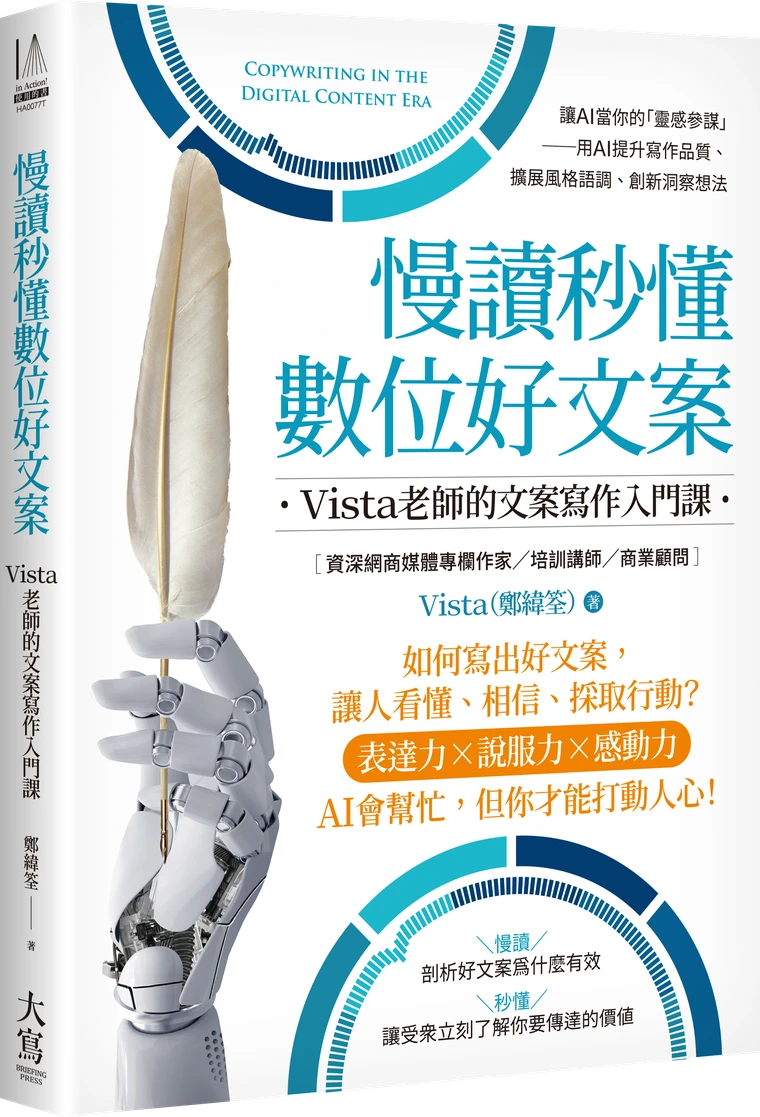
Vista’s introductory course in copywriting
Original title: 《慢讀秒懂數位好文案》:Vista老師的文案寫作入門課
All of Vista Cheng’s books are written and published in Traditional Chinese and sold in Taiwan. There are no English editions; English titles on this page are descriptive translations.
Briefing Press (大寫出版) · 240 pages · list price NT$430 · ISBN 9786267676967
Traditional Chinese edition, sold through Taiwanese bookstores. The links go to the stores’ Chinese-language product pages.
I’m glad this book is back in print. In almost every class over the past few years, someone has asked me the same question: now that AI can help us write, do we still need to learn writing? My answer is firmer than it was when I wrote this book in 2018. AI seems to make writing easy, but it makes saying things clearly more valuable. It can polish your draft, rephrase it, and produce ten versions at once, but what to say, who to say it to, and where to stop are still yours to decide. That is what this book teaches from start to finish.
I went through them one by one. Some I now say more loudly; some I have to admit I got wrong. Here is one from each group; the rest are on the audit page.
Note that the more background context and material you can give it, the better it can help you find the right solution.
When I wrote this in 2023, the idea didn’t have a name yet.
I also want to stress this: when you use AI tools such as ChatGPT, never use them as a search engine.
This is now the exact opposite of true, so I have to take it back.
How do you write so that AI cites you?
The book is about writing for people. This is the new battleground of 2026.
It’s a product, not a sum: if any factor is zero, the whole thing is zero. Clear but not credible is useless; credible but without warmth is forgettable.
Copywriting power = Expression × Persuasion × Emotional pull
Translating the value in your head into a few lines anyone can understand.
Not eloquence, but a unique selling proposition and concrete benefits that make people willing to believe.
Warm stories and scenes that bring customers onto your side.
In the internet age we also depend on social media to spread the word. This is a hyperlinked era, and it calls for special copywriting skills. Vista has grown up in the digital environment for many years, he explains this especially well, and he shares a great deal of his own copywriting journey. I like this book, and I hope you will too.
Back-cover endorsement, translated from the Chinese.
Before the main text there are two pieces: a foreword by Professor Lu Hsi-peng and the introduction, “A Wonderful Mission Without a Standard Procedure.” The first nine chapters are the original 2018 book; Chapter 10 was added in the 2023 second edition. Chapter titles are translated from the Chinese.
Demystifying copywriting
揭開文案的神祕面紗
Clearing up the myths first: copywriting isn’t literary creation. It is built from three elements: audience, features, and goals.
What is copywriting power?
何謂文案力
The book’s core formula arrives, breaking an abstract skill into three multipliers you can practice separately.
Laying the groundwork
奠定文案力的利基
The homework before you write: define your target audience, resonate with potential customers, and find opportunities in their pain points.
Expression: how copy supports marketing
表達力:文案如何協助行銷
Content strategy, copy structure, and headlines, plus the widely shared logic pyramid.
Persuasion: winning customers with benefits
說服力:用利益收買顧客的心
Build a unique selling proposition, talk about benefits rather than just features, and find what makes a product most appealing.
Emotional pull: bringing customers onto your side with stories
感動力:用故事拉攏顧客與你同一國
Pixar’s six-part story formula, the peel-the-onion storytelling method, and using scenes to connect product and customer.
Running your own social media
如何經營自己的社群媒體
Running social media isn’t just opening a fan page, and follower count was never the point.
How to write different kinds of copy
不同類型的文案怎麼寫
Press releases, brand stories, product copy, and sales pages: four kinds of copy, four playbooks.
A creative journey, together
陪您走過一段創作的精神旅程
The real core of the book is not technique but content power. It closes with a copywriting toolbox.
The alchemy of AI writing
AI 寫作煉金術
How to ask questions, how to make AI your creative advisor, and how much of those judgments still hold today.
Added in the 2nd edition 9 related articles (in Chinese)
Which judgments came true, which I take back, and what’s still missing in 2026. It also corrects 4 places in the printed book that need fixing, including a URL that no longer works.
This book was written in 2018. The writing articles that have built up on this site since then are its sequel: the same method, applied in the age of AI.
The book has two layers. The principles (who copy is written for, how the three powers break down, how to design a story) still hold eight years later. The parts about tools and cases of the time do need some corrections. So instead of pretending everything is still right, I made a separate “eight-year audit” page that lays out the 6 judgments that came true and the 6 I take back.
The 3rd edition has a new cover; the text carries over from the 2023 revised edition, including the new preface and Chapter 10, “The Alchemy of AI Writing,” added that year. If you already own the revised edition, the eight-year audit on this site is your update. If you haven’t read it, this is the edition currently in print.
This book is the introductory course. It starts from the most basic question, “Have you ever been drawn in by a piece of copy?”, clears up the myths, and then gives you a formula you can break apart and practice. Many of the examples come from real situations my students ran into in corporate and university classes.
Yes, but for a different reason than three years ago. Back then the reason was that AI didn’t write well enough, and that no longer stands. Now the reason is that once AI makes execution cheap, what becomes scarce is judgment and taste: deciding what to write, who to write for, and where to stop. That is exactly what this book teaches from start to finish.
Two things. First, the eight-year audit, which lays out the book’s judgments one by one. Second, 13 related articles on this site, matched to the chapters, that you can read without buying the book. Both are in Chinese.
Briefing Press published the 3rd edition on September 14, 2026. It is a Traditional Chinese book sold through Taiwanese bookstores; the “Where to buy” section above links directly to each store.
Copywriting, content production, and AI writing, tailored to your industry and your team’s level.
Go All books See the other booksVibe Coding from Zero, the book in progress, and the full timeline.
See the books Newsletter Weekly notes on writing and AINew articles, new books, and extra resources go to the newsletter first. Written in Chinese.
Subscribe (opens in a new tab)