Customers no longer Google, but instead ask AI to place orders: "AI Changes Your Customers" Three Lessons for Marketers
“This isn’t science fiction. This is next Tuesday.”
Mark W. Schaefer (opens in a new tab) in “AI Transforms Your Customer” (opens in a new tab) When I put down this sentence in the preface, I happened to be doing something very similar: turning on AI, asking it “Who is teaching AI content marketing in Taiwan?”, and then staring at the screen to see if I was on that list.
At that moment I realized that this book was not about marketing skills at all. It talks about something more troublesome: your customers have quietly turned into another kind of person.
Over the past few decades, our industry has followed an iron rule: if you want to be successful in marketing, you must first understand human nature. The question is, what if human nature itself is rewritten? Schaeffer’s answer is straightforward. Artificial intelligence is not only changing the way we shop, search and browse, it is also reshaping how we think, feel and interact with brands. Previous technology made us faster, stronger, and more efficient; but this time is different, it touches something at a lower level.
Regarding this point mentioned by the author, I have actually felt it for a long time. When everyone is still worried about whether AI will replace people, I have long discovered a deeper problem. So, when I saw this book in the bookstore, I felt like I had met a soulmate.
First understand the skeleton of this book: it does not teach you how to use AI, it tells you what AI changes people into
To be honest, Xue Fo is not a technology person. He has been in sales, public relations and marketing for more than 30 years. His clients include Dell, Johnson & Johnson, Adidas, and even the U.S. Air Force. He also studied under Peter Drucker when he was studying for an MBA. His podcast “Marketing Companion” (opens in a new tab) has been in the top one percent of iTunes business programs for more than ten years. To put it bluntly, this is an old-school marketer who suddenly found that the foundation he was familiar with was loosening, so he went back and studied “people” again.
The origin of this book is a seminar in 2025 that invited 300 future scholars to jointly answer a question: How should humans deal with each other if machines know everything? The results were compiled into the report “Humanity in 2035”. Schaeffer extracted several signals from it and used them to judge the future of the marketing industry.
The eight chapters are actually eight human abilities that are being changed by AI: deep thinking, empathy, self-confidence and autonomy, goals and meaning, communication and belonging, and brand survival determined by algorithms. In other words, this is a book of consumer psychology disguised as marketing: what it wants to rewrite is our assumption of “what customers think.”
After reading this, there are three things that I think everyone who does marketing, content or running brands should take note of.
The first lesson: If it is not on the list of AI, it means it does not exist.
The scene described by Schaeffer is something I experience every day. Before customers buy something, they only need to throw their needs to AI, and it will list the specifications, analyze the pros and cons of each product, and then directly give suggestions. No one is opening your hard-written unboxing articles one by one anymore, now AI has become a potential decider for your customers.
One of the recommenders in the book, Dr. Chen Yujie, puts it more bluntly: “In the AI era, people have changed their search methods. If you are not on AI’s recommended list, it means you don’t exist.”
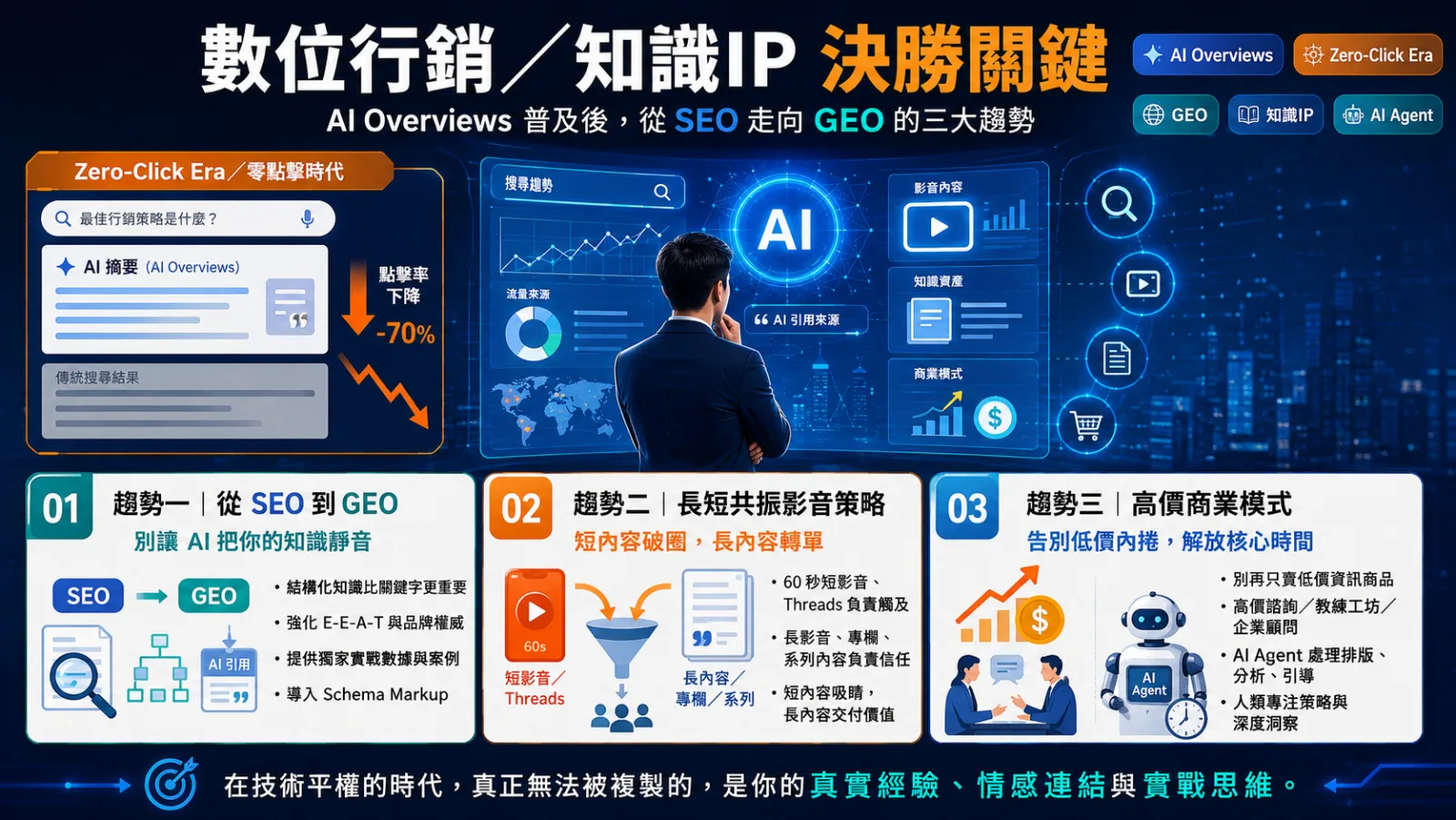
This sentence is undoubtedly a wake-up call for people like me who rely on content for their livelihood. We have been working hard on SEO for the past ten years, trying our best to squeeze into the first page of Google. Now the battlefield is moving forward: the battle is GEO (opens in a new tab) (Generative Engine Optimization), which is to find ways to make AI willing to mention you, quote you and recommend you when generating answers. I also talked about this shift in the article The Digital Marketing Shuffle Caused by AI Browsers. Here we might as well use a table to break down the differences:
| For | SEO Era | AI Recommendation Era |
|---|---|---|
| How to find customers | Enter keywords yourself and filter articles one by one | Describe your needs and let AI screen them directly |
| The position you want to win | Google first page | Those named in the AI answer |
| Exposure logic | My content is ranked first | AI recognizes me, trusts me, and is willing to quote me |
| The biggest risk | The ranking falls to the second page | Not included in the AI at all, as if it does not exist |
It’s not about throwing away SEO, it’s about growing an extra layer of muscle. In addition to being readable by humans, your content must also be readable and remembered by AI. Which brands are mentioned again and again by AI and which ones are ignored are quietly determining the next round of winners.

If you also want to continue to add fresh perspectives on marketing and content in the AI era, welcome to subscribe to my “Vista AI Inspiration Supply Station” and let me send the latest thinking directly to you.
Second lesson: AI’s thoughtfulness can be overdone, and your imperfections are becoming expensive
Schaeffer quoted a quote from his teacher Robert Crosby in the book, which I like very much: “There is no such thing as a ‘shortcoming’, only an overused advantage.” Too much confidence is arrogance, too much determination is stubbornness, and too much love is ennui. The same goes for AI.
The book mentions an unsettling observation: AI’s empathy is sometimes stronger than that of human counselors. It is online 24 hours a day, has zero emotions, and has infinite patience. It can personalize your journey planning, exercise suggestions, and recipes for you. It sounds wonderful, but if empathy is taken too far, it will become a seductive emotional crutch, pulling people away from real interpersonal relationships step by step.
Here’s the question: When AI can do things like caring, thoughtfulness, or being available on call, AI can do it better than you, so what differentiation is left for humans?
A sentence from the recommender Wang Dongming helps this book break the title: In the age of automation, your “imperfect sincerity” is the most valuable. I totally agree. When the service quality is pushed to an infinite level by AI, the real moat is overturned. It is no longer “I serve better”, but “I am a real person, I have a position, I make mistakes, and I dare to say no.” This kind of rough reality, no matter how similar the AI simulation is, the customer still has trouble getting over it. I talked about the same experience in No matter how well written AI is, it cannot replace warm content.
This lesson is especially critical for one-person company (opens in a new tab) and for creator (opens in a new tab). What you are most easily replaced by AI are those standardized and replicable services; what you are most irreplaceable are precisely those parts that you have always considered “not professional enough”: your face, your temper, and your true judgment. Stop hiding it away, it is your most valuable asset.
The third lesson (also the most painful chapter): When customers have no motivation to buy anymore
If the first two lessons are still within the scope of marketing book talks, the third lesson is where Schaeffer really hits hard and where the least people dare to touch it.
He said that AI has replaced many professions, and there is a large group of people who rely on work to establish their self-identity and rely on consumption to maintain their professional image. When their jobs are taken over by machines, they suddenly lose the meaning of life and lose the motivation to consume certain products or services. Why would a person who no longer needs to go into the office every day and play a certain role to the outside world buy that suit, that watch, that cup of specialty coffee?
This is a huge challenge for marketing. In the past, what we worried about was “how to make him choose me among the many options.” Now there is a more previous question: how to help him find a sense of meaning when he is still wavering on “why he should buy it”.
The direction given by Schaeffer is: a new kind of marketing should help this group of people regain their confidence, participate in decision-making and regain their autonomy. The brand no longer just sells things, but accompanies the customer in the process of re-finding the coordinates of life. I paused for a long time when I read this. Because this is no longer just a marketing issue, but a question about how much place humans have left in the AI era.
Where I reserve my opinion
Frankly speaking, this book is not an operation manual that can be copied, and Schaeffer himself deliberately does not give you a grand framework. The sentence in his book is very honest: “It’s not guessing. It’s preparation.” It gives signals and a sense of direction, not SOPs.
And this is a map from an American perspective and jointly researched and judged by future scholars. Taiwanese readers should make some discounts when they get it: our AI adoption speed, trust structure, and main platforms (such as LINE and Shopee) are different from those in the United States. Some of the judgments in the book will happen in Taiwan earlier, some may happen a little later, and some may even look like completely different things.
Therefore, my suggestion is: don’t read it as a reference book, but read it as a map of customer psychology. In other words, the map won’t drive the car for you, but it will let you know if there are any cliffs ahead.
If you only had an afternoon, this is how I would use this book
After you finish reading this book, I don’t want you to only have the feeling of “very enlightening” in your mind. Here, are three actions you can do today:
- **Test your AI visibility once. ** Open three mainstream AI and ask in a customer’s voice “Who and which brand do you recommend (in your field)?” and see if you are included in the answer. If not, your GEO homework starts from this moment.
- **Take stock of your “imperfect sincerity” assets. ** Take a piece of paper and list the things that AI cannot give: your stance, your face, the mistakes you will make, the customers you dare to reject. This list is what you should amplify and show off most in the next three years.
- **Add a column for your customer profile. ** Add a question after the existing customer description: What has this person lost recently because of AI? (Security? Professional status? Confidence in decision-making?) Then think about whether your product can give him back a little bit.
Schaeffer writes at the end of the preface that a new type of human being is not coming soon, but has already arrived. Now it’s time to meet them. Well, I’ve finished reading the book. Next, it’s time for me to meet my clients.
Want to really develop muscles in these three classes?
Understanding the trend is the first step, and turning it into a content and marketing system that can be operated every day is the real homework. Over the years, I have compiled my complete methods on how to use AI to build a content flywheel, run a personal brand, and amplify the influence of a one-person company into the courses and workshops of Content Hacking Academy (opens in a new tab). If you also want to make customers really think of you when they should think of you in the AI era, welcome to practice this system with me.
Next step
Bring this topic to your team
Vista Cheng speaks and runs workshops on AI workflows, writing and content systems for companies, schools and public agencies.