Marketing strategy in the AI era: From being searched to being recommended, the next competition for brands

The last time you bought headphones, backpacks or skin care products, did you ask AI first?
Many people will open ChatGPT or Gemini and enter the sentence “With a budget of 3,000 yuan, which wireless headphones are recommended for commuting?” AI will soon give three brands and a reason for each. What will you do next? Most of the time you pick one of those three and then search for the price. As for brands other than those three, you may not even think of them.
To be honest, this is the biggest change in the marketing scene in recent years. Customers have already made half of their decisions based on AI answers before they even enter your website. In the past, brands focused on “being found” and being ranked among the top search results; now there is an additional level, which is to “be recommended” first, appear in that answer, and be said correctly. I also talked about this change in “Customers no longer use Google, but instead ask AI before placing orders”.
The following article summarizes the content of the course “Marketing Strategies in the AI Era” that I taught in college: what is happening internationally, what brands are doing right or wrong, and how to redistribute the work of marketers. Every number in the article is attached with its source, so you can check it one by one. There are also several exercises that can be completed by one person.
The basic skills of marketing have not changed, but three new questions have changed.
Let’s talk about the unchanging part first, because it is more important than the changing part.
Customer value is still the starting point of all planning; segmentation and positioning are still choices that must be made by humans. AI can help you list ten positionings, but which one to choose and which nine to abandon is the brand’s own business (I wrote more about this in “[You can’t choose a positioning, you just can’t bear it>”); long-term trust still depends on words and deeds. No tool can replace these three things.
What has changed is three new questions:
- How customers find you: From a row of links to an answer.
- How to create content: Everyone can create 80% of content, and production capacity is no longer scarce.
- How to personalize the experience: from a focus to one person per version.
The core of this class can be summed up in one sentence: AI allows everyone to create 80% content, and what brands want to win is the remaining 20%.
People who are familiar with the 4Ps can compare it this way: Product needs an additional question so that the specifications and FAQs can be written so that AI can understand it; Price needs to face customers and ask AI to compare prices for them; Place has a new place, which is the AI dialog box itself; Promotion’s goal changes from buying exposure to being cited in AI’s answers. The 4Ps are all still there, and every P has been rewritten.
Five international trends happening right now
Converging global changes, they can be classified into five directions.
First, generative search. Google announced in 2026 that the global monthly active users of AI Mode have exceeded 1 billion, and the query volume has more than doubled every quarter since its launch (Search Engine Journal quoted Google, 2026 (opens in a new tab)). The search box is turning into a dialog box.
Second, mass production of AI content. An idea can be expanded into dozens of versions along the lines of audience, size, and tone, and the scarce ones become selection and control.
Third, hyperpersonality. Recommendations, content and offers begin to be generated based on each person’s profile. The boundary lies in whether the customer knows or not: if the information is used a lot, but the customer knows and gets the benefits, it is considerate; if the information is used a lot but is not informed, it feels like being monitored.
Fourth, dialogue and agent business. In the past, to buy something, you had to go through five steps: search, price comparison website, brand official website, shopping cart, and checkout; now recommendation, comparison, and checkout can be completed in the same AI conversation, and even AI agents can place orders on behalf of customers.
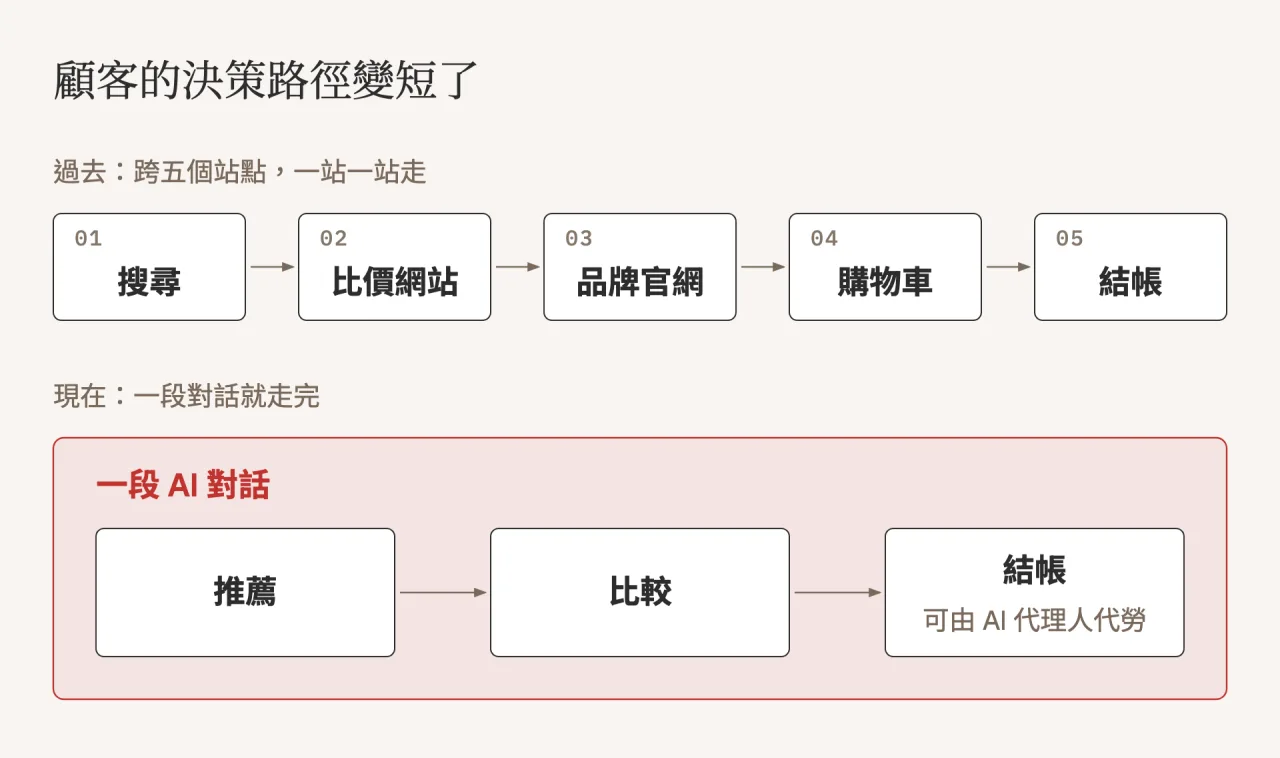 ▲ What used to take five stops can now be completed in one conversation, and checkout can even be handed over to an AI agent.
Fifth, advertising automation. Audiences, bids, and placements are gradually handed over to algorithms, while marketers stay in goal setting, material strategy, and effectiveness measurement.
What about Taiwan? According to the Ministry of Economic Affairs’ 2025 “SME White Paper Survey Report,” only 7.4% of Taiwanese small and medium-sized enterprises have actually adopted AI; the top reason for not adopting it is “no clear use case yet,” cited by 63.9% (Business Today, 2026 (opens in a new tab)). A separate survey, the “2025 SME AI Adoption Status Survey,” commissioned by the MOEA’s Small and Medium Enterprise and Startup Administration and conducted by ITRI among companies with fewer than 200 employees, found that about 92% of SMEs either do not understand AI or understand it only in general terms (TurnNews, 2025 (opens in a new tab)).
My interpretation is: most companies are still at the starting point. The opportunity lies not with “people who can use AI”, but with people who can use AI to make marketing decisions. If you are that company that “does not yet have clear application requirements”, you can first read “Introducing AI, starting from work pain points”.
From SEO to GEO: Goal from ranking first to being cited
Let’s look at a few numbers first to get a feel for how much the discovery path has changed.
Ahrefs tracks 300,000 keywords and compared March 2024 with March 2025 for the first time. It was found that when AI Overviews appeared, the number one page clicks decreased by 34.5% (Ahrefs, 2025 (opens in a new tab)); in the updated version in 2026, the decline expanded to 58% (Ahrefs, 2026 (opens in a new tab)).
Pew Research Center analyzed the real browsing history of 900 American adults: without AI Overviews, there were 15 clicks to the general results for every 100 searches; with AI Overviews, there were only 8 clicks, and only 1 click on the citation link in the abstract (Pew Research Center, 2025 (opens in a new tab)).
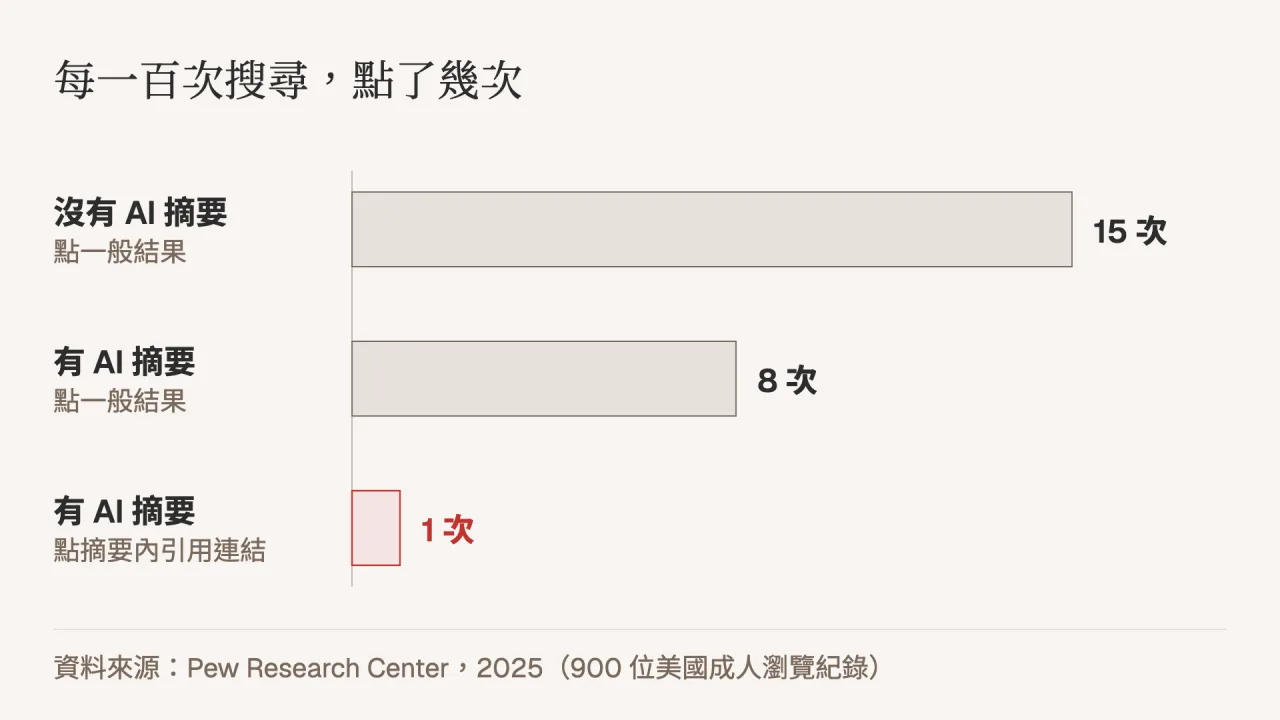 ▲ When there is an AI Overview, the number of clicks is almost halved, and there is only one click on the reference link.
Seeing this, it’s easy to come to the conclusion “It’s over, no one ordered anymore.” But there was a reversal in the same batch of research: Seer Interactive found that brands cited by AI summaries had 35% more natural clicks and 91% more paid clicks (Seer Interactive, 2025 (opens in a new tab)); using a larger sample (53 brands, 2.43 billion exposures) and re-measured, the cited pages still had 120% more natural clicks per exposure (Seer Interactive, 2026 (opens in a new tab)). It should be noted that this is related and cannot be directly interpreted as “being quoted leads to more clicks”.
There is another number that is particularly worth remembering for marketers: BrightEdge found that only about 17% of the sources cited by AI summaries were also ranked in the top ten for organic searches (Search Engine Journal quoted BrightEdge, 2026 (opens in a new tab)). In other words, ranking first does not guarantee being cited, and not being on the first page does not mean there is no chance.
So the goal changed. It used to be called SEO (search engine optimization), but now it’s called GEO (Generative Engine Optimization). This word has an academic origin: a 2023 paper by a team such as Princeton University first made it into a study, using the same batch of web pages to rewrite it in nine ways to see which one was most often written into AI answers. The results combined with cited sources, quotes, and statistics performed best, while traditional keyword stuffing performed poorly; the best method increased the visibility of content in generative answers by up to 40% (Aggarwal et al., arXiv, 2023 (opens in a new tab)). My experience from listening to a GEO lecture before, “When Search Changes Its Owner”, also has practical supplements.
How does AI decide who to cite?
Based on these research and practical observations, I have compiled four judgment directions (this is my judgment framework, not an officially announced algorithm):
- Structure that can be captured: question and answer format, clear subscripts, AI can easily use the entire paragraph.
- Make a clear claim: Answer the question in the first sentence without going around in circles.
- Third-party evidence: Reports, comments and cooperation cases carry more weight than what the brand itself says.
- Consistent brand entity: on the official website, community, maps and e-commerce pages, the name and description do not conflict.
GEO is built on top of SEO. A webpage must first be found and read before it can be cited, so the basic skills of SEO cannot be lost. If you want to catch up on basic skills, you can read “Use three stages to create a content strategy with SEO thinking” and “AEO Getting Started Guide for Creators”.
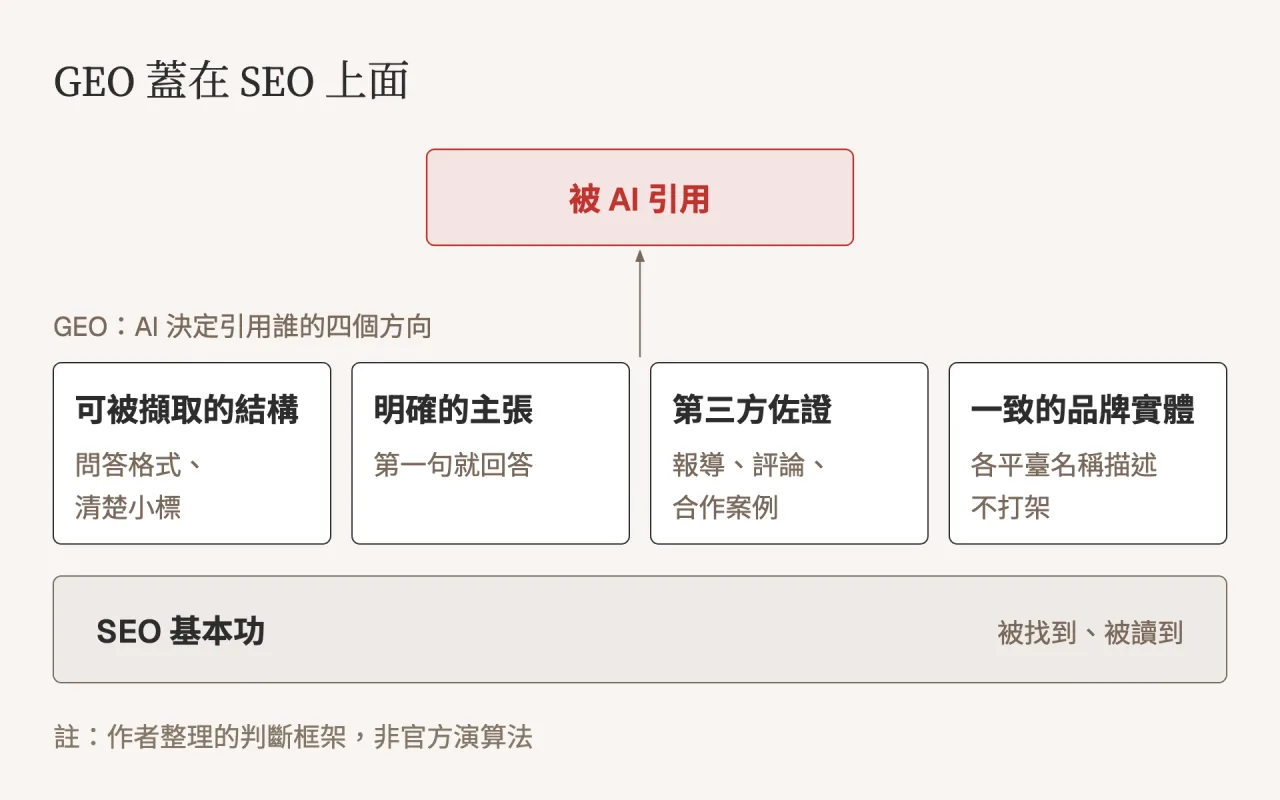 ▲ It must be found and read first, and only then can it be quoted.
When the buyer is an AI agent
There is also a newer change: AI begins to compare prices and place orders for customers. In September 2025, ChatGPT launched Instant Checkout, which allows users to purchase directly in the conversation (SiliconANGLE, 2025 (opens in a new tab)); in November, Perplexity and PayPal launched Instant Buy, which allows users to check out after stating their needs and comparisons (PayPal, 2025 (opens in a new tab)). Visa’s survey pointed out that 47% of U.S. consumers have let AI help with at least one shopping task (Visa, 2025 (opens in a new tab)).
How do AI agents compare products? If you look at the product information specifications published by OpenAI, you will know that the product name and brand, price, inventory status, and product description are required fields, while evaluation, return and exchange policy, and shipping method are optional (OpenAI Developers (opens in a new tab)). Agents cannot compare products with blank fields.
So brands now have to convince both types of buyers. To convince people, you rely on brand memory, favorability, and word-of-mouth; to convince agents, you rely on clearly written specifications, prices, and inventory, with reviews and policies available, and information consistent across platforms. The tasks on both sides are completely different.
AI content: Capacity is no longer scarce, judgment is
The supply of content is getting more and more year by year, but the attention of consumers has not increased. The attention allocated to each piece of content will only become less and less. When AI makes production capacity no longer a threshold, what is truly scarce are people who know which version to release.
I selected seven brand cases to see who is using AI and first thought about what they want.
Heinz (USA, 2022): Use DALL·E 2 to generate an image of “ketchup”, and the result will probably look like your own bottle. The brand took advantage of the trend and turned it into a social event to prove its weight in the hearts of consumers (Campaigns of the World, 2022 (opens in a new tab)). The AI is here as evidence and the claims are the brand’s own.
Coca-Cola (USA, 2024 to 2025): For two consecutive years, it has hired an AI studio to remake the classic Christmas commercial “Holidays Are Coming”. The technology is in place, but it has attracted a lot of criticism in two years and was called “AI slop” by netizens (NBC News, 2024 (opens in a new tab); Newsweek, 2025 (opens in a new tab)). The picture was made, but the temperature did not follow. Klarna (Sweden, 2024): Officially revealed that sales and marketing expenses will be reduced by 11% annually in the first quarter of 2024, of which 37% of the savings will come from AI; external agency expenses will be reduced by 25%, and the production period of a marketing image will be shortened from 6 weeks to 7 days (Klarna, 2024 (opens in a new tab)). This is a number announced by the company itself, not a third-party verification.
L’Oréal (France): Built its own CreAItech content platform, connecting multiple models to produce marketing visuals for each market. The production cost has been reduced by about 40%, and about 50,000 pieces of materials have been produced (Digiday, 2026 (opens in a new tab)). What’s more noteworthy is its boundary: the official statement states that it does not use AI to generate realistic faces, bodies, hair or skin to support or enhance product efficacy (L’Oréal (opens in a new tab)). Draw the boundaries first, then let go of mass production.
Mondelez (US, 2025): The parent company of Oreo has partnered with Accenture to invest more than $40 million in building its own generative AI advertising tools. Supervisors interviewed estimated that production costs could be reduced by 30% to 50%, but this is an estimate and not an actual result; and currently no lifelike images are released, and all output is inspected by humans (CNBC, 2025 (opens in a new tab)).
Ito Sono (Japan, 2023): Launches Japan’s first TV commercial with AI-generated characters. There are rumors on the Internet that it “saves half the time and saves 30%”, but the marketing manager said in an interview that the entire advertisement took about five months, and the total cost should not be much different from the traditional method (ITmedia, 2023 (opens in a new tab)). It also reminds us that the source of the performance figures circulated on the Internet is often difficult to find.
Duolingo (USA, 2025): TikTok is run by an in-house team led by a community manager. The “Duo is Dead” campaign took only 6 days from idea to launch, and the number of followers grew from 50,000 to 16 million in about four years (The Drum, 2025 (opens in a new tab)). Its speed comes from human judgment, not tools.
Put these cases into a simple matrix. The horizontal axis is the amount of AI used, and the vertical axis is the strength of brand judgment. You will see one thing: Heinz, L’Oréal, and Mondelez fall in the “AI usage is large, judgment is also strong”, AI amplifies the proposition that the brand has already thought clearly; Coca-Cola falls in the “AI usage is large, judgment is not in place”, the technology is in place, but the emotion is not there. In fact, most brands are still at the starting point of “judgment without thinking clearly, and have not yet used AI”. What should be improved first is judgment, not tools.
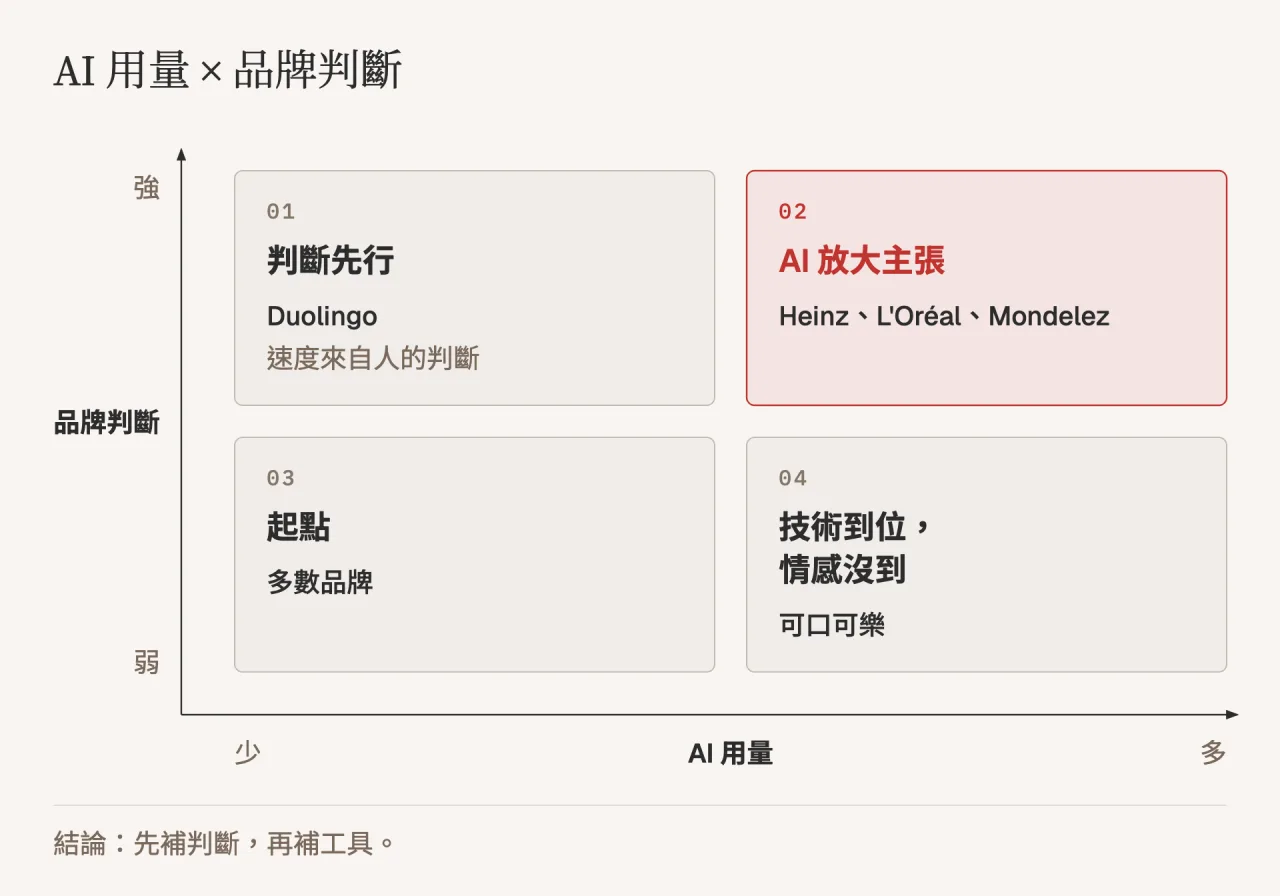 ▲ Make up the judgment first, then the tools.
A human-machine collaboration content production line
So how should we actually divide the labor? I suggest splitting the content production line into six stations:
- Insight: Where customers get stuck.
- Proposal: Set an angle.
- AI mass production variants: Produce many versions at once.
- Manual control: selection, modification, verification.
- Test: go online in small quantities.
- Learn: Note down the results and feed back to the next round of insights.
AI is responsible for the volume of the third station, and humans are responsible for the judgment of the other five stations.
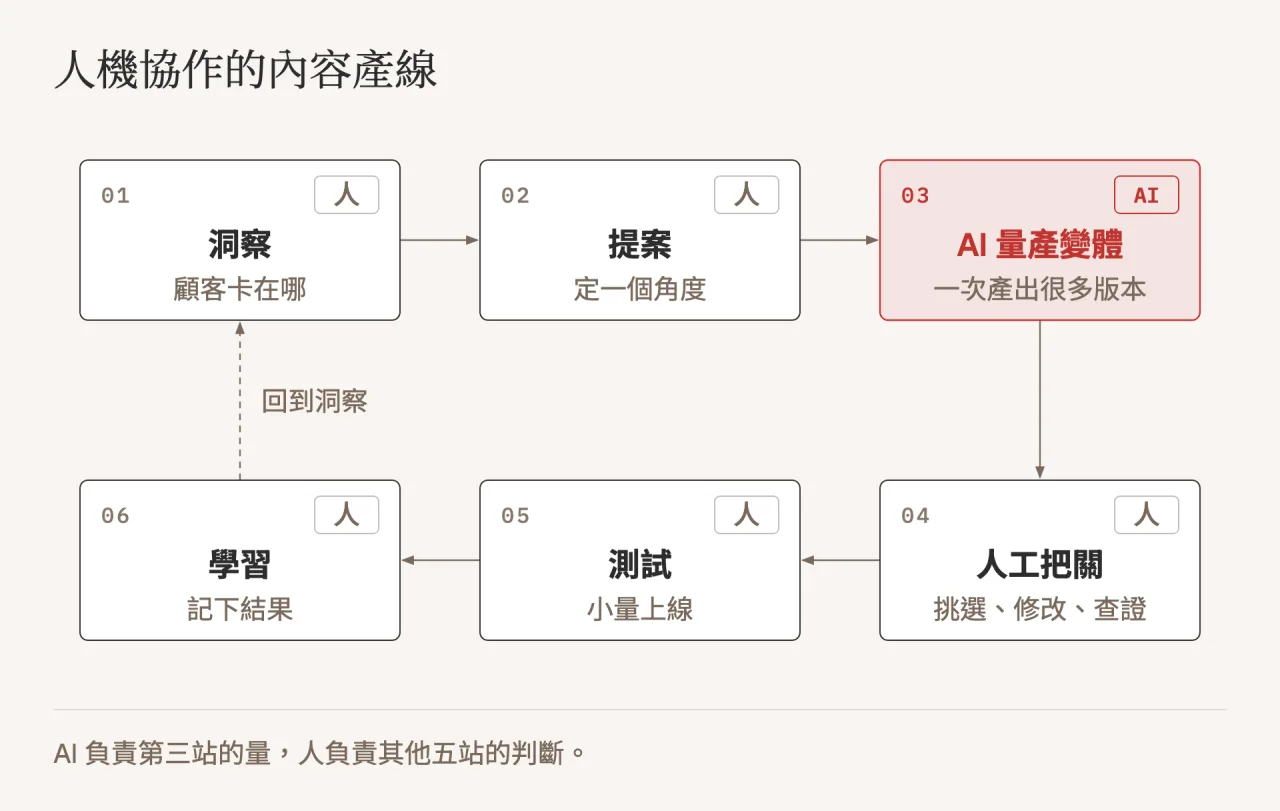 ▲ Only one of the six stations is left to AI, and the other five stations are human judgment.
To get your AI started in the right place, there are two documents worth writing first. The first one is a brand voice guide. Write down five items: who the brand is, who it speaks to, tone spectrum (what it is like and what it is not like), word usage rules (common words and forbidden words), examples and counterexamples. Why brand voice is more valuable in the AI era, you can refer to “Unique brand voice, creating a moat in the AI era”. The second copy is the four parts of the prompt: role (who you are), task (what to do), context (what is the background), and format (how to hand it over). If one part is missing, the AI will guess on its own; for a complete demonstration of these four parts, I wrote in Why does the copy written by AI always look like the editor? 〉.
There are also six things that I do not recommend leaving the entire package to AI: verification of facts and figures, brand stance and bottom line, whether to generate real people, emotional and cultural judgments, commitment to customers, and the click of publish. How to check whether there is AI smell after output, you can use 〈AI smell removal checklist for Chinese writers〉.
Do you want to really build this content production line?
The hardest thing about the above six stations is not to understand, but to make it spin steadily every week. The “AI Content Production System Workshop” designed by me is a 3-hour practical course. Based on the five-layer structure of “input, research, production, refinement, and distribution”, it will lead you to create a personal style file, automate research, and finally produce six platform formats from one piece of material. It is suitable for those who run blogs, self-media or brands, as well as consultants and lecturers who need to continuously produce content.
👉 Understand the course content and steps: vista.tw/courses/ai-content
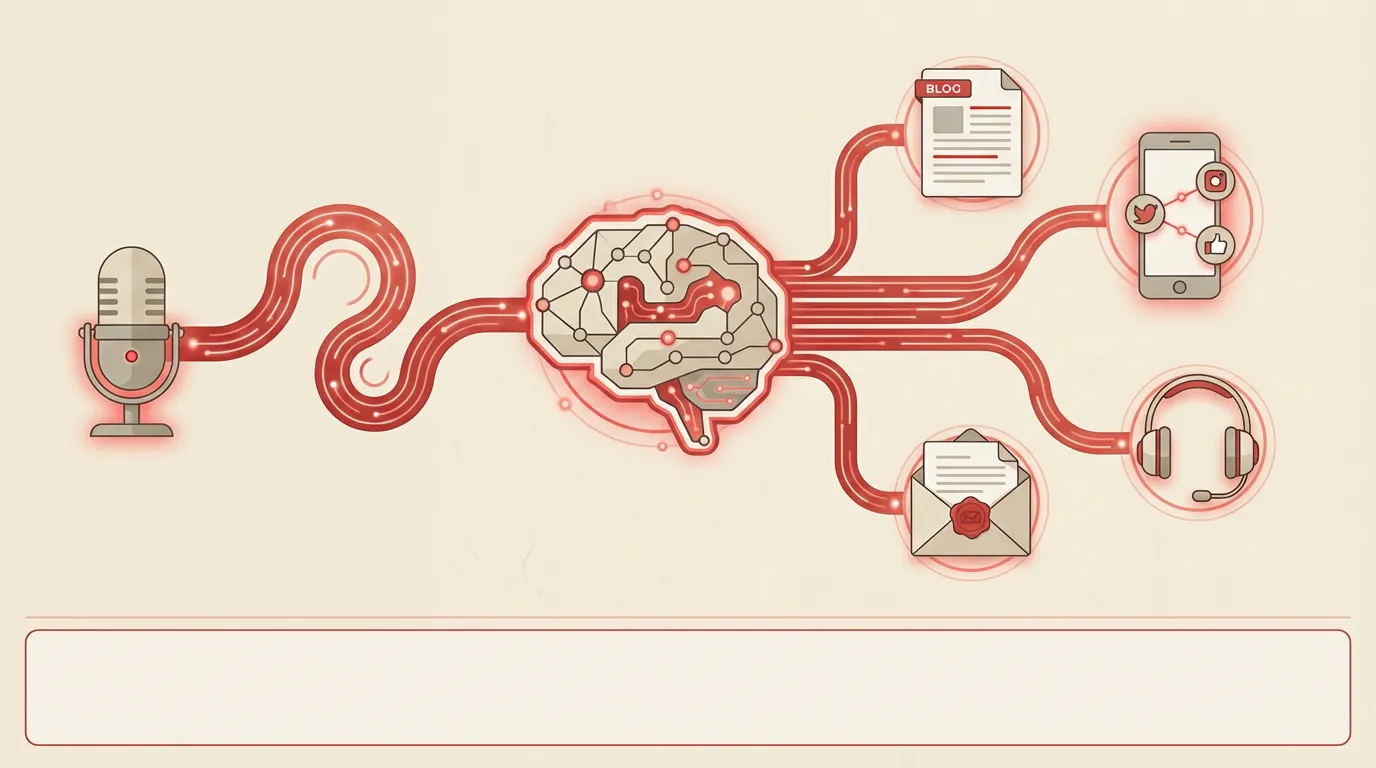
For a more complete systematic approach, you can also read “What really widens the gap in the AI era is the establishment of a content production system”.
One person, one version: personalization, AI customer service and agent business
The number of versions is changing from “mass” (one advertisement hits everyone), “segmentation” (segmentation into several groups based on age and gender), “focus” (more detailed segmentation based on interest and behavior), all the way to “one version per person” (generated based on each person’s data).
The most classic example is Spotify Wrapped. About 24 hours after the 2025 version went online, 200 million users interacted, 19% more than in 2024 (it took 62 hours to reach this number in 2024); the number of shares was about 500 million times, an annual increase of 41% (Music Business Worldwide, 2025 (opens in a new tab)). Everyone gets their own version, and sharing it becomes brand exposure.
Musinsa, a Korean fashion e-commerce company, has gone further: In 2026, it used its self-developed serial connection interface (MCP) to connect the service to ChatGPT. When users ask “What to wear to work tomorrow?”, the system will take into account the time, location, occasion, weather, and season, and give outfit recommendations (Aju News, 2026 (opens in a new tab)). Brands have moved from their own apps to the AI that customers are using.
Personalization is actually a cycle: collect signals (what you have seen, bought, asked about), predict needs, give this version, see the customer’s response, and then go back to collecting signals. You have to keep turning it, and it will become more and more accurate.
The two sides of AI customer service
Conversational commerce has benefits and costs. Klarna is the most complete teaching material: the AI assistant launched in 2024 handled 2.3 million conversations in the first month, accounting for approximately two-thirds of customer service conversations, equivalent to 700 full-time manpower, and the average processing time dropped from 11 minutes to less than 2 minutes (Klarna, 2024 (opens in a new tab)). But by 2025, the CEO admitted in an interview that the previous focus was too much on cost saving, and the service quality had declined as a result, and was changed to AI and real people in parallel (Customer Experience Dive, 2025 (opens in a new tab)). I have another perspective on how the customer service industry can find a new position in the AI wave in “From “most likely to be replaced by AI” to leading the trend against the trend”.
Another jurisprudence that is important to know is Moffatt v. Air Canada. Air Canada’s official website chatbot tells passengers that they can apply for bereavement discount fares afterwards, which is wrong. The company argued that the chatbot was an “independent entity,” but the British Columbia Civil Arbitration Tribunal did not accept it and ruled that the company was responsible for all information on the website (Business Law Today, 2024 (opens in a new tab)). The amount of compensation is not large, but the accuracy is very important: the AI customer service speaks on behalf of the brand, and if the answer is wrong, the brand will be responsible.
After handing over the budget to the algorithm, what do marketers have left?
Advertising placement is gradually changing from human manipulation (selecting audiences, setting bids, selecting placements, and adjusting based on reports) to people providing goals, materials, and first-party data, and algorithms determining audiences, bids, and placements.
The scale is already huge. Meta announced at the Legal Conference in the second quarter of 2026 that the annualized revenue of Advantage+ automated advertising exceeded US$75 billion, and 9 million small and medium-sized enterprises have used at least one of its AI advertising creative tools (The Motley Fool Legal Conference verbatim, 2026 (opens in a new tab)). EMARKETER’s survey also shows that nearly 60% of US advertising buyers are already using or planning to use AI procurement tools (EMARKETER, 2024 Survey (opens in a new tab)).
After the algorithm takes over, people are left with four things:
- Goal setting: If the goal is set wrong, the system will run very fast in the wrong direction.
- Material strategy: When the audience is set to a wide range, the appeal of the material determines who the advertisement is sent to. Materials that emphasize time saving will find office workers who are in a hurry, and materials that emphasize cost-effectiveness will find students who are budget-conscious.
- First-party data: Feed the best signal to the system.
- Measurement: The credit in the report is not necessarily due to advertising.
This last point is most easily overlooked. Platform reports often include people who would have bought the product in the first place as part of the advertising effort. Only by comparing the two groups of people who saw the ad and those who did not see the ad can we get the true incremental impact of the ad. Therefore, no matter how small the budget is, it is recommended to keep a set of comparison items.
If you want to do A/B testing, the minimum method is only five steps: write a hypothesis that can be overturned, only change one place at a time, split the budget equally and go online at the same time, determine the criteria in advance, record the results and start the next round. Tools will continue to change, but these judgment principles will not change. I have summarized the views of Meta’s former marketing manager in “Tools will change, but principles will last forever: Read “Click to Grow”>; and what pitfalls you will encounter when actually advertising, you can read “I used Claude Code to cast my first Facebook ad>.
Trust is the final moat
The risks of AI marketing can be divided into four categories, each with different victims:
- Authenticity: fake endorsements and deep fake images, customers are misled.
- Privacy: Customer lists and conversation records are pasted into the AI tool, and the data is out of control.
- Copyright: Generate content that bumps into someone else’s work or likeness.
- Bias: Stereotypes in the information cause certain ethnic groups to be distorted or disappear.
Authenticity risks are sometimes encountered when a brand does nothing wrong at all. For example, in 2024, an advertisement using AI to synthesize Taylor Swift’s voice appeared on the community, claiming to give away free Le Creuset pots, but it was actually a personal information fraud. The brand was not involved at all, but it had to state that official giveaways would only come from official accounts (NBC News, 2024 (opens in a new tab)). Of course, relevant regulations are also being tightened. The U.S. Federal Trade Commission (FTC) handled multiple exaggerated or deceptive AI claims in its 2024 “Operation AI Comply”, and DoNotPay, which claimed to be a “robot lawyer,” was fined $193,000 (FTC, 2024 (opens in a new tab)). The transparency obligations of Article 50 of the EU AI Act apply from August 2, 2026: AI that talks to people must make it known from the beginning that the other person is an AI, and systems that generate synthetic content must be labeled in a machine-readable manner (European Commission (opens in a new tab)).
Looking back at Coca-Cola and Klarna, the two companies have gone through the same path: AI brings advantages in speed or cost, and at a certain point it begins to cost trust, and in the end it has to pay a price to make up for it. Traffic can be bought and taken away by algorithms, but trust can only be accumulated bit by bit. This is what I want to say in “Traffic will return to zero, trust will not”.
So I would suggest that disclosure should not be viewed as an admission of mistake, but rather as a way to save customers the effort of guessing. There are three common methods: marking on the content, AI customer service saying that they are AI first (leaving a way to find a real person), and publicly writing out the brand’s principles for using AI.
Before publishing, check it out with these six questions:
- Can every fact and figure be traced back to its original source?
- Have the faces and voices of celebrities or customers been used without consent?
- Are the sources and authorizations of images, fonts, and music clearly stated?
- Can you tell that the images and videos generated by AI are made by AI?
- Are customer lists and order information posted to public AI tools?
- Ask someone who is not involved to read it. Does the tone and facts sound like this brand?
AI can write for you, but it cannot be responsible for you. Customers cannot tell which sentence is written by AI. Every sentence sent with the brand name is considered to be said by the brand.
Do It Yourself: Four exercises that one person can do
It’s better to start after reading. The following four exercises can be done with any free conversational AI. Please replace the content in brackets with your own, and other parts can be copied.
Exercise 1: See who the AI recommends. Think of something you want to buy recently, post this paragraph to AI, write down the three brands it recommends and the reasons, and then circle which of the reasons are facts and which are just adjectives.
I want to buy [category], and my budget is about [amount] yuan, mainly for [usage situation]. Please recommend three brands or products, describe each of them in one sentence and explain the reasons for the recommendation, and tell me which sources of information you consulted. Exercise 2: Three AIs, asking the same question. Ask the same question to ChatGPT, Gemini, and Perplexity respectively, start a new conversation each, and compare which brand has been recommended the most times and which sources have been cited. You will intuitively feel that being recommended and being searched are two different things.
Exercise 3: Rewrite the brand introduction into a question and answer. Pick a brand introduction you are familiar with and let AI rewrite it into a format that AI can easily quote. After editing, remember to delete the sentences that the AI added by itself and whose source cannot be found.
You are the brand’s content editor. Please rewrite the following introduction into five sets of questions and answers. Use questions that customers would ask the AI; answer directly in the first sentence of each answer, and then add one or two sentences of specific facts. Uncertain information is marked "to be confirmed" and do not fill in the numbers yourself.

Brand: [Brand Name]
Introduction: [Paste introduction text]
Exercise 4: Perform a pre-publish check for an AI post. First ask the AI to write a post, then open a new conversation and let another window use the six questions above to check one by one. Finally, judge for yourself whether the AI’s grasp is correct or not, and make at least two changes.
A nine-frame AI marketing planning canvas
If you happen to have a brand to plan, you can use this canvas to collect the previous content into a plan. It is divided into three rows and nine grids:
- Arrange the direction: target (which number to change, pick one as the main indicator), audience (write down a specific person and what he will ask the AI before buying), recommended strategy (why the AI mentions you).
- The middle row is the engine: content production line (who comes up with ideas, what AI produces, and who controls it), personalized touch points (where customers see exclusive content), delivery and measurement (what materials are given to the algorithm, and which indicators are used to judge effectiveness).
- Lower row of checks and starts: risk checks (what will go wrong, who is responsible for checking), human role (tone, bottom line and final decision are left to people), first experiment (one hypothesis, two versions, one indicator, results can be seen within two weeks).
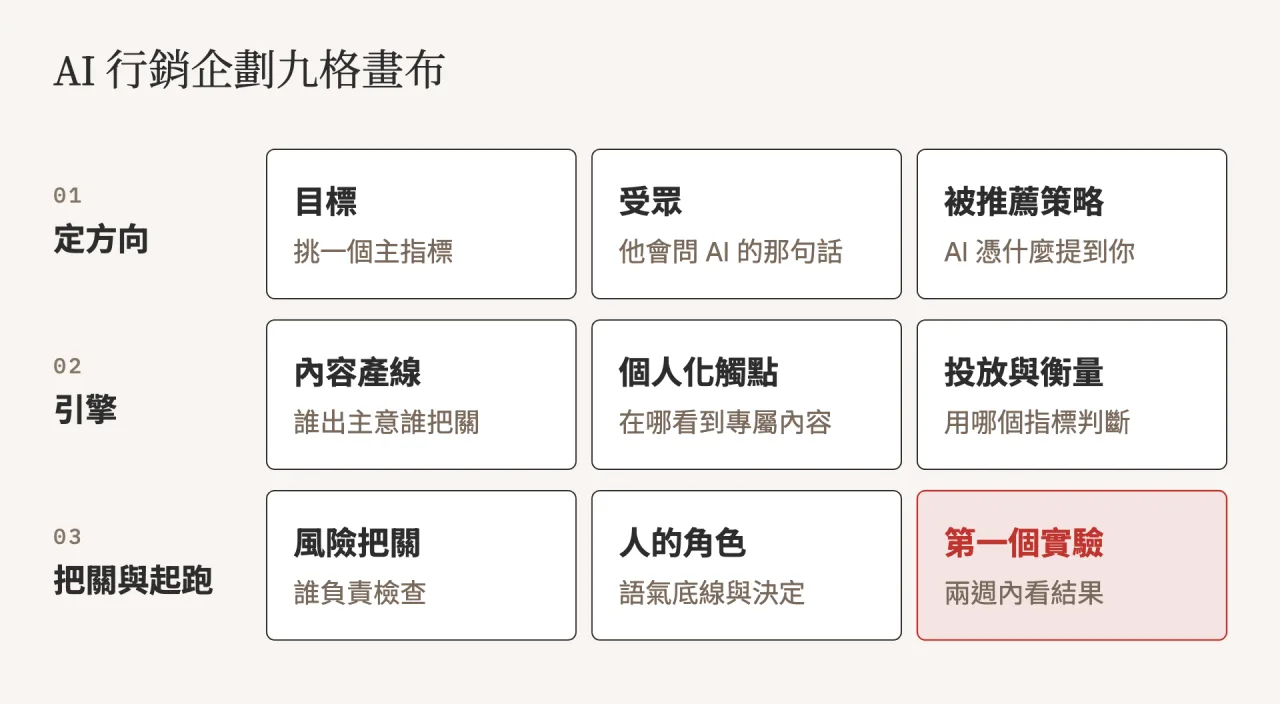 ▲ It is a good plan if all nine frames can be turned into one action.
Weak planning, every box is written but cannot be moved: the goal is “increase brand awareness”, the audience is “18 to 35 years old”, every box is written “use AI” but no step is mentioned. With a good plan, every frame can be turned into an action.
Take away three things
First be understood, then you will be recommended. Write the facts about your brand clearly and put them in the right place, then AI can tell your name and reasons.
AI is responsible for quantity, and humans are responsible for judgment. Leave eighty ten points to AI, and leave the rest of the angle, tone, and bottom line to people.
Trust is like a fixed deposit, it takes time. Every exposure and check is a deposit, and a false endorsement can wipe it out.
One last thing to remind you: the conclusion in this field is likely to be revised within half a year. Seer Interactive predicted in September 2025 that the click-through rate for searches with AI summaries would continue to fall; after falling to a bottom of 1.3% in December, it would rise again to 2.4% in February 2026 (Seer Interactive, 2026 (opens in a new tab)). So don’t take any number as the truth for three years, including the one in this article. For everyone, what is more valuable than numbers is the set of judgments: where do customers make decisions, how does the brand need to be said right, and what things must be left to people.
If you want to implement this set of judgments into a content system that is rotated every week, welcome to “AI Content Production System Workshop” to do it together.
Next step
Bring this topic to your team
Vista Cheng speaks and runs workshops on AI workflows, writing and content systems for companies, schools and public agencies.