Recommendations don’t depend on luck: Small and medium-sized enterprises use AI to design MGM’s practical notes on attracting new customers from old customers and employee recommendations
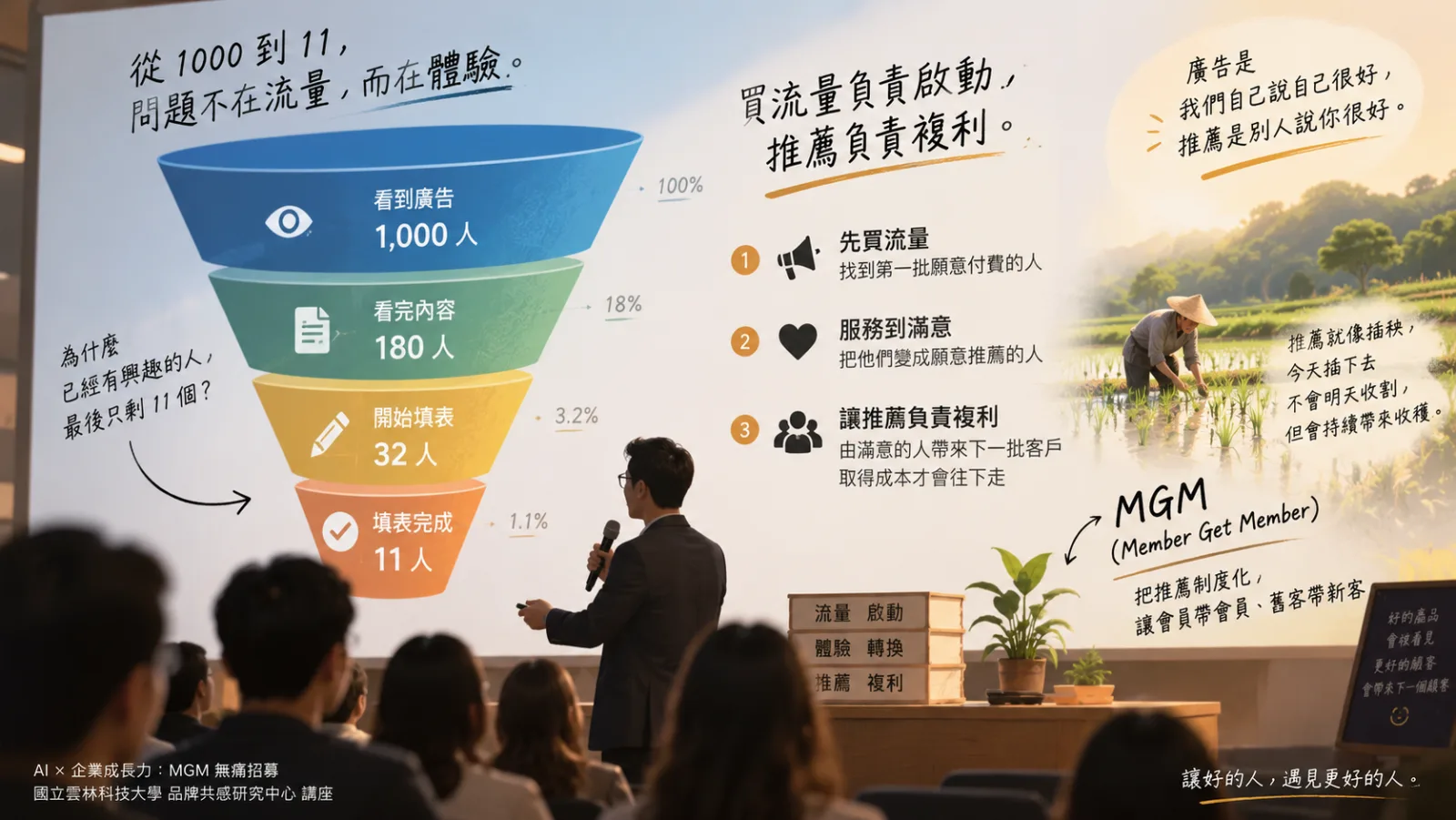
When 1,000 people saw the ad, 180 people finished reading the content, 32 people started filling out the form, and finally only 11 people completed the form.
Here’s a funnel chart I put up in my lecture tonight. When most companies see this set of numbers, their first reaction is to increase their advertising budget and increase the number of people on the upper tier to 2,000. But of the 180 people who had read the content, they were obviously interested, so why were there only 11 left at the end?
Tonight, at the invitation of the Brand Empathy Research Center of the National Yunlin University of Science and Technology, I gave a lecture on “AI × Corporate Growth Power: MGM Painless Recruitment”. We talked about the same thing for two hours: recommendation is not just luck, it is a process that can be designed.
Buying traffic is responsible for startup, recommendation is responsible for compound interest
Word-of-mouth recommendations have a high conversion rate, high credibility, and low cost, but in most companies, referrals attract the fewest people. The reason is not difficult to guess. No one in the company is responsible for this matter, and there is no way to promote it. We can only wait for the customer to forward it on a whim one day.
Buying traffic is another extreme. You get what you pay for, but it’s gone as soon as you stop, and it’s very addictive. The recommendation is just the opposite. The initial start-up is very slow and it takes time to ferment. It is like transplanting rice seedlings. If you plant them today, you will not be able to harvest them tomorrow.
So the sequence I give is three steps: first buy traffic and find the first batch of people who are willing to pay; then serve them until they are satisfied; then let the recommendations be responsible for compound interest, and the satisfied people will bring the next batch of customers, and the acquisition cost will go down.
The reason why recommendation is worth operating is that the starting point of its funnel is different. Advertising must start with a large amount of exposure and convince a stranger from scratch; the starting point of recommendation is directly in the middle of the funnel, trust is established before contact, and the recommender will screen you for a round first, because recommending is equivalent to endorsing his own face. To put it in one sentence: advertising is when we say we are good, recommendation is when others say you are good.
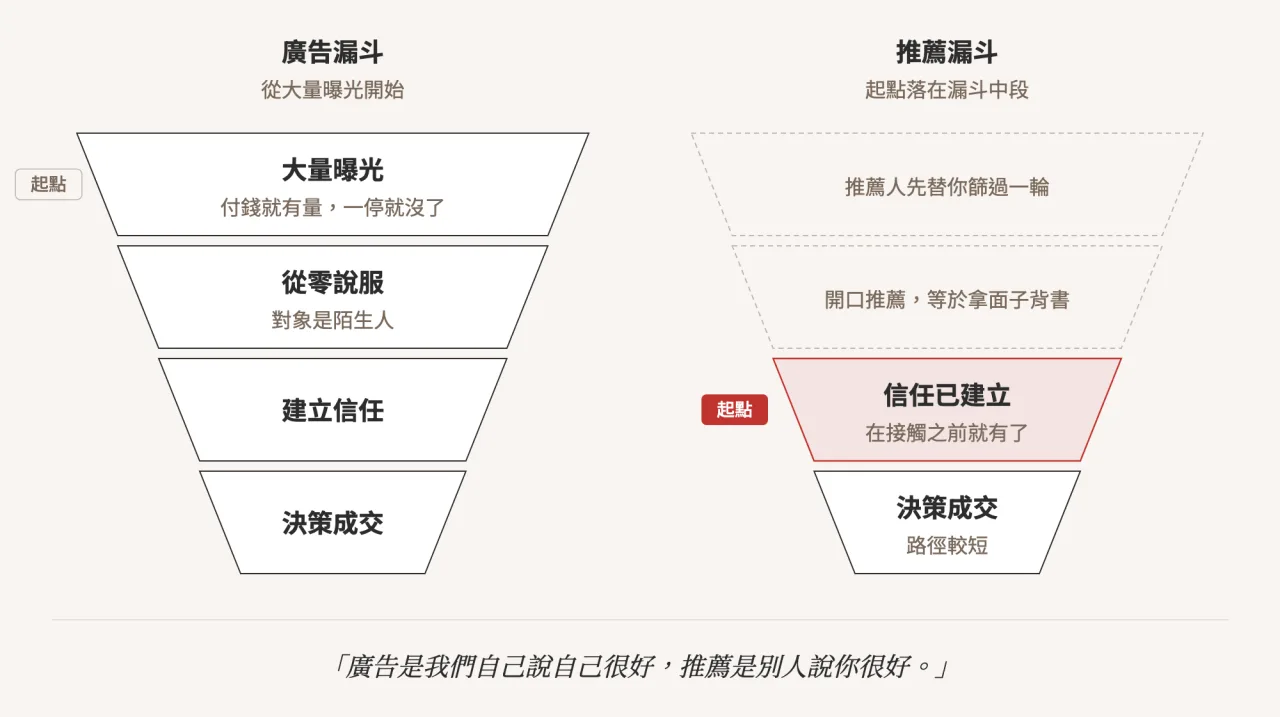
▲ Advertising must start with massive exposure to convince strangers, and the starting point of recommendation falls directly in the middle of the funnel, because trust is established before contact. MGM (Member Get Member) is to institutionalize this matter, allowing members to bring members, and old customers to bring new customers.
AI makes output cheaper and trust more expensive
Why talk about recommendations now? Because AI has emerged, it has rewritten the rules of the game.
The advantages established in the past by “doing things faster and more than others” have been wiped out by AI overnight. The three things of speed, quantity, and threshold were rewritten at the same time, and people from the literary group and non-undergraduate departments could also write the program. It used to take an hour or two to write a copy, and only one version could be written; now it takes five to ten minutes to produce several versions for testing. The content production skill I designed myself can reduce the average person’s 11-hour process to about half an hour.
The AI gives an answer of 60 points, but cannot give an answer of taste or temperature. The ones who are most affected are those who originally only scored 60 points. When everyone can produce something that is sixty or seventy percentile, content will no longer be scarce. What will be scarce becomes trust, judgment, and relationships. As costs become cheaper, trust becomes more expensive, so recommendations are more valuable than before.
Having said that, this also means that the bottleneck has moved. On the same growth path, the stuck place has moved from producing materials to receiving lists, tracking, management and analysis.
During the live broadcast, I gave everyone a lesson: draw down your workflow in detail. Even if you are an expert for three or five years, you will often find missing links when writing down. After drawing, decide which ones should be handed over to AI, which ones should be done by yourself, and which ones should be done in collaboration with AI. Don’t use the time you save to go from three posts a week to three posts a day. Use the time you save to chat with customers, find people who are willing to recommend you, and supplement tools such as Google Analytics and Google Search Console. The rewards will be much greater.
It is recommended that it cannot be done, and it is usually stuck in the four holes.
There are three reasons why the recommendation mechanism of most companies cannot be implemented: there is no dedicated person in charge, the recommender has no material that can be forwarded, and there is no tracking mechanism. The latter two AIs can help, but the first one can only be decided by management. There is no need to set up a new department. It is enough to spend ten minutes to half an hour reviewing it every week.
The order of filling holes is materials, entrance, rewards, and tracking.
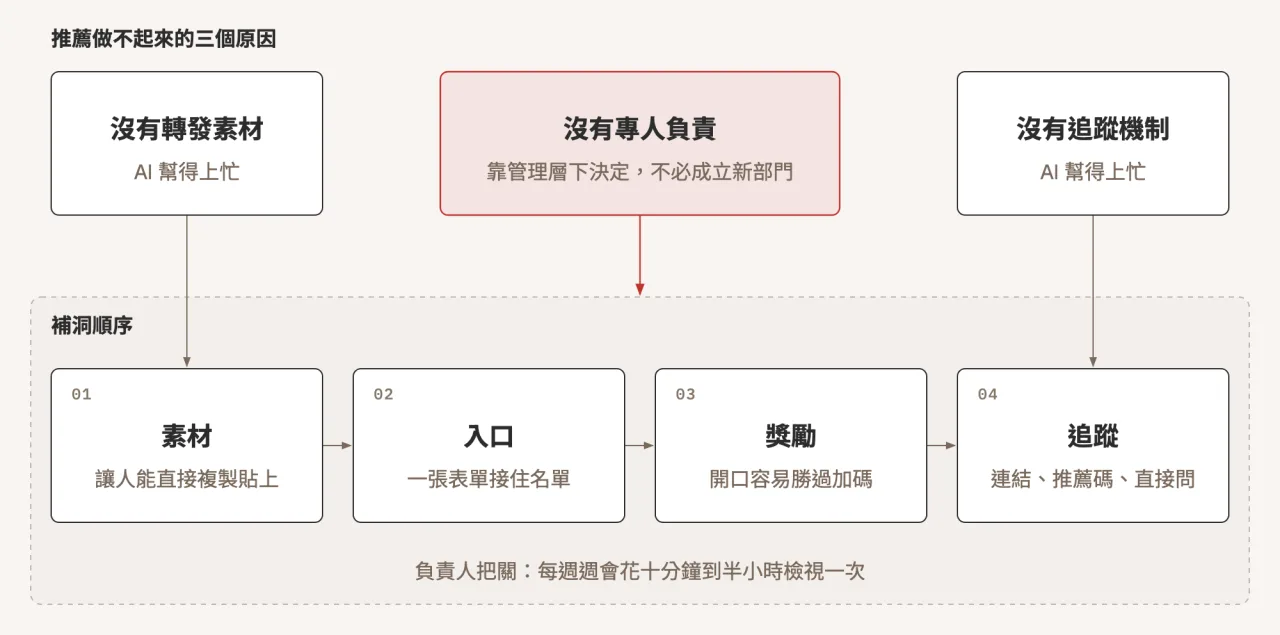
▲ There are three reasons why the recommendation cannot be done. The last two AIs can help. It is up to the management to decide who is responsible. The order of filling holes is material, entrance, reward, and tracking. The material should be thoughtful enough that the other person can copy and paste it directly. As a small example, instead of throwing out a map screenshot, you can directly attach an address, phone number, zip code, and Google Maps link that you can copy. The less effort the recommender puts in, the higher the chance of speaking.
When it comes to rewards, many people think that just adding more money is enough. This is the point I want to clarify most tonight. If people don’t recommend you, it often has nothing to do with the amount of rewards. You get stuck because you don’t know how to say it, you feel stressed, and you don’t know if it will be useful to recommend it. This is also human nature. If I recommend a company once but it goes nowhere, there probably won’t be a second time.
Recommendations won’t happen because the reward is big enough, they will only happen because it’s easy enough to ask.
A complete recommendation path has seven links, and many companies break off at the third and sixth links.
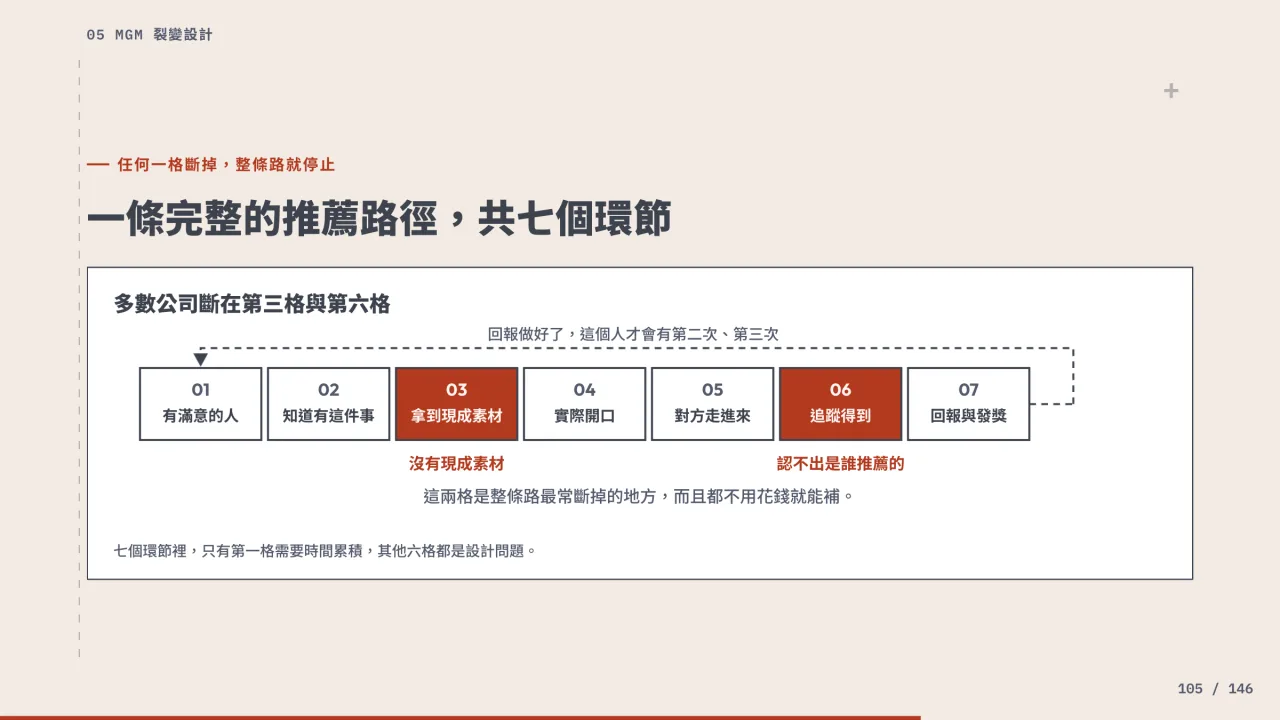
▲ A complete recommendation path has seven links in total, and most companies stop at the third box “getting ready-made materials” and the sixth box “tracking it.” The rewards themselves are also learned. One way or two way? The psychological cost of a recommender is often greater than the amount of the reward. Rewards do not necessarily have to be cash. A sincerely written open letter and a donation of materials in the name of the recommender are sometimes more cherished. The distribution time can be divided into two parts: small amounts will be given immediately when the recommendation is sent, and large amounts will be given after the other party completes the transaction or retains it for a period of time. At the same time, the feelings of the recommender are taken into consideration, and screening is also done.
Fraud prevention must also be done, but the cost can be very low: binding rewards to transactions or retention, limiting the number of recommendations from a single recommender, using exclusive links, and retaining the right to final audit. The purpose of anti-fraud is to protect people who sincerely recommend, and don’t go so far as to exclude most people.
Use AI to write recruitment copy, become a reporter first and then a writer
The title of the lecture mentioned “Painless Recruitment” because employee recommendation is one of the most common application scenarios of MGM.
The most common problem with recruitment copywriting is that it is vague. There is nothing wrong with the sentences “Have good communication skills” and “Welfare benefits are better than labor law”, but every company can write them, and job seekers can’t remember anything after reading them. A good recruitment copy must do four things: find the right people, let the unsuitable people leave on their own, give sufficient reasons, and lower the submission threshold.
The problem is that the real features within a company cannot be written by AI. So the first step is to play reporter and interview the hiring manager with six questions to uncover details that only insiders know.
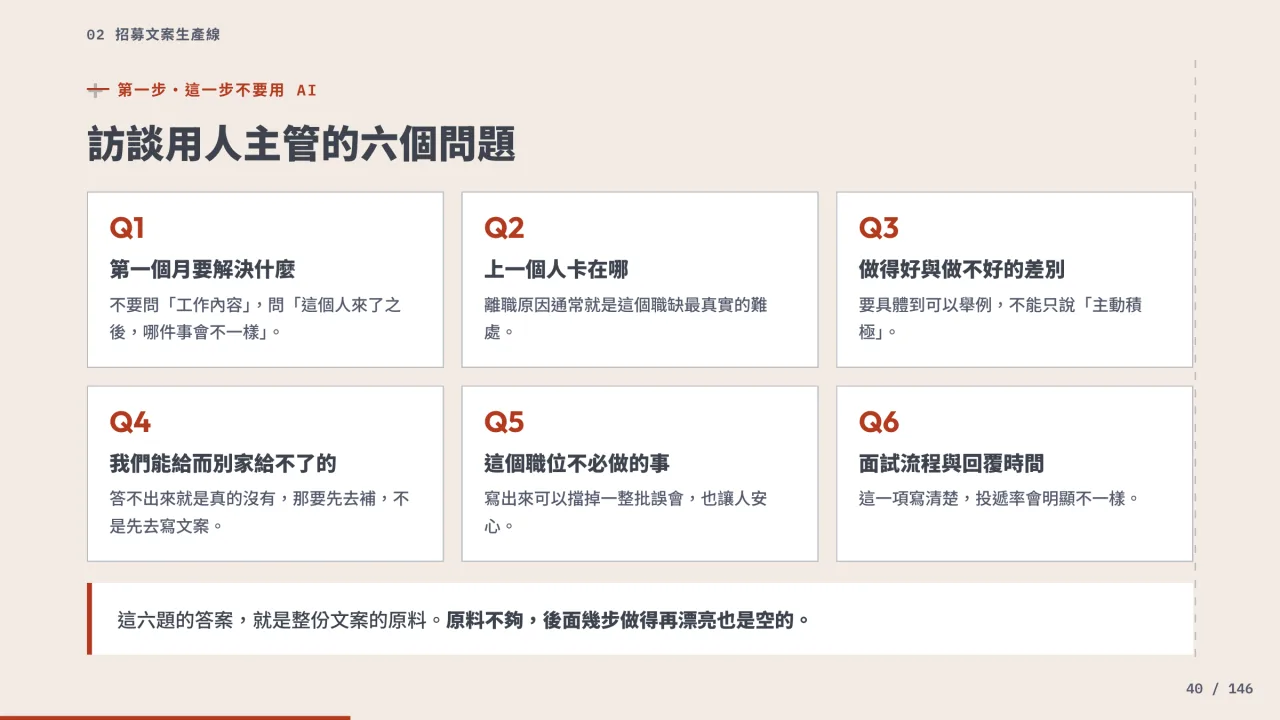
▲ The answers to the six questions in the interview with the hiring manager are the raw materials for the entire recruitment copy. After getting the material, hand it over to AI, and the prompt word captures four elements: role, material, restrictions, and format. Two details are particularly important. The first is to require the AI to ask questions and use specific examples; the second is to only ask one question at a time. If you throw in seven questions at a time, the AI will only briefly pass them through. If you are tired of typing, it is also good to switch to voice input and speak like you are chatting with someone. What you should pay attention to at this stage is the density of facts, not the writing style.
When writing, arrange it according to the four blocks of pain points, incentives, evidence, and actions. First talk about the other party’s situation, and then talk about what the company can provide. AI is easy to fabricate and beautify. When it comes to content such as salary and benefits that must be strictly true, you must check it yourself.
A solid piece of material can eat more than one fish and produce at least six versions: a long-form recruitment article, a social post, a LinkedIn version, a private message version, an internal forwarding version, and an employee referral article.
I recommend writing employee referrals in the first person, and writing “Why did I think of you?” so that the recipient feels that the paragraph is written for them, and the word count should be controlled. At the end, leave a sentence: “It doesn’t matter if it’s not suitable. Help me see if there is anyone else around me who is suitable.” This sentence makes it easier to speak.
Before launching, write down the elimination criteria. After going online, track the number of impressions, click-through rate, read rate, and delivery rate. Among them, the pass rate is the most worth keeping an eye on.
Turn the form into a conversation
Go back to the beginning of the set of numbers. Rather than adding more advertising, it would be more cost-effective to repair the penultimate layer, which is the section where you start to fill out the form but don’t finish it.
Filling out a form is like “you get it first, he gets it later”: the other party doesn’t know what he’s going to get, so he has to hand over a bunch of personal information first. I myself am often willing to help fill out questionnaires, but when I see that the questions are too long and have inconsistent logic, I can’t continue.
It’s much more comfortable to do it the other way around. First, care about the other person’s situation, give him a useful judgment or resource, and finally ask: If it is convenient, leave your contact information. This is the dialogue process of an AI consultant, which is opening, clarifying, giving value, triaging, and receiving in order.
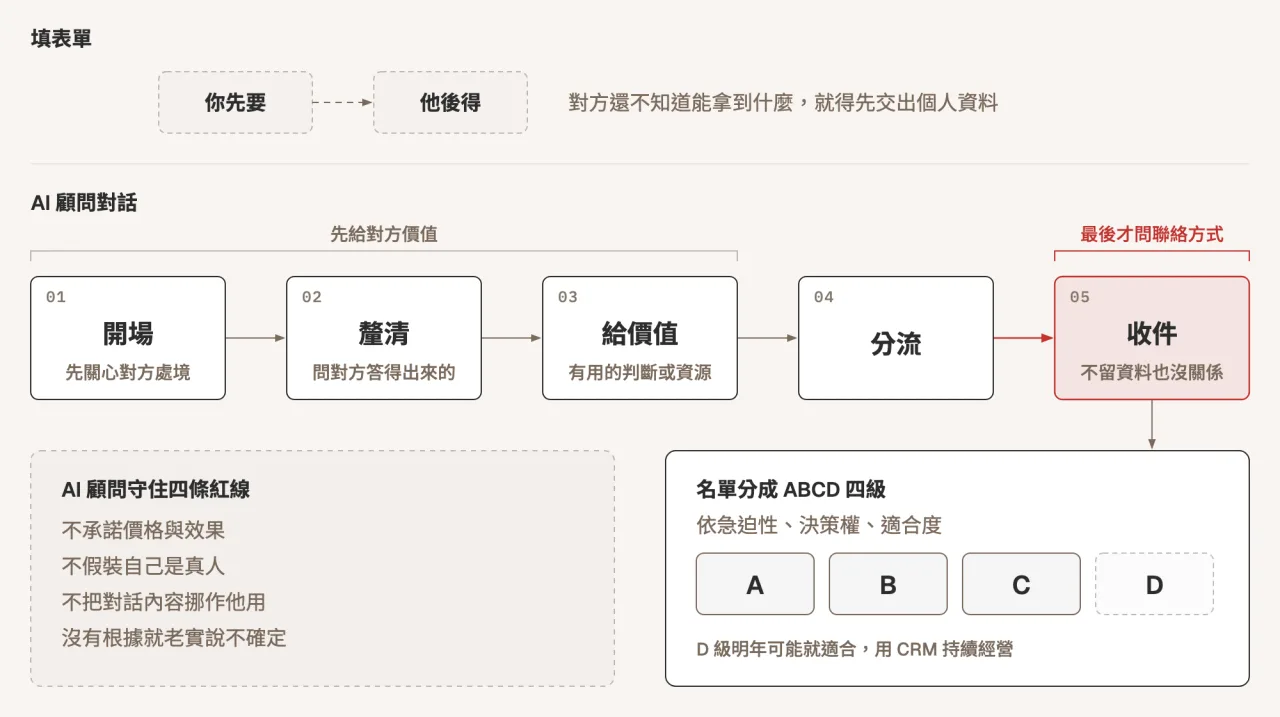
▲ When filling out the form, you want it first and others get it later; the AI consultant gives the value first and then asks for contact information last. The list received is divided into four levels of ABCD. There are several details in designing this conversation. Make sure the other party can answer the question. Don’t ask about the budget as soon as you open the door. Don’t just leave a blank input box, but give suggestions and options first. Finally, tell the other party “It doesn’t matter if you don’t leave any information.” This sentence can remove the defense and reduce fake lists.
AI consultants must adhere to four red lines: do not promise prices and results, do not pretend to be real people, do not misappropriate conversation content for other purposes, and be honest and unsure without basis. Personal information and business secrets must be de-identified first, and testing must be done before going online. For example, ask the AI to play the role of a guest, or ask it questions outside the knowledge base to see if it can answer questions randomly.
The incoming list is divided into four levels ABCD based on urgency, decision-making power, and suitability. People who are ranked D today may be suitable next year and just use CRM to continue operations.
Start with a paragraph, a form, and a person
Most companies in Taiwan are small and medium-sized enterprises, so I don’t recommend building a large system from the beginning. The minimum viable version only needs three things: a paragraph that is easy to forward, a form, and a person in charge.
Next, it will take 90 days to grow slowly: first make materials, then connect the entrance, recruit colleagues, and finally add rewards and tracking. Tracking methods can use a mix of exclusive links, referral codes, and directly asking customers “where do you know us?”. Relying solely on exclusive links will underestimate the contribution of referrals.
Just look at five indicators: proportion of recommenders, number of recommendations per capita, recommendation conversion rate, retention, and unit acquisition cost.
If you want to get started this week, here are five things you can do:
- Calculate what proportion of current customers are referrals.
- Chat with your supervisor and colleagues to confirm who will be responsible.
- Take a sample prompt word and actually run it once.
- Chat with two or three old customers and ask them if they are willing to make referrals and where they get stuck.
- Schedule a fixed weekly review time on your calendar.
In the Q&A at the end of the lecture, someone from the audience asked me how to manage time well? In fact, I started learning Vibe Coding only after the Lunar New Year this year. In half a year, I built 44 gadgets and more than 10 websites, including the backend of audience management and the AI editing process. Every morning, my virtual secretary will give a morning report; in the evening, I will use three questions to review. Tools will be changed all the time, and this regular daily review rhythm is what keeps these things running.
The same goes for recommendations. AI can certainly help you write the material and change the form into a conversation, but it all depends on your decision whether you want to spend half an hour every week staring at this path.
Next step
Bring this topic to your team
Vista Cheng speaks and runs workshops on AI workflows, writing and content systems for companies, schools and public agencies.