95% of B2B marketing teams are using AI, only 39% say it’s effective: The problem is buyers fill up their lists on day one
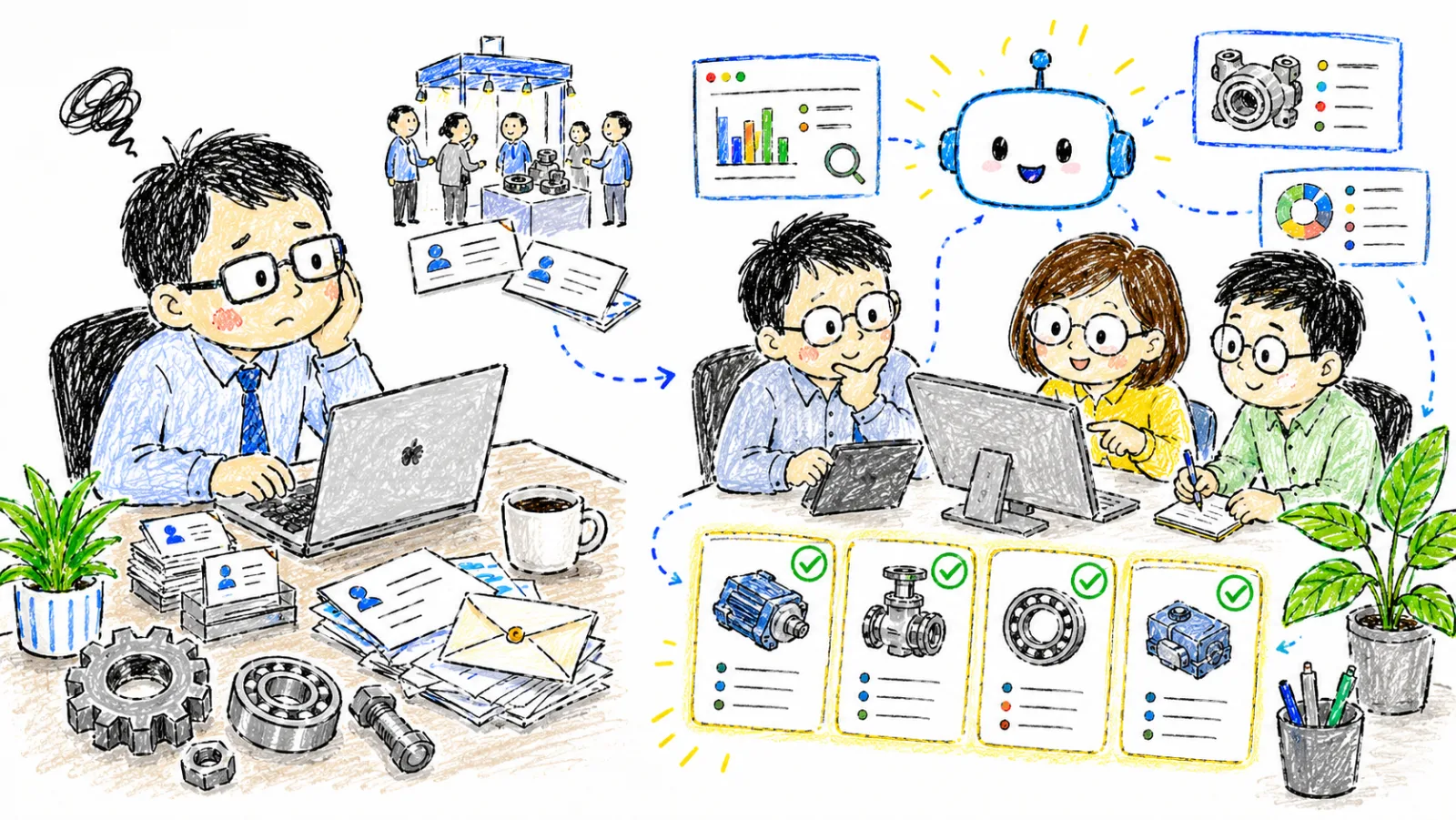
I have a friend who makes industrial components, everyone calls him Lao Zhang. Lao Zhang came back from an exhibition in Japan a while ago, bringing with him forty business cards. After the meeting, he sent development letters one by one as usual, but most of these letters fell into the dust. Two weeks later, Lao Zhang only received three replies, one of which even said rudely: “We are already evaluating the other three companies, and your actions are relatively late.”
Lao Zhang was very unconvinced and came to ask me what should I do? In terms of specifications, they have advantages, the price is not bad, and the delivery time is even shorter.
The problem was that the moment the other party started evaluating, the company wasn’t even on the list. By the time the business sends its first letter, the comparison has been completed.
To be honest, this has nothing to do with whether Lao Zhang is diligent or not. It’s because marketing didn’t appear at the time it should have, and that time has been moved to a place you can’t see in the past few years. This is also an old problem I talked about in the article How to use AI for foreign sales teams, but this time, it has become harder to detect.
A set of numbers that make people uncomfortable to look at
Content Marketing Institute (opens in a new tab) interviewed 1,015 marketers in its 2026 B2B Content Marketing Survey. 95% of them said they have used AI in their processes, and only 39% said AI has actually improved results. In the same survey, 45% of people ranked AI tools as the first place to increase their budget this year, which is the highest among all budget items.
The money has increased, the tools have been bought, and the people have taken classes, but 60% of them say they can’t see the difference.
When the adoption rate of something reaches 95%, it is no longer a competitive advantage, but a threshold. Your peers use the same models, the same prompt words, and even the same agency. Therefore, the question worthy of discussion is no longer whether to use AI, but why most people cannot get results even when using it.
The answer to this question lies not in the model, but in the process.
The buyer’s journey is moved to the part where you are not present
Let’s look at the buyer’s side first. What’s going on?
Gartner (opens in a new tab) In a sales survey released in March 2026, 67% of B2B buyers said they preferred a buying experience without business involvement. That number jumped six percentage points from 61% the year before.
Many people will come to the conclusion when they see this: Then we will downsize our business and change everything to online self-service. This conclusion is drawn too quickly. Gartner conducted another survey two months later and found that 69% of buyers would come back to find business to verify the judgment given to them by AI.
Taken together, the two numbers tell two halves of the same story: The buyer doesn’t want no one, but he wants no one while he does his homework. When he really wants to make a decision, he still needs someone to say, “I’ve seen this, it’s okay.”
Even more noteworthy is the time allocation. Gartner’s research on the B2B purchasing journey shows that buyers spend only 17% of their time engaging with potential suppliers, with the remainder spent doing independent research online, offline, and in meetings with their own company’s internal purchasing group.
And this 17% is not exclusive to your family. According to 6sense (opens in a new tab)’s B2B Buyer Experience Report, buyers evaluate an average of four to five vendors. Spread to a single family, only about 4% of the time remains.
No matter how wonderful your presentation is, it only reaches these 4%. The remaining 96%, the decision is made in those searches, those meetings, and those conversations where you are not present. This is what I felt most deeply after reading “AI Changes Your Customers”: the customer’s decision-making scene has completely moved.
名单第一天就填满了
If you could only remember one number, I would recommend remembering this one.
6sense interviewed more than four thousand buyers and found that in 95% of cases, the winner was already on the shortlist on day one. In four out of five transactions, the winner was the one that was preferred before being contacted. Buyers fill an average of 3.4 candidate slots on the first day of their purchasing journey.
In other words, the real battlefield in B2B marketing is the moment the list is formed.
So how did the list come to be? A 2026 survey by Forrester (opens in a new tab) gives the answer: 94% of B2B buyers will use ChatGPT, Perplexity or Gemini to build a short list of suppliers.
The gatekeepers of B2B marketing have changed several times over the past two decades. First it’s the reporters from industrial media, then it’s the ranking of search engines, and then it’s the algorithms of social platforms. Now switch to a large language model, and there is a key difference between this gatekeeper and the previous ones: the previous ones will give you a position to speak for yourself, but this one will not. It reads everyone’s information, tells it in its own words, and decides whether to mention you or not.
I wrote about the same twist in “The key to the survival of a personal brand in 2026 is not to be seen, but to be cited by AI”, except that we were talking about individuals at that time. This time it is a business, and the cost is much higher.
The first line to add to the outside world: let AI read you
Search engine optimization (SEO) is not dead, but the nature of its work has changed. Ranking is still useful because the sources crawled by the model highly overlap with the search results. But ranking first no longer automatically equals getting customers, because users may not click down at all.
What you want is not just that the blue link is clicked, but that your sentence is copied into the answer, and the company name is included when copying, and it is said correctly. How to do this? I have a complete practical review in “When AI replaces Google: Is your website ready to be cited”. If you want to understand the terms from the beginning, you can also read “AEO Getting Started Guide for Creators” first.
There are two facts here that many people ignore.
First, the quality of visitors diverted from AI is on another level entirely. Measurements by Seer Interactive (opens in a new tab) show that the conversion rate of ChatGPT traffic diversion is 15.9%, while the conversion rate of Google organic search is 1.76%, a gap of nearly nine times. The reason is not difficult to understand: the screening work has already been done at the AI level. The user asked if there are any solutions that are suitable for small and medium-sized production lines, support Chinese interfaces, and have a budget within a certain range. The AI will exclude those that do not meet the requirements before giving a list. People who click in have passed the three conditions of filtering.
Second, approximately 85% of the citations the model gets when answering category questions come from places other than your own website. Just paying attention to the official website is equivalent to only paying attention to 15%.
The software industry has G2 and Capterra to lay out, but what about companies that sell gears, chemicals, testing equipment or system integration? There is no ready-made evaluation platform for B2B in Taiwan, but you have other positions: directories of public associations and legal entities, company files on international procurement platforms, technical videos, industry vertical media, personal professional communities of technical directors, and official websites for seminars and exhibitions.
Finding your niche is straightforward: ask the AI a question that buyers would actually ask, and ask it to include sources. The domains it lists are where you should go. It can be done this afternoon at zero cost. If you want an easier way to start, I made a free GEO Physical Checker, enter your brand name and see how the AI describes you now.
 (opens in a new tab)
📮 Do you want to turn AI into a tool to amplify yourself? Welcome subscribe to "Vista AI Inspiration Supply Station" (opens in a new tab). I will regularly share my first-hand experience in AI applications, content creation and one-person company management, and help you turn your expertise into a cumulative asset.
The second line to be supplemented internally: Turn personal skills into team assets
At this point, most managers will start to think about which set of tools to buy. This is one of the main reasons why 95% of them don’t work.
MIT’s NANDA (opens in a new tab) team conducted a study in 2025, interviewing 52 senior executives, collecting 153 executive questionnaires, and analyzing 300 public enterprise introduction cases. The conclusion is that 95% of generative AI trial cases have no measurable profit and loss impact. This study later received many methodological doubts. I included it not to scare people, but because it found another finding that is more worth watching: the failure of the company on the table and the success of the employees on the table occur at the same time. In the same study, only 40% of companies have official large-scale language model subscriptions, but 90% of employees surveyed use personal AI tools to handle work every day.
Taiwan’s figures are more specific. The “2026 Taiwan Industrial AI Survey” released by the Artificial Intelligence Technology Foundation (opens in a new tab) in April 2026 pointed out that 61.8% of AI applications within enterprises are completely out of company control.
Your team is already using it, but you don’t know where to use it.
I would suggest viewing this as a signal rather than a threat. The fact that employees are willing to figure it out on their own means that they judge that the tool is really useful, and it also means that the tools or processes provided by the company have not kept pace. Sending an announcement prohibiting use at this time will only move the risk from a place you can see to a place you can’t see. I wrote about Moderna’s reversal of the purchasing order in “The most expensive way for a company to import AI is to buy it and no one uses it”. That article can be read together with this paragraph.
So what’s stuck? According to what I saw at the enterprise introduction site, there are usually three boring things.
First, there is no baseline. I didn’t measure how long it would take before the introduction. After the introduction, I could never prove whether it was faster. As soon as the review meeting came in the second month, the budget was cut.
Second, knowledge is not centralized. Everyone has to re-explain the company background, product lines and tone specifications to AI every time, which means starting from scratch every time. To solve this problem, the starting point is not to pick tools, but to disassemble the workflow.
Third, the results are not recycled. A colleague called up a very useful prompt word and kept it in his conversation record after using it. Others didn’t know about it. When he resigned, his method followed suit. This also echoes what I have been saying: The prompt words will expire, but you will not. What really should be left behind is the method, not those few lines of words.
None of these three things require buying new tools, they just require someone to put their name in charge. As for where small and medium-sized enterprises should start, I have compiled five key points, which can also be used as a self-checklist.
This 120-page briefing, I put it publicly on the Internet
I have compiled the above content into a complete briefing, which is embedded directly below. You can read it here, or you can open the full screen to view it:
In addition to the numbers mentioned in this article, there are also several parts that cannot be accommodated in the length of the article.
Five external work streams include market and customer intelligence, technical content production, development letter and ABM layering, inquiry processing and quotation pre-operation, and the pre-show, during and post-show stages. Each one has a comparison of working hours between traditional methods and AI methods, as well as prompt words that can be directly copied back for use, a total of eight groups. These prompt words have built-in provisions to prevent AI fabrication, which is particularly important in B2B, because once the numbers quoted externally are wrong, the trust of customers cannot be repaired.
A four-layer stack of internal tools, from baseline, intelligence layer, knowledge layer, production layer to governance layer, and a 90-day import path sheet. The order is important: measure the baseline first, then build the knowledge layer, and finally start the workflow. Doing it the other way around would be painful.
There is also a special paragraph on the actual conditions in Taiwan. Figures from the Statistics Office of the Ministry of Finance (opens in a new tab) show that exports in the first half of 2026 were US$416.66 billion, an annual increase of 47.1%. However, when broken down, the total growth of information and audio-visual products plus electronic components was 52.9%. Traditional industrial goods had only been growing for four consecutive months in June. If you are not in the AI hardware supply chain, this wave of growth has little to do with you. You are still faced with the old problems of fewer inquiries, customer price comparisons, and insufficient business manpower. This is the scene I described in “AI Assists Export Sales: How Small and Medium-sized Enterprises Can Build an All-Weather Transnational Order-taking Engine”.
There are also three hands-on exercises, including conducting an AI visibility audit for your brand. I have conducted this exercise many times in class, and the most convincing moment is often when someone discovers that AI has made a mistake about its own product line.
If you want to apply this process to your own industry
I want to be honest about one thing: the working hours comparison of the five workflows in the briefing is the range that I actually measured in the company’s internal training and consulting projects, not the statistics of the research institution. I also marked it this way on the briefing. When your team runs, there may be discrepancies.
Moreover, the hardest part about processes is never knowing which steps there are. It is determining which workflow to start based on your industry, your product complexity, and your team’s manpower. Those who make gears and those who make industrial software have completely different starting methods; the order of marketing for a company with only one person and a company with a team of three people should also be different.
If you feel you are on the right track after reading the briefing, but are not sure where to take the first step, please feel free to chat with me. I currently offer three forms of cooperation:
- In-company training and workshop (opens in a new tab): From half a day to one day, take your team to actually run through the five workflows, and produce the first version of your own prompt words and knowledge layer on site.
- Introduction Consultant (opens in a new tab): Starting from the quantitative baseline, we will accompany you for one to three months and convert the results into numbers that can be reported to the boss.
- Single Consultation (opens in a new tab): If you just want to confirm that you are going in the right direction, one meeting is usually enough.
Finally, please allow me to repeat what I often say in class. Tools are constantly being replaced, and those who are replaced are usually those who have not retained the methods. If everything your team is using AI to do now only remains in someone’s conversation record three months later, then those three months have not happened.
Next step
Bring this topic to your team
Vista Cheng speaks and runs workshops on AI workflows, writing and content systems for companies, schools and public agencies.