Stop "reading hard", AI is rewriting your reading efficiency and knowledge absorption methods
It’s been three years since ChatGPT came out! In the past two years or so, friends have often asked me about AI applications. I have also given lectures in many enterprises, public sectors, and universities, introducing many useful AI tools. However, it seems that I have never had the opportunity to share with you, **How to make good use of AI tools to read and absorb knowledge? **
The new year is coming soon! This time seems to be a good time to look back and look forward. So, I want to talk to you about this topic.
Standing at the intersection of knowledge explosion and AI revolution
There was an earthquake late at night a few days ago. What I was most worried about was whether the many stacks of books in the room would collapse. As a book lover, this worry may also be a kind of luxurious happiness, right?
Looking back on the past fifteen years, as a writer, lecturer and business consultant, I have accompanied countless friends on their reading and learning journeys. From traditional paper books to the popularity of e-books, from one-way knowledge input to the rise of community learning, and now to the explosive development of AI tools - I have indeed witnessed with my own eyes the dramatic changes in reading methods.
My feelings are particularly strong, perhaps because I also have the identity of a writer. I often laugh at myself as a “not best-selling” writer, but after all, I have published twenty books… I think I should have a little say in the matter of reading.
As we enter 2026, we stand at an unprecedented juncture in history. Large-scale language models such as ChatGPT, Claude, and Gemini have long been integrated into our daily lives; various AI-assisted reading tools are springing up like mushrooms after a rain; the ways of creating, disseminating, and absorbing knowledge are undergoing fundamental reconstruction. To be honest, this is both a challenge and a huge opportunity.
However, advances in technology do not automatically equal improvements in learning efficiency. In my teaching and coaching experience over the years, I have found that many people are even more confused when facing this wave of AI: “AI is so powerful, do I still need to study?” “There is so much information, where should I start reading?” “How can I make what I read truly my own?”
These questions are the original intention of me writing this article. I want to tell you: in the AI era, reading is not obsolete, but has become more important - but the methods, purposes and strategies of reading need to be adjusted, and we also need to keep pace with the times. Those who can leverage AI tools to accelerate learning, deepen understanding, and expand their horizons will gain a huge competitive advantage in this era.
Redefining reading in the AI era
Before we discuss how to read smart, let’s get back to basics: What exactly is reading? Why do we read?
Simply put, reading is the process of receiving, understanding and digesting other people’s thoughts through written symbols. Whether the carrier is bamboo slips, paper or screens, or brain-computer interfaces that may appear in the future, this essence will not change. Reading is to stand on the shoulders of giants and obtain the greatest cognitive value with the least time cost.
In modern intelligent reading, I think there are several key changes:
- From linear reading to network reading: We can jump freely between different knowledge points through hyperlinks, tags and search functions.
- From single media to multi-media integration: Combine paper books, e-books, podcasts, videos and other media.
- From passive reception to active dialogue: This is the biggest change brought about by the AI era. Before that, if you read, the book will not answer you. Now, you can feed AI what you read and then question and debate it.
- From individual learning to community learning: The value of knowledge is often magnified in sharing and discussion.
However, before you start reading a lot, I strongly suggest you think about a question: What does your Personal Knowledge System look like?
A complete knowledge system usually contains four links:
- Input: Your source of knowledge.
- Process: The method of digestion and absorption.
- Store: Management of notes and experiences.
- Output: Writing, sharing and teaching.

I hope you can first draw a status map of your current knowledge system, and then draw a goal map after reading this newsletter.
Complete Guide to AI Reading Assistant Tools
The time series is about to enter 2026. If you have not started using AI tools to assist reading and learning, then you are missing out on a huge efficiency bonus.
Large-scale language model applications (ChatGPT, Claude, Gemini)
- Book Preview and Book Selection Decision: Help you quickly judge whether it is worth investing your time.
- Concept Explanation and Background Supplement: Explain terms in an easy-to-understand way.
- 观点延伸与批判思考:让 AI 扮演反对者,提供不同视角。
- Content summary and key points extraction: Quickly establish the overall structure.
- Application Scenario Exploration: How to apply brainstorming at work.
Recommended special reading tools
- PDF Smart Reading Tool (ChatPDF, PDF.ai): Quickly digest reports and papers.
- Readwise Reader: Integrate reading later and smart summaries, I personally highly recommend it.
- Blinkist: A summary of the essence of business books, suitable for quick preview.
- Speechify: Convert text to speech, an artifact of “listening to books”.
- VoiceInk: Voice note organization tool, convenient for recording inspiration.
AI 辅助阅读黄金流程
- Book/Article Selection: Use AI to quickly filter.
- Preview and Set Goals: Read with questions.
- In-depth reading and annotation: core steps, no shortcuts.
- Deepen dialogue with AI: Test understanding, explore and extend.
- Organize notes and create links: This requires the assistance of digital note-taking tools.
- Output and Application: Test the effectiveness.
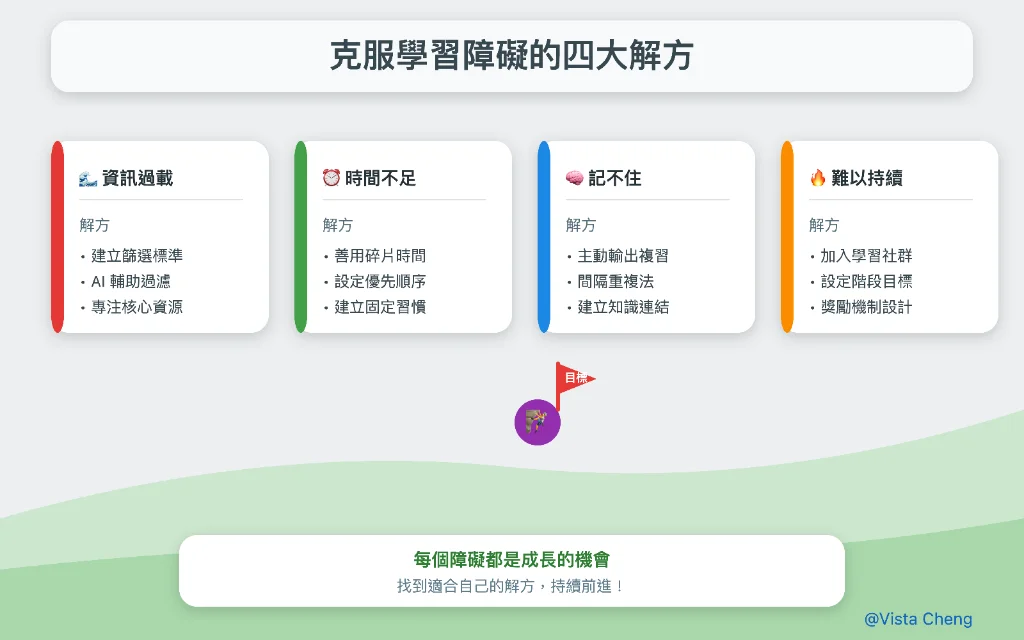
Before getting into specific strategies, let’s take a look at how to overcome common learning barriers through these methods:
Five effective reading strategies
After years of practice and teaching, I have compiled five of the most effective reading strategies:
1. Thematic Reading
Choose a topic and read three to five books plus related articles around it. Finally, a theme research report is produced.
2. Fragmented and efficient learning (Fragmented Learning)
Break long content into bite-sized chunks that can be completed in five to ten minutes. Make good use of commuting time input, but have a fixed time each week to organize the links.
3. Social Learning
“A person can go fast, but a group of people can go far.” Community learning provides opportunities for diverse perspectives, external accountability, and in-depth discussions.
4. Learning by Teaching
The retention rate of simply reading is only 10-20%, while teaching others can reach 90%. Set an output quota for yourself, such as writing one review after each book you read.
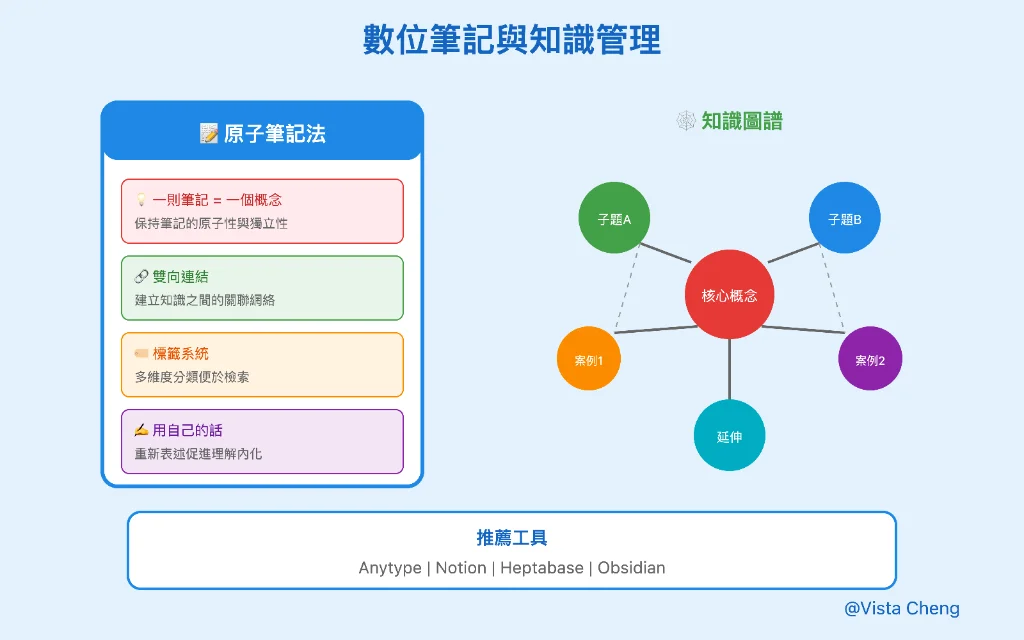
5. Digital Notes and Knowledge Links (Digital Knowledge Management)
Record fragmented knowledge through atomic note-taking and establish two-way connections to form a knowledge graph.
Leverage the power of community learning
What is the difference in effectiveness between studying alone and with a group of people?
- 观点多元性:十个人有十种视角。
- Social facilitation effect: Perform better in the presence of others.
- External Accountability Mechanism: Commitments are more binding.
- Teaching and Learning: Sharing is the best learning.
Welcome to Vista Reading Club
Vista Book Club started in 2016 and has been running for nearly ten years. Our core philosophy is “Read good books, make friends, and do good deeds.” In 2026, the Vista Reading Club will especially strengthen the theme of AI-assisted reading.
If you want someone to accompany you on this learning journey, I sincerely invite you to join.
In Vista Book Club, you will get:
- Monthly selection of good books to read
- AI 工具实战教学
- High quality social communication
- Exclusive learning resources
In 2026, let us use reading to reshape life and create the future with knowledge!
Small actions are the beginning of change.
📖 深入探索相關主題