What creators really sell is not words: Listen to Lin Yutang's "Creator's Awakening Day." Realization Class", recalibrate your three-layer realization logic
 *▲ Teacher Lin Yutang (Elton) gave a lecture on “Creator Awakening Day. “Monetization Class” clearly explains the essence of making money through creation. *
As a lecturer, continuous improvement is necessary. Therefore, every once in a while, I will deliberately listen to some teachers’ public lectures or paid courses (opens in a new tab). On the one hand, I want to see what kind of discourse changes are taking place in the market; on the other hand, I also want to check whether I have been kidnapped by experience unknowingly and take some outdated concepts for granted.
Last night, I participated in the “Creator Awakening Day” lectured by teacher Lin Yutang (Elton). Realization Class” is such an opportunity. In the ninety-minute online course, he used the three axes of personal brand (opens in a new tab) positioning, business model design and multiple monetization models to connect the entire lecture. It may not seem like a novel proposition at first glance, but the angle and level it cuts into are enough to make anyone who wants to make a living through creation recalibrate their strategies.
Don’t place your hopes on “purely selling words”
The sentence that impressed me the most in Mr. Elton’s lecture was his straight-to-the-point reminder - “Don’t fantasize about selling words.”
This sentence sounds gentle at first, but it is actually very sharp, because it denies the most romantic imagination of many writers: they think that as long as they write good articles, publish books well, and start a subscription system, they can get long-term stable income. Teacher Elton used an extreme example to illustrate: Cai Kangyong can sell more than one million books, and his royalties can easily exceed 30 million, but those are the few at the top of the pyramid. For most writers, simply selling words has a very low chance of success and is difficult to copy.
When I heard this, what came to mind were the many freelance writers I have come into contact with over the past decade or so. They have good writing, sharp opinions, and stable output, but they are often stuck in the cycle of “Why do I work so hard to write, but my income is still not enough to live on?” The problem is not that they are not serious enough, but that they have bet their entire career on a track with the lowest success rate.
If purely selling words is a special case at the top of the pyramid, then selling with words, which Teacher Elton then proposed, is the middle layer. The so-called selling with words refers to copywriting (opens in a new tab): using words as a business tool to assist marketing or sales. This path is much more pragmatic than selling words directly, but he also pointed out two limitations very honestly:
First, copywriting cannot save a bad product. “The product is not good enough. The copywriting can only sell it for the first time, but if the reputation is bad later, it will not sell.” I deeply agree with this sentence. I have handled content projects for many brands in the past. When it comes to the quickest results, it is never because the copywriting I write for the manufacturer is particularly beautiful, but because the product itself is tenable, and the copywriting only clearly conveys that tenable confidence. So, copywriting is an amplifier, not an alchemy.
Second, if you rely purely on copywriting to sell other people’s products, the market is very crowded and it is not easy to win. Nowadays, every brand is piling up content and every platform is trying to grab attention. If you want to break through the torrent of copywriting alone, the difficulty is rising year by year.
Words are tools, business models are the foundation
So Mr. Elton converged the entire discussion to a higher level, that is, relying on the business model to sell.
His logic is this: it is better to sell with words than to sell with words, and it is better to sell with business models than to sell with words. The first two are single points, and the latter is a system. The former two rely on individual talent, while the latter can design, expand, and even establish competitive barriers.
 *▲ There are three levels of monetization for creators, from low to high: selling words → selling with words → selling based on business models. The first two are single points of labor, and the third layer is the real system. *
This statement is completely consistent with the trend I have observed in recent years. From the early days when I ran the Content Hacker (opens in a new tab) website and the Vista Writing Companion Program, to now investing in AI writing teaching, I have come to realize one thing more and more: what really makes you monetize stably is never a hit article, a big lecture, or a best-selling book, but the overall business model connected behind these single points.
Put it another way: writing is just one cog in the engine, courses are another, and community, consulting, publishing, or branding are still others. When these gears can mesh with each other and drive each other, your income will have the opportunity to escape the linear trap of exchanging time for money and enter a state closer to systematic income.
Teacher Elton mentioned that he only worked about two hours a day. He initially felt that the income was not satisfactory, but then after calculating the working hours, “I suddenly felt that my life was not bad.” This is not to show off, but a natural result of the well-designed business model. I particularly agree with this, because when your income no longer depends solely on what you wrote or talked about today, you truly have time and surplus.
For you who are reading this article, I want to say one more thing: working two hours a day is never about doing less, but about reorganizing. In other words, the same time invested in things at different levels will produce vastly different values. Writing an instant post is a consumable; designing a course (opens in a new tab) that can be sold repeatedly is an asset; building a community that operates automatically is infrastructure. Creators must learn to distinguish whether they are creating consumables or accumulating assets every hour.
Those who do not have a clear positioning can first rely on traffic to monetize
In addition, for friends who are still exploring and have no clear business positioning, Teacher Elton’s suggestion is to monetize traffic first.
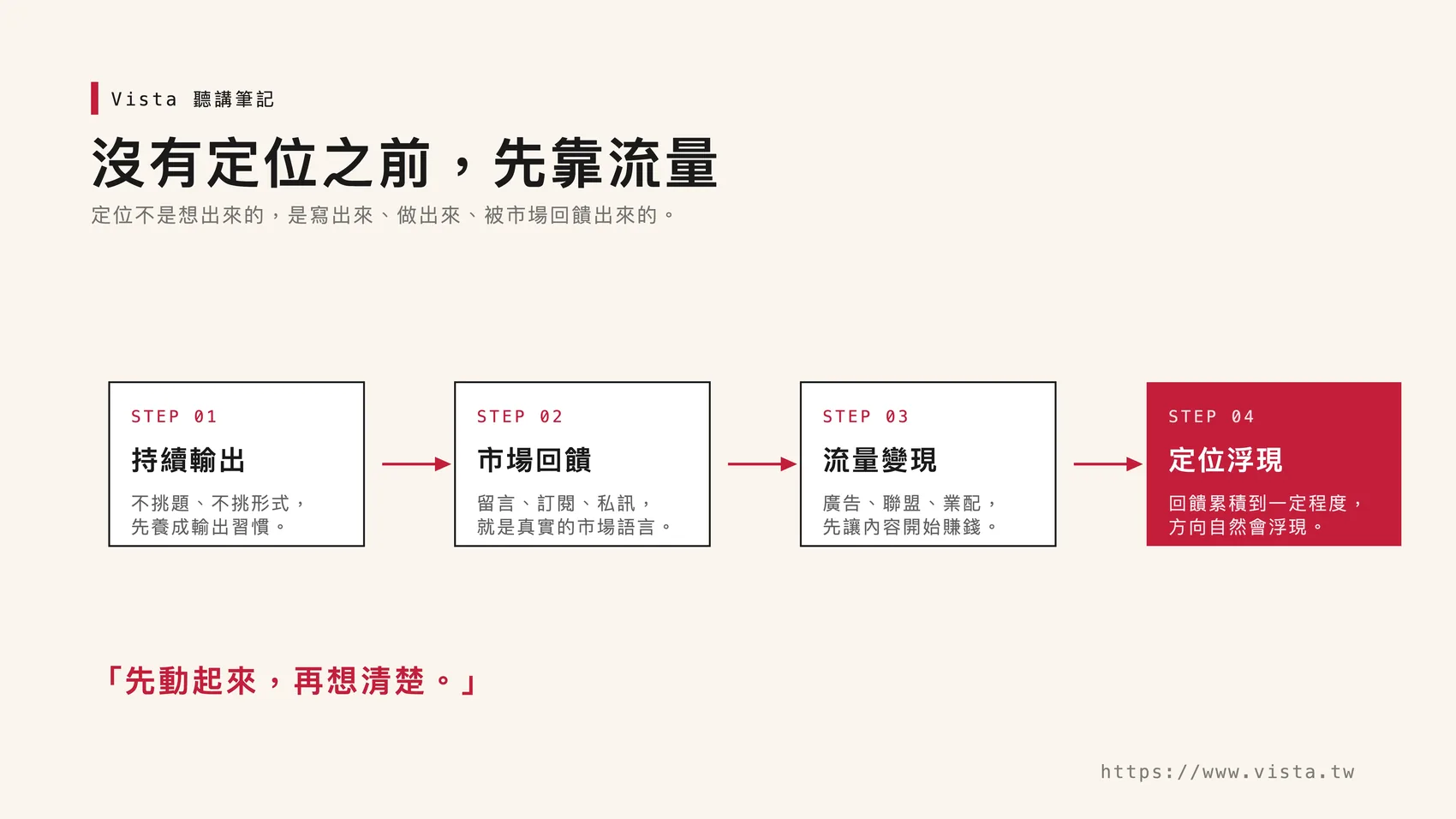 *▲ Before positioning, rely on traffic first. Positioning is not something that is thought out, but something that is written, made, and fed back by the market. *
Although this sentence is an understatement, it is actually an important solution for many creators who are starting out. Because many people feel an inexplicable pressure when facing brand positioning and business models - it seems that they can’t start without thinking clearly. But the fact is that positioning is often not thought out, but written, made and fed back by the market.
Traffic monetization can be said to be a low-threshold starting point. You don’t have to figure out what you will look like ten years from now. As long as you continue to output, accumulate audiences, and try different forms of content, you will slowly see which directions are responded to and which directions are not? Comments from viewers, growth in subscriptions, or questions in private messages are all feedback the market gives you. When feedback accumulates to a certain level, your positioning will naturally emerge.
This also reminds me of what I used to say to students in class: “Get moving first, and then think clearly.” This is similar to Mr. Elton’s advice. The point is not to get the right answer right from the start, but to put yourself in a loop where you can continue to be rewarded.

🛰️ Want someone to accompany you to see clearly in the wave of AI changes?
Almost all the public articles you see are finished products after repeated polishing. But what I cherish the most is the warm judgment before the finished product - this is the reason why I made Vista AI Inspiration Supply Station (opens in a new tab): a weekly thought note for fellow travelers in the AI era, sharing those Yoshimitsu Kataha that will not appear in official articles with you who are willing to get closer.
👉 Subscribe now and receive weekly emails → (opens in a new tab)
##Three Questions about Personal Branding: Start with “Who Are You”
Later in the lecture, Teacher Elton began to get into the specific framework of personal brand positioning. He mentioned three questions about personal branding, the first of which is - “Who are you?”
This problem alone is enough to get most creators stuck. In the past few years, I have led the Vista Writing Companion Program and have coached students from various backgrounds, from students to senior workers. I have discovered a common phenomenon: it is not that most people cannot write, but they do not know how they should be recognized as a brand.
The reason why the question “Who are you” is difficult is not to answer “What is my name” or “What do I do”, but to answer - “In this information-exploded market, why should others remember you?”
To answer this question, you have to be honest about a few things: What is the difference between you and others? Do your opinions, experiences, or perspectives truly create a unique combination? Can you use one sentence to make a stranger understand what you are doing and why it is worth stopping and looking at?
There are no standard answers to these questions, but every creator should ask themselves regularly. I do a brand inventory every year to see what I have accumulated, what I have given up, and where I have been pushed by the market in the past year. This inventory won’t necessarily bring about a huge turnaround, but it will give you a better idea of where you stand on the map.
After listening to the class, I gave myself three reminders
After listening to Mr. Elton’s lecture, I compiled three reminders for myself and wanted to share them with friends who are on this road.
 *▲ Three reminders for creators: re-examine the income structure, shift the focus from single point to combination, and don’t wait for perfection before starting. *
First, re-examine your income structure. If more than 80% of your income comes from selling words or using words to sell, then be careful. This means that your career is still in the state of linear labor. I suggest you start thinking about how to recombine existing content, skills, and communities into a more systematic business model? Even just upgrading selling articles to selling courses (opens in a new tab), or upgrading case writing to consulting, consultation or subscription, is a step forward.
Second, don’t focus on a single point, but on a combination. A book, a popular post, a community or a course all have limited value in themselves. But if they can guide each other, support each other, and form an ecosystem together, that is another matter. My own experience in the past few years is that the most valuable time investment is often not writing a single article, but designing the connections between these single points. Writing an article may be two hours of work, but designing links such as how this article leads readers to the community, how the community leads members to the course, and how the course feeds back to the next article may be the most leveraged thing in two hours.
Third, don’t wait for perfection to begin. Even if you don’t have a clear positioning or a complete business model, you can still start with traffic monetization. The key is to get yourself into a cycle of continuous output and continuous feedback from the market. Positioning will emerge in this cycle, and business models will grow in this cycle.
Conclusion: That is the real awakening
In the ninety-minute lecture, Mr. Elton did not use too many technical words. Instead, he used a way that was close to a confession to explain clearly the essence of making money through creation. For those who have been on this road for a while, this is a calibration; for those who are just starting out, it undoubtedly provides a rare map.
And for me—who has published twenty-one books (opens in a new tab), run a community for many years, and mentored countless writers—the most precious reminder of this lecture is: never bet your career solely on the words themselves. Text is an entrance, a tool, and an expression, but what really allows creators to go a long way is the system behind the text that you design bit by bit.
That is true awakening.
If you want to see more of my thoughts on marketing, AI and content creation, you are welcome to get to know me at vistacheng.com (opens in a new tab), or follow my main website vista.tw, content.tw (opens in a new tab) which focuses on content strategy, and those belonging to fellow one-person companies solo.tw (opens in a new tab), and vista.st (opens in a new tab), where I have accumulated English writing notes, together sharpen my judgment in this changing era.
Next step
Bring this topic to your team
Vista Cheng speaks and runs workshops on AI workflows, writing and content systems for companies, schools and public agencies.