When wisdom begins to depreciate, where is your moat? Read Cheng Shijia's "New Business Opportunities under Smart Inflation" and talk about Taiwan's old problems

That afternoon I was casually flipping through books in a bookstore. The words “Smart Inflation” suddenly came into view on the waist of a new book, which made me stop.
I picked it up and flipped through a few pages, and the more I flipped through it, the more I had a strange feeling: there were several passages in it, which I had written repeatedly on my blog in the past two years, and some of them were almost two versions of the same thing.
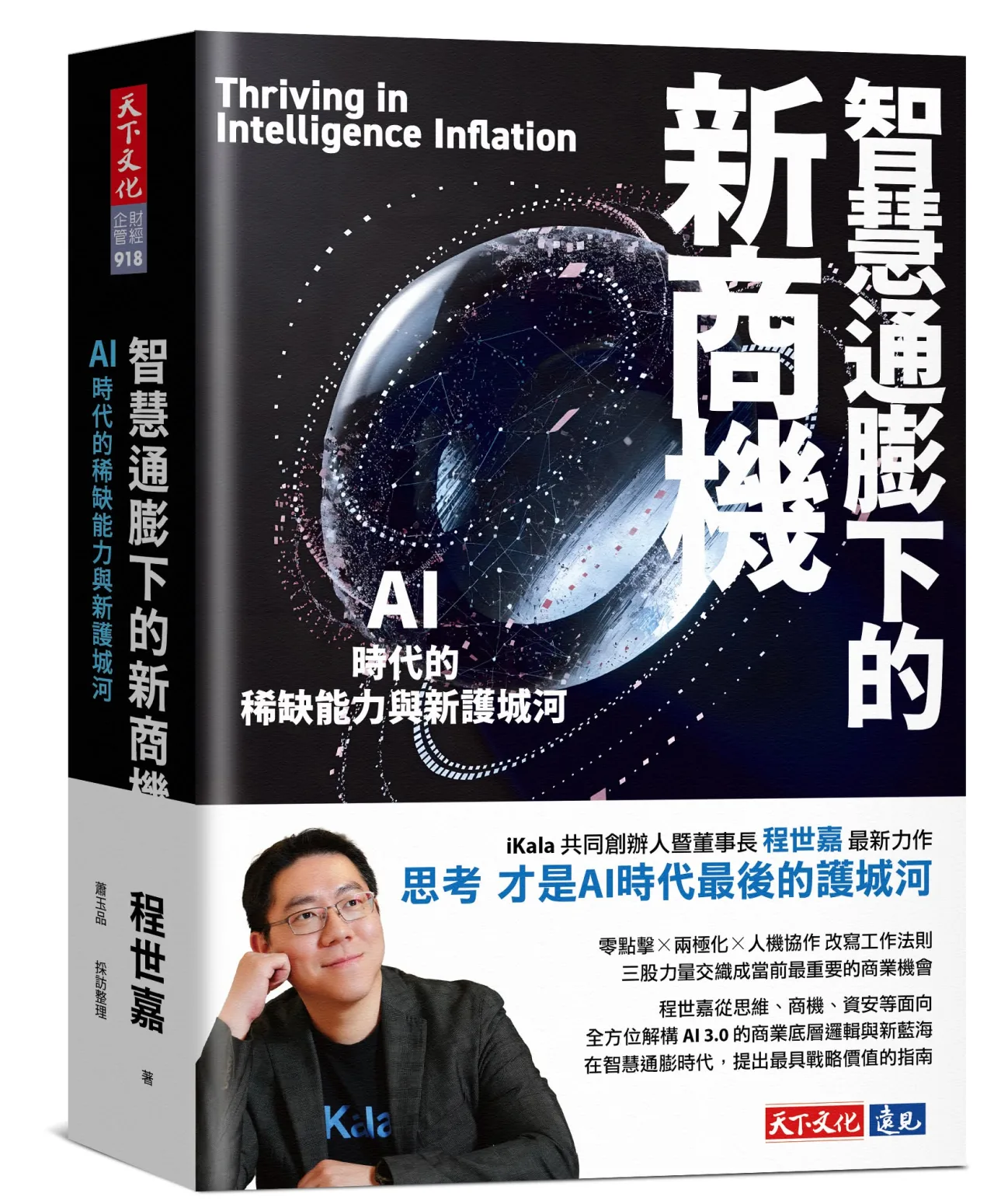
I turned to the book cover and discovered that the full title is “New Business Opportunities under Smart Inflation: Scarce Capabilities and New Moats in the AI Era (opens in a new tab)”. The author is Sega Cheng, who is also a friend on Facebook.
I usually read long articles written by Sega on social media, and I always feel that the way he talks about AI is very organized, which is different from most people: he neither deliberately touts new technologies, nor scares everyone, he just lays out the underlying logic of things for you to see. He is the co-founder and chairman of iKala. He holds a master’s degree in computer science from Stanford. He has worked at Google’s Silicon Valley headquarters and was one of the first engineers to put AI into Google’s search engine. The previous book “The underlying logic and survival rules of the AI world (opens in a new tab)” is said to have been released in five languages.
In other words, this is a guy who is actually at the table, not commentating from the sidelines.
 (opens in a new tab)
Smart inflation is the same thing as the leveling effect I wrote about
Well, let’s talk about the core concept mentioned in the title of the book first.
Cheng Shijia’s statement is: In the past, wisdom was a scarce resource. Companies were willing to pay high salaries to lawyers, consultants and engineers to buy the knowledge and judgment in their minds that could not be replaced by machines. But when major manufacturers lower the price of AI APIs to almost free, anyone who turns on their mobile phone can obtain wisdom output comparable to professionals, and the asset “wisdom” begins to depreciate like an inflationary currency.
He used a very understandable metaphor: In the past, if you had a wisdom of 1 million yuan, it would be worth 1 million yuan in the market; now that AI has made everyone carry 1 million yuan in their pockets, your share may only be 500,000 yuan.
I laughed when I read this, because this is exactly what I talked about in the article “The Cruel Divide in the AI Era” last year, but I borrowed the “leveling effect” from chemistry.
What I said at that time was this: In the past, among workers in the market, some could only achieve 3 points, some could only achieve 6 points, and the top ones could achieve 9 or even 10 points. Customers were willing to pay for this difference. But AI instantly pulled everyone’s baseline to 6 points. A novice who originally scored 3 points can now produce 6 points, and the original 6 points may become 7 points. But what about the top experts who could originally achieve 9 or 10 points? In contrast, the room for progress is limited.
When the market is flooded with 6-point pieces, customers will naturally start to wonder: Do I really need to pay five times the price for that extra 3-point piece?
The conclusion I wrote at the time was: **AI has raised the bottom line, but it has also lowered the ceiling. **
Sega’s wisdom from the supply side is that the price has collapsed, and I’m from the demand side as to why customers are no longer willing to pay the premium. Two roads, leading to the same destination.
The Google figure mentioned in his book is the data announced by Google CEO Pichai at the Google I/O 2026 conference: the number of tokens processed by Google every month has increased from 9.7 trillion in May 2024 to 3.2 gigabit in May 2026, an increase of seven times year-on-year.
This curve not only reflects that AI applications have fully entered the stage of large-scale implementation and real-time reasoning, it also directly draws the scale of smart production. And when something is mass-produced at this rate, we don’t actually need economists to tell us what will happen to its price.
Those chapters with zero clicks, I happened to be in the same pit.
The first part of this book talks about zero-click and GEO, which is a topic that I have been involved in in the past six months.
Sega’s judgment is that when AI agents begin to search, compare prices or place orders for users, the business model of traditional websites that rely on traffic and clicks to survive will collapse. Users no longer need to open any web pages, because the agent does everything in the dialog box. He made a very important conclusion: if your brand is not mentioned or recommended by AI, it will disappear on the Internet.
What I wrote in the article “Your next customer is not a human being” is the same thing: the first-line audience of brand marketing is quietly changing from humans to machines. Agents will not be impressed by a beautiful photo, nor will they be moved to tears by your brand story. What they want is structured, readable, and comparable information.
My conclusion at the time was: **Not being seen or referenced by AI means that it is disappearing from a rapidly growing entrance. **
On a personal scale, this is also true. I talked about it in “The key to the survival of personal brands in 2026 is not to be seen, but to be cited by AI”. Letting AI know you is more important than letting people find you. If you want to complete this aspect from a technical perspective, I have also written an AEO Getting Started Guide for Creators.
However, I would like to add something here that is not particularly emphasized in the book, but I think it is important for small teams.
Agency business is actually an underestimated opportunity for small and medium-sized enterprises and one-person companies. In the past, competing for rankings on Google was an arms race between budget and content. It was difficult for small brands to win over large companies. But what agents care about is that the information is unclear, the specifications are incomplete, and the reviews are untrue. These are precisely where flexible small brands can do things quickly and solidly.
In other words, agency business has the opportunity to bring competition back to who can do the basics better, rather than who has a bigger marketing budget. For the small and medium-sized business owners who read this book, this matter may be more practical than any of the business opportunities mentioned in the book.
But what really impressed me was not the so-called AI business opportunities
To be honest, the second part of this book spends seven full chapters talking about the gold mines of the AI market: edge computing, customized question and answer engines, companion healing, experience economy, and entertainment industry. The content is all solid.
But what really made me sit upright was the self-sequence.
Cheng Shijia spent a long time talking about what he calls “Taiwan Disease” in his preface. The figures he cited are cruel: Taiwan’s direct semiconductor employment population is only over 300,000 people, accounting for only about 3% of the total employment population of more than 11 million; Taiwan’s stock market market capitalization is already the sixth largest in the world, but one company, TSMC, accounts for about 45%.
Then he wrote this sentence: AI will not cure Taiwan’s disease, but will amplify it.
When I read this, I remembered an article I wrote in July. The starting point of that article was completely different. I was talking about the fact that everyone working with AI is producing the same thing for free: your prompts, your tool calls, and most importantly, how you correct the model when it gets it wrong. Every correction is the distillation of your judgment.
But as I kept writing, I came to the same place:
The moat of hardware is in our hands, but the moat of software intelligence is in the hands of others. We are very good at creating value, but very bad at retaining value.
Sega, which has an international outlook, obviously looks at this from the structural perspective of the overall economy, exchange rates, tax systems, and housing prices; while I look at it from the position of a freelance worker who takes on a case, a one-person company. But what we see is the same problem: Taiwan is good at producing, but not very good at retaining Japan.
In the past, the name of the disease was OEM, and the gross profit was eaten up by both the upstream and the brand; in the AI era, what is eaten will be the wisdom of the entire company’s operation, and you won’t even receive a bill, because it is likely to be given away for free.
After reading the entire book, I found this section to be the most interesting, the most deserving of extensive discussion, and the most likely to be skipped. Because it is not as easy to understand as “Where are the AI business opportunities?”
Temperature has become a scarce substance, I have understood this for a long time
Chapter 14 of this book talks about temperature becoming a scarce substance and hand feel being a thermal demand. Chapter 4 talks about how reality is the most valuable selling point when filled with generative content. I had a great time reading these two chapters, because they were the most touching parts of the year for me.
I talked about Vibe Content in an article for small and medium-sized enterprises: When everyone can produce a professional-looking post within three seconds, professionalism itself is no longer a threshold. What is truly scarce becomes those things that AI cannot imitate.
The conclusion of that article is: **When content production capacity is no longer the bottleneck, taste and judgment are your last moats. **
Sega has brought this matter to the scale of the entire economy, such as: companionship, healing, real experience, game entertainment, tactile creation and concert economy, all of which are taking off because they satisfy people’s desire for reality.
My own vision and experience are not that grand, but the direction is the same. In my opinion, more and more people will be able to use AI. That is technology, and it is not difficult to learn it; and those things that machines cannot make up for will always be scarce, because it tests your taste and judgment. I also mentioned this in the article about Audio and Video Threshold Moving: AI takes over the labor layer, leaving the judgment layer intact to you.
Admittedly, this also echoes the assertion in Chapter 20 of the book: thinking power is your moat, and thinking cannot be outsourced to AI.
I have my own opinion about this. I condensed my judgment into a system that stayed local and belonged to me: my writing voice, word taboos, and workflow specifications all have an original copy that I control.
**The large language model is a worker hired by me, not my brain itself. Workers can be replaced at any time, but the brain is not outsourced. **
This matter sounds abstract in words, but is actually very concrete in practice. I split the entire content production into a production line that can be run again and again, one person plus an AI army, and maintained several product lines at the same time. If you also want to condense your own standards, voice, and workflow into a portable copy, instead of being scattered in hundreds of conversations, I held an “AI Content Production System Workshop” on August 30, and used Claude Code to guide you in 3 hours to build this line yourself.
👉 Click here to view course details
(opens in a new tab)
##Finally
There is a sentence in the introduction of this book: Money in the AI world is moving, but it never leaves the same table.
I love this metaphor. It doesn’t say that there is more money, nor does it say that money disappears. It says that the location has changed.
Sega admits in its preface that it has few answers to the systemic social problems caused by AI. He traveled around the United States for two months and met with representatives from Stanford, Google, OpenAI, Anthropic, Congress, and city governments. The most common answer he heard was four words: I don’t know.
An author who can write “I don’t know” in his preface makes me more willing to read the parts he knows. Because on this topic, those who dare to admit boundaries are more credible than those who dare to make assertions. There are too many books on the market about AI, and most of them are either selling fairy tales about “AI will make everyone rich” or selling panic about “AI will replace everyone.” Both of these are easy to sell, but they may not be what everyone needs.
At the end of the book, a question is left for readers: Do you know where you should stand?
My answer is not so certain, but I know what I have been doing this year: I leave the judgment in my own hands, hand over the repetitive work, and then try to put myself in the position where “the machine can’t do it, but I happen to do it well.”
That location moves every year. So there is no day when this thing is done, there is only a question of whether to continue or not.
And if this question stumps you, it’s probably not because you don’t think clearly enough. I wrote in another article that many people cannot choose their own position. It is not a matter of ability, but of reluctance. If you really want to go through that hurdle, Teacher Susie’s “Positioning Convergence Workshop” will open its second session on September 26. It will be held online and take away one sentence of positioning in 3 hours.
👉 Click here to view course details (opens in a new tab)
If you feel that uneasiness but can’t figure out where it comes from, this book (opens in a new tab) can at least give you some direction. And once anything has a direction, it won’t be so scary.
Next step
Bring this topic to your team
Vista Cheng speaks and runs workshops on AI workflows, writing and content systems for companies, schools and public agencies.