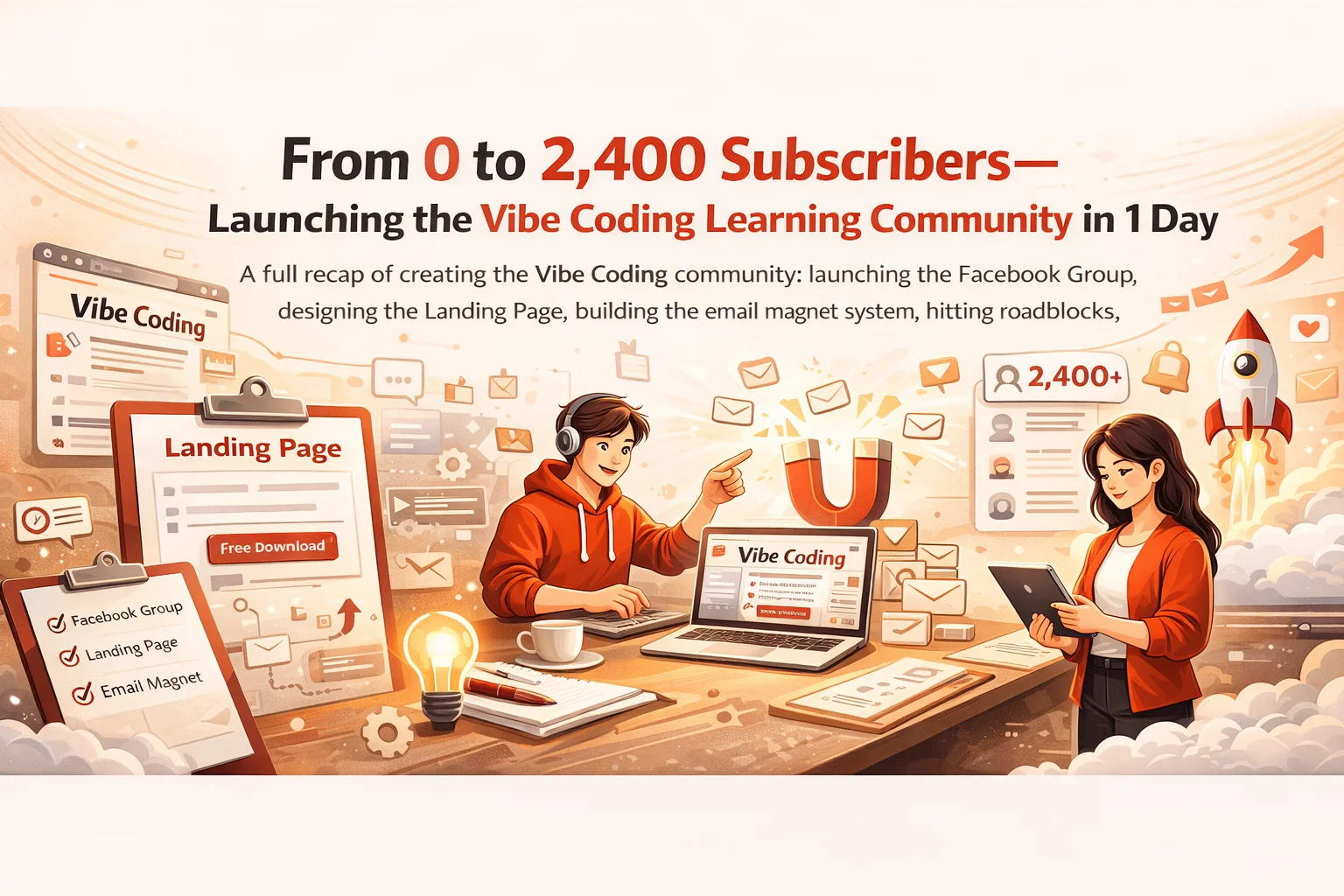
From 0 to 2,400 lists - a complete review of building the Vibe Coding community in one day
This article records my complete process from the idea to the actual establishment of “Vibe Coding Practical Community”. It includes setting up a Facebook community, designing a Landing Page, creating a list magnet system, as well as various setbacks and breakthroughs encountered in the process.
A thought: Why establish a Vibe Coding community?
This story begins in February 2026.
In the past few months, I have been asked the same question repeatedly in corporate training and speeches: “Vista, Vibe Coding sounds great, but I don’t know where to start?”
These questioners are not engineers, but entrepreneurs, lecturers, consultants and marketers - obviously they have a lot of things they want to do in their minds, but are blocked by the wall of not being able to write programs. Recently, I have written several in-depth articles about Vibe Coding and also opened a practical workshop, but I realized that learning cannot only rely on one-time activities, it requires a continuous environment.
Learning cannot just rely on one-time activities, it requires an ongoing environment.
So, on February 28th, I made a decision: to establish a free Vibe Coding learning community.
Instead of talking about it later, do it today.
Start with Facebook community: community first, then content
As for the carrier of the community, I thought about it for a while, and finally I chose the Facebook community.
The reason is pragmatic: the social platform most familiar to most of my target audience—working professionals between 30 and 55 years old—is still Facebook. Compared to Discord or Slack, Facebook Groups has the lowest entry barrier. There is no need to download any additional applications, and updates will naturally appear in their daily browsing.
I named the community “Vibe Coding Practical Community” and set the website address to facebook.com/groups/vibecoding.club. The club’s introduction is simple: “Designed for entrepreneurs and professionals with non-technical backgrounds, learn to use AI to turn ideas into products.”
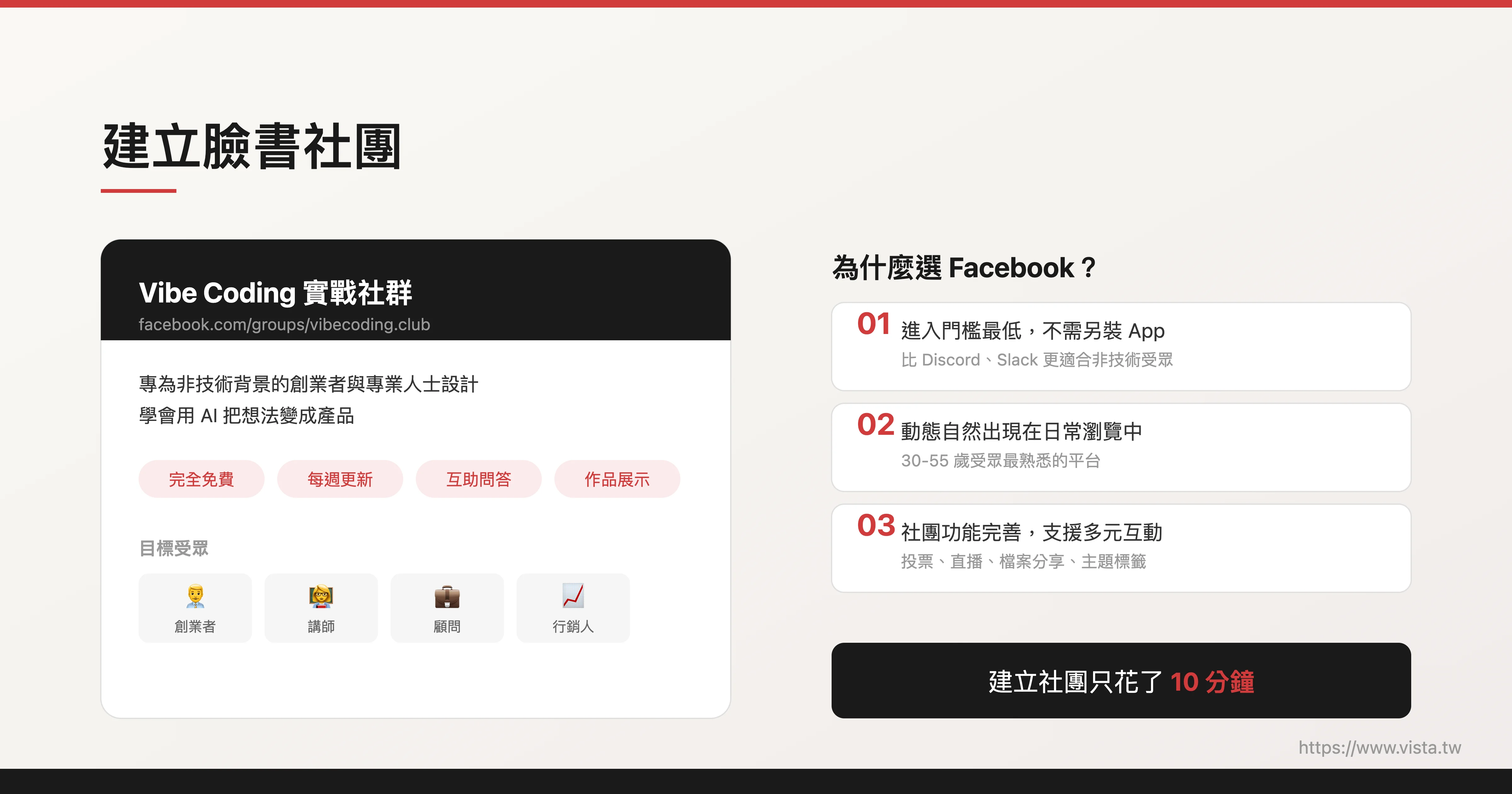 ▲ Vibe Coding Practical Community Facebook Community Page
It only took ten minutes to set up the club itself; but I knew that no one would want to join an empty club. In addition to the original intention of building things, I also need an incentive, a reason for people to leave their email, download the information, and then join the club.
Well, that’s the role of list magnets.
The idea and design logic of Landing Page
Why do you need a separate Landing Page?
After the Facebook community is established, the next step is to design an exclusive Landing Page on your website vista.tw. Instead of pushing the community link directly on Facebook.
The underlying logic is this:
Although Facebook groups are convenient, the problem with them is that you can’t keep track of the members’ contact information. Facebook’s algorithm determines who sees your posts, and you don’t have members’ emails. Once the algorithm changes, the group is blocked, or Facebook declines, you are no longer connected to this group of people.
Therefore, I made this positioning: **Landing Page is the real entrance, and the Facebook community is the extension. ** The core mission of Landing Page is to collect emails (through list magnets), and the Facebook community is the field for subsequent interactions. In this way, you can have a controllable contact channel (e-mail list) and a field of continuous interaction (community) at the same time.
Design logic of page structure
In order to accomplish this task, I need a page that does three things at the same time:
- Explain what Vibe Coding is - so that friends who have never heard of it can quickly understand it.
- Free download available - Use “Vibe Coding Beginner’s Guide” as a list magnet.
- Direct traffic to Facebook community - After downloading, guide users to join the community.
The page design adopts a classic funnel structure, and each block has a clear psychological purpose:
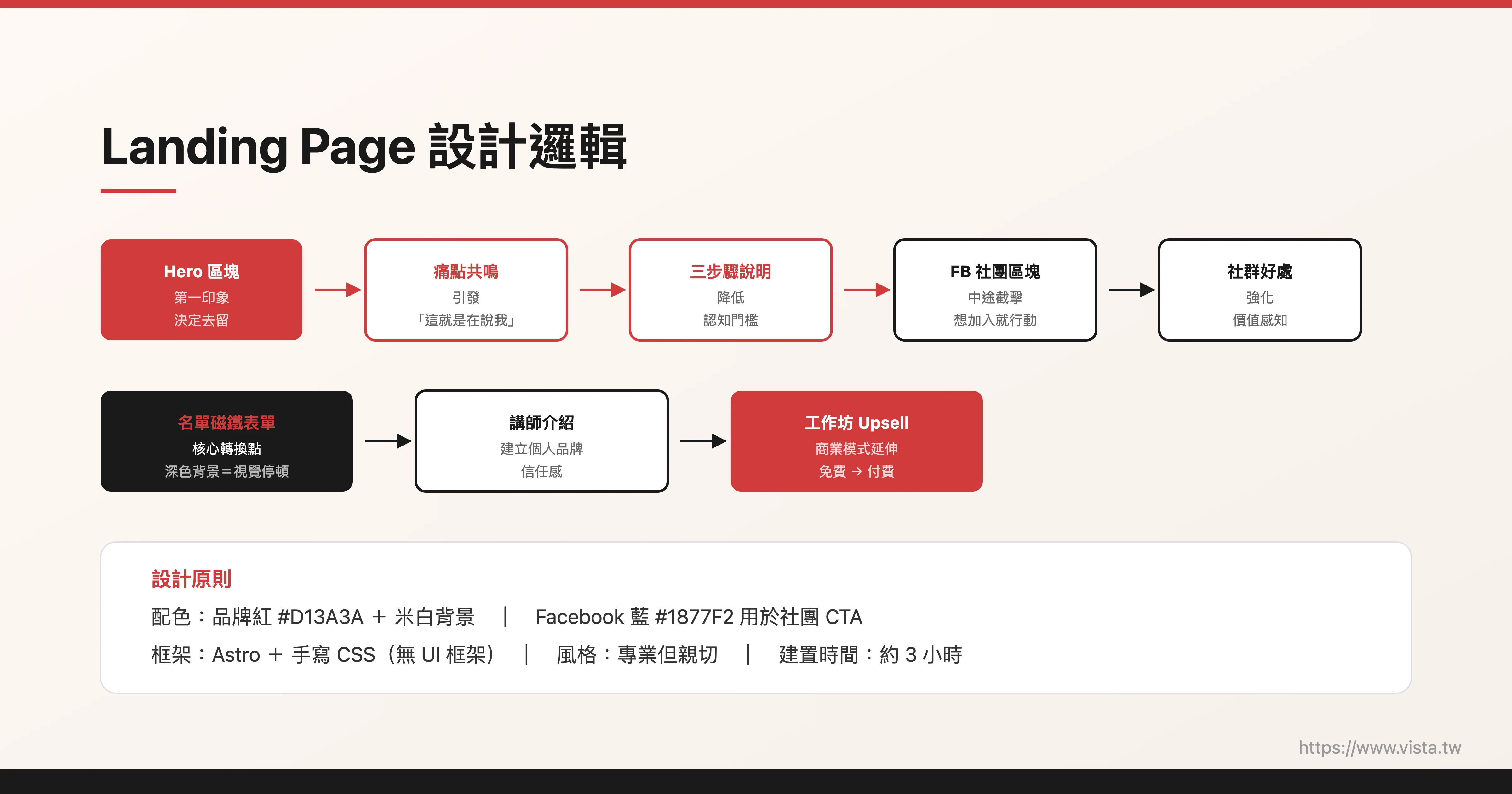 ▲ The funnel structure and design logic of Landing Page
(1) Hero block - the first impression determines whether to stay or not
The headline reads “Can’t program? Use Vibe Coding to turn ideas into products.” The design logic of this sentence is: first use questions to evoke pain points (you can’t write programs), and then use solutions to give hope (turn ideas into products).
Paired with two Call To Action (CTA) buttons - “Download Startup Guide for Free” and “Join FB Community”, it gives visitors two clear action paths. Below are three sets of social certification data—18,000+ newsletter subscribers, 100+ in-house trainings, and 20+ published books—to establish credibility in three seconds.
(2) Pain point block - triggering resonance
Next, I use four cards to present the most common problems faced by the target audience:
- 💡 Have ideas but don’t know how to program
- 💸 Asking an engineer to quote is too expensive
- 🤖 Have heard of AI but don’t know where to start?
- 🏝️ Self-study is too lonely and there is no one to ask.
These pain points are extracted from feedback from past workshop students. The design logic is very simple, it is to make readers feel that “this is talking about me”. Once the resonance is triggered, everyone will naturally be more willing to continue reading.
(3) Three-step instructions - lowering the cognitive threshold
“01 Describe your idea → 02 AI will help you produce the program → 03 The work will go online directly”
The purpose of this block is to allow readers to understand what Vibe Coding is in 10 seconds? Only three steps are deliberately used because three is the easiest number for the human brain to process. Too many details will scare away non-technical audiences.
(4) Facebook community block - Intercept midway
Put an independent community recommendation section in the middle of the page, and use blue cards with clear benefits (completely free, weekly updates, mutual help Q&A, work display).
Design logic: Some people have already decided “I want to join” after seeing this, and there is no need to scroll down. Give them an outlet to act immediately rather than forcing them to read the entire page.
(5) Community benefits - strengthen value perception
Six benefits are presented in the format of icon + title + description: weekly trend updates, practical teaching demonstrations, community interactive discussions, member work display, exclusive resources and discounts, networking and cooperation opportunities.
The reason why this block exists is to solve the problem of “what can you get after joining?”
(6) List magnet form - core conversion point
Use a dark background to make your form stand out. The title is “Free Download: Vibe Coding Beginner’s Guide”, and four content highlights are listed below:
- ✅ Vibe Coding core concepts
- ✅ Recommended list of AI development tools
- ✅ First project Step-by-Step
- ✅ Solutions to frequently asked questions
Just fill in your name and email in the form, check the box to subscribe to the newsletter (checked by default), and click “Free Download” to complete.
Key design decision: Place the form on a dark background. The entire page has an off-white background. The sudden appearance of a dark area will create a visual pause, allowing the user’s eyes to be naturally drawn to the form.
After the form is sent, it will automatically display the success status and guide the user to check the mailbox. At the same time, it is recommended to join the Facebook community again - this is a deliberately designed “double conversion”: filling in the email is the first conversion, and joining the community is the second time.
(7) Lecturer’s introduction—Building personal brand trust
Here are my photos and experiences: I used to be the product director of “Wind Media” and the editor-in-chief of “Digital Times”. I have given more than 200 AI keynote speeches.
(8) Workshop Upsell - Extension of business model
There is a workshop recommendation section at the bottom of the page: “Want to learn more deeply?” [Vibe Coding Practical Workshop] (/workshop/vibe-coding) with a limit of 10 people.
Color matching and visual design
The color scheme is mainly brand red #D13A3A with an off-white background, and Facebook blue #1877F2 is used on club-related CTA. The overall style pursues a professional but friendly feel - making people with non-technical backgrounds feel that this page is designed for them, rather than a cold technology product.
The entire page is completed using the Astro framework with handwritten CSS, without using any UI framework. The reason is that I wanted complete control over every visual detail and didn’t want to be limited by the frame’s preset styles.
From conception to page launch, it took about less than two hours.
If you also want to use AI to quickly build your own products and community systems as described in this article, you are welcome to sign up for the small-class workshop with a limit of 10 people. Start from scratch and take you step by step to complete your first work.
👉 Learn about workshop details and registration
 ▲Vibe Coding Practical Workshop-Use AI to turn ideas into products
List Magnet System: Technical Architecture
Front-end: Form → API → Letter
When the user fills out the form and presses Submit, the front-end JavaScript will POST the data to the /api/lead endpoint.
The API does these things:
- Layers of Protection: Rate limiting (5 times per minute per IP), blocking bots, and email format validation.
- Data writing: The list is stored in the database, and the device type, country, UTM parameters and source page are recorded at the same time.
- Generate download token: Generate a download token, which is valid for 24 hours.
- Send Email: Send a branded HTML email containing a download link.
Download page
After receiving the letter, the user clicks the download link to enter the exclusive page. The page verifies that the token is valid (not expired), and then displays a list of all downloadable files.
Background tracking
Integrate webhooks to instantly track the status of each email—whether it was sent, opened, clicked, or bounced. Taking this opportunity, AI helped me build a management backend, including five tabs:
- Overview: Number of lists, conversion funnels, country distribution
- List: searchable, filterable, and pageable
- List Magnet: independent statistics for each resource
- Mail Status: Incident Tracking
- Source Analysis: UTM sources, traffic source rankings
Review and Reflection
Might have done something right
Use the spirit of Vibe Coding to build a Vibe Coding community.
The entire system construction process was completed by myself and AI. Whether it’s a Landing Page, List Magnet API, or Admin Backend – describe your requirements, let the AI produce it, and then fine-tune it. I think this in itself is the best implementation of Vibe Coding.
Landing Page’s funnel structure may be effective. Pain point → solution → social proof → call to action, each block has a clear psychological purpose.
Real-time monitoring and instant repair. Because of the management background, I can detect and deal with problems as soon as they occur.
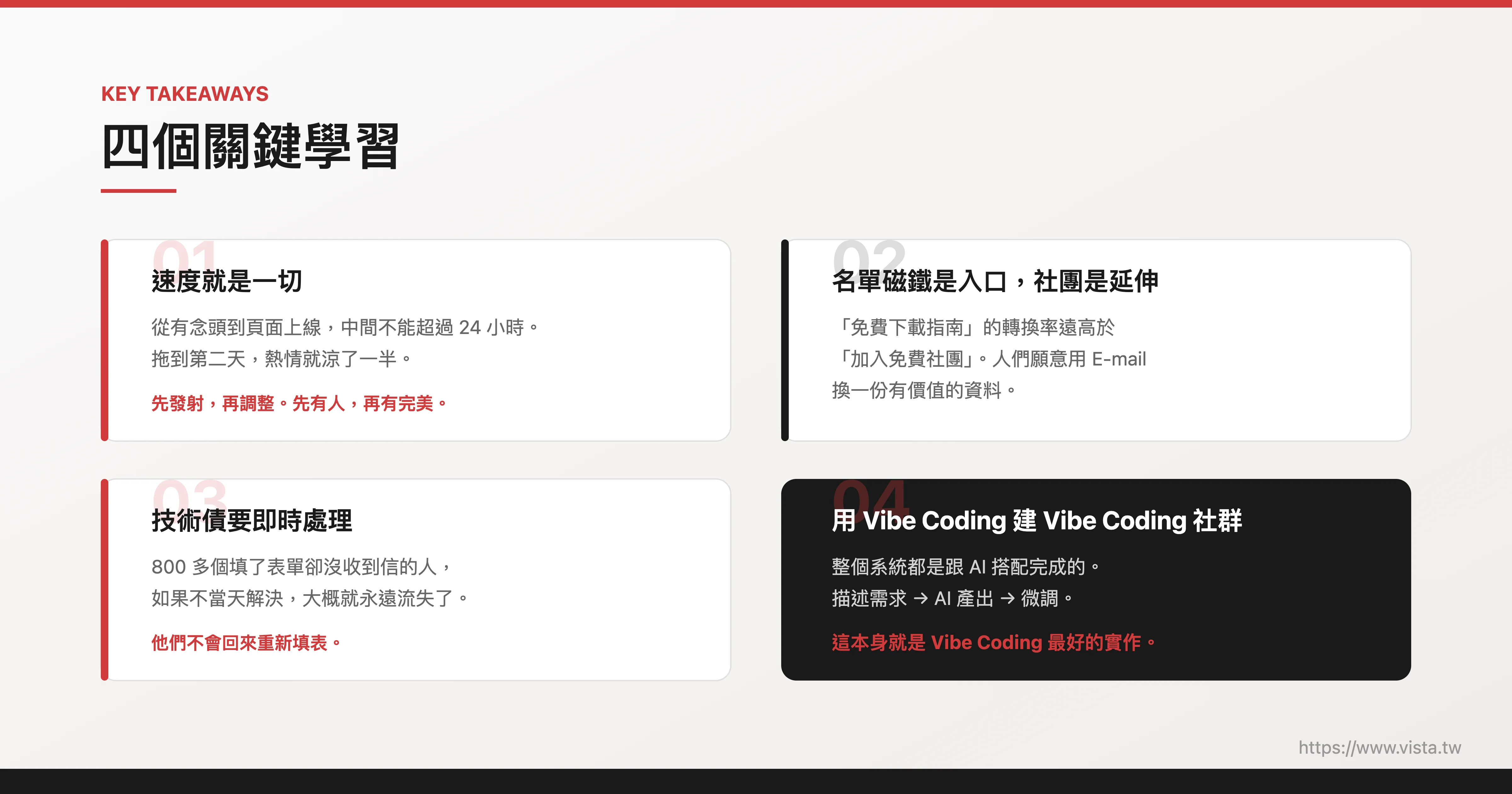 ▲ Four key learnings in this community building process
Could be a better place
Paid options should be considered from the get-go. Once a list magnet is launched, there is no way to control how quickly lists come in. The limitations of the free plan will prevent the earliest and most interested users from receiving the letter.
Batch reissue function should be built-in. If batch processing is designed from the beginning, there is no need to debug under high pressure.
The next step in community establishment
Establishing a community is indeed just the starting point. The next key points may be:
- Content Rhythm: When you are free every week, publish trend updates, practical teachings or tool recommendations in the community.
- Community interaction: Encourage members to share their works and establish a display culture of “made with Vibe Coding”.
- Workshop linkage: The community is a free entrance, and the workshop is an advanced experience. The two can match and drive each other.
- Continuous optimization of funnel: Use background data to further optimize copywriting and form position.
- Consider VIP community: In the future, we can provide paid community services for more advanced students.
Launch first, adjust later. First there are people, then there is perfection. That’s the spirit of Vibe Coding, isn’t it?
Postscript
Thank you for reading this. If you are considering building your own community or work, my biggest advice is: **Don’t wait until everything is ready to start. **
To be honest, the first version of my Landing Page left a lot to be desired. For example, the list magnet system broke down dramatically just four hours after it went live. The UI of the admin backend is only passable and is still a bit rough.
However, these are all iterable. What you can’t iterate on is your earliest and most enthusiastic potential users—if you don’t catch them at the moment they’re most interested, they’ll leave.
The inspiration for this incident came from a post I posted on Facebook post. I didn’t expect the response to be so enthusiastic, and it made me more determined to continue running this community.
**Launch first, then adjust. First there are people, then there is perfection. **
Further reading
- Vibe Coding Beginner’s Guide - Free download to start your first AI development project
- Vibe Coding: Turn your idea into a product today - In-depth article about Vibe Coding
- Vibe Coding Practical Workshop——A small class practical course with a limit of 10 people
External resources
- Vibe Coding Practical Community - Join the Facebook community for free
- Vista Newsletter - Subscribe for weekly AI trends and practical sharing
📖 深入探索相關主題