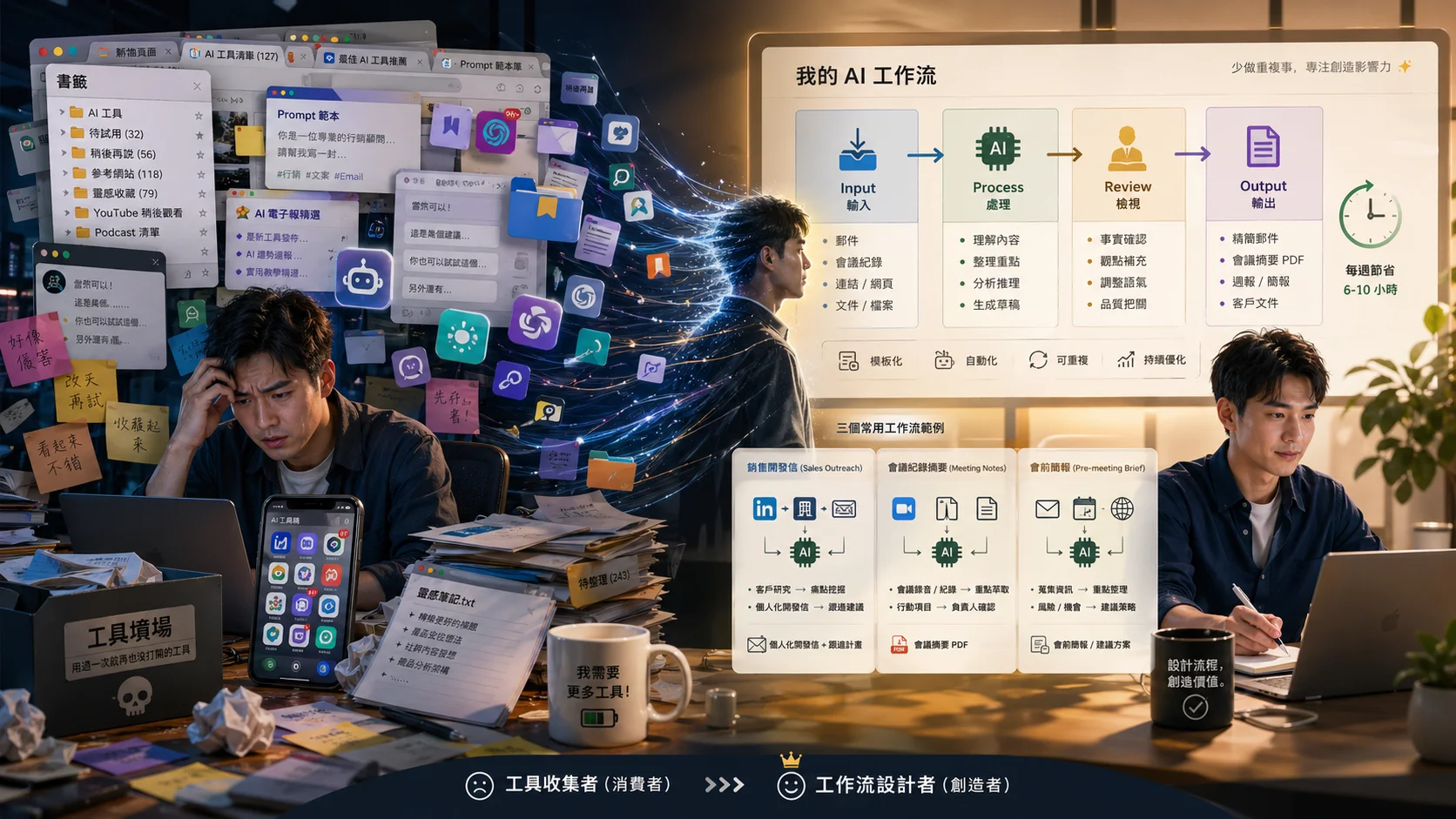
You must have the ability to invest: After listening to Mr. Giga’s talk about judgment, I used Vibe Coding to create my own stock picking compass.
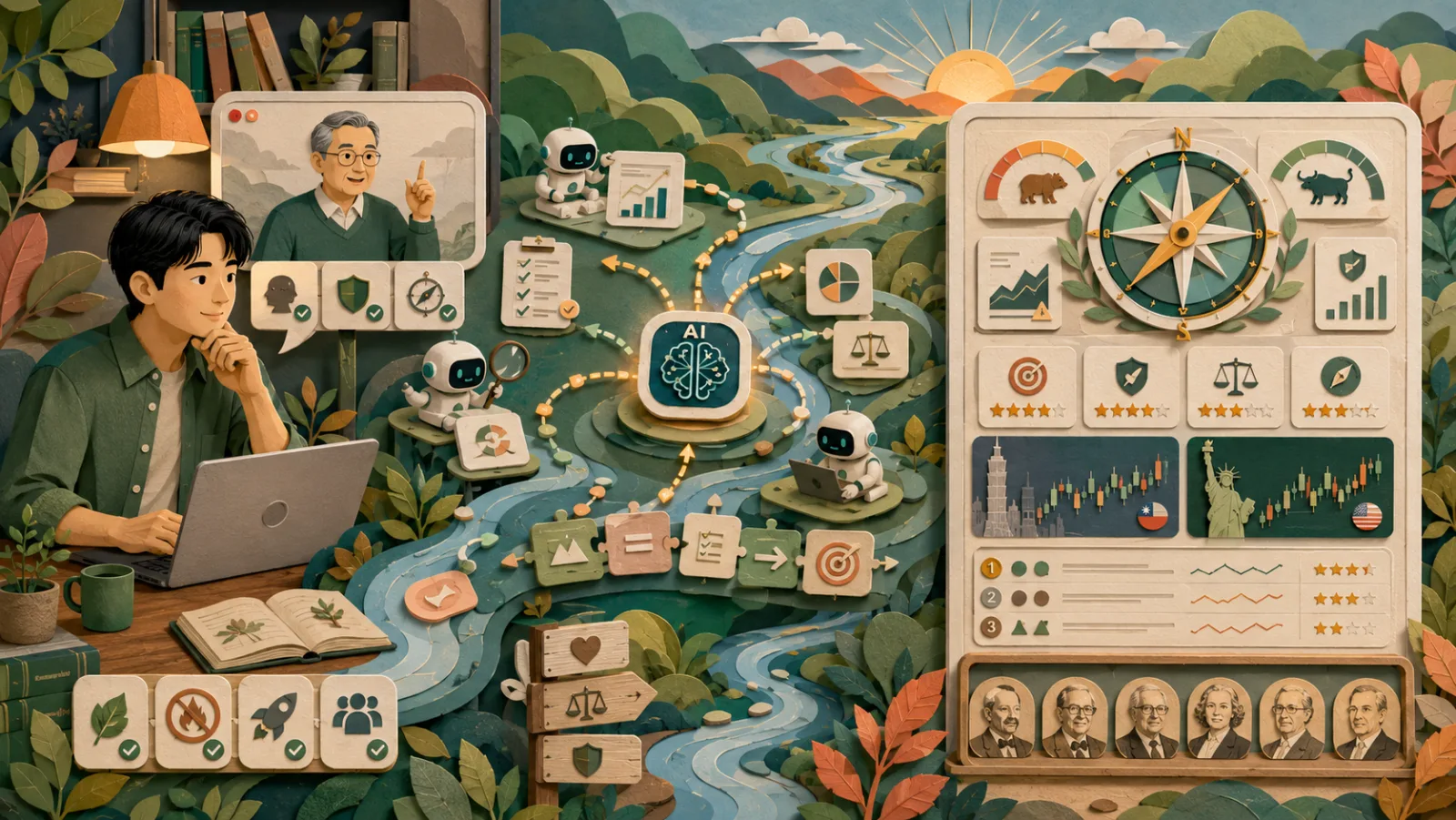
Teacher Sun Zhihua held a live broadcast last night and invited an old friend of his: Teacher Zeng Siyuan (Giga (opens in a new tab)). Not long after the show started, Giga talked about a scene from more than 20 years ago, which impressed me deeply.
At that time, Mr. Giga had just retired from the army, and his first job was in the bond department of KGI Securities as an interest rate derivatives trader. I wear a neat suit and cufflinks to work every day, and I feel extremely handsome. Sitting on his right was a colleague who made more than 20 million in one day and treated the entire department to Japanese food for lunch. About a week later, this colleague lost more than 10 million and lay on the table as quietly as if he was asleep. Another colleague’s goal that year was to earn 50 million, but he reached the target after only four or five months of working. He spoke very loudly, but one day the market fluctuated, and all the original 40 to 50 million was given back, and a compensation of 10 million was paid, and he resigned a month later.
Teacher Giga said that these people are all from the finance department of National Chengchi University or prestigious foreign universities, and they are extremely smart. However, he started to think about one thing from here: What does it mean to be a powerful person? Are you the kind of person who always makes money? Does such a person really exist?
The answer he gave himself was also the basis of the entire sharing: being great is not about making money forever, but being able to make profits with controllable risks.
Trading Values: First figure out who you are
Teacher Giga’s career path is unique. I studied from the Department of Mechanical Engineering to the Institute of Mechanical Engineering at National Taiwan University, and then went to the Institute of Finance and Economics at National Taiwan University. I completed two master’s degrees together. In my first job at a securities firm, I did bond splits and did more than 10 billion in volume that year. I was the second largest in the market, only losing to China Trust. Then he left the financial industry to start a business, bypassing online learning, and worked his way up to a private equity fund in Hangzhou, writing quantitative trading strategies. His competitor at the time was called Magic Square Quantification, and his boss Liang Wenfeng was the person behind DeepSeek later.
Because of his cross-field background, Mr. Giga said that he later discovered that many things were connected together.
He threw an interactive question to the audience: If you want to wait for the low to buy, rate 1; if you want to chase after seeing a new high, rate 2. Almost everyone wants to buy the bottom. He said that this is called trading on the left side, and chasing highs is called trading on the right side. There is no absolute right or wrong between the two. He has a classmate from National Taiwan University who is a standard right-side trader. He dares to buy TSMC even if it breaks 1,000 or 2,000, making tens of millions a year. Is the method right? In terms of results, people really made a profit. But Teacher Giga bluntly said that he did not dare to do it.
To put it bluntly, what he wants to say is: the most important thing in trading is to first establish your own trading values. Are you a research type or an intuitive type? Do you chase the highs or buy the lows? Do you want to short-in and short-out, or do you want to buy it and keep it for your children? There are no standard answers to these questions, but you have to know who you are first before other people’s methods can become yours. This also echoes my feelings when I read “Primitive Wisdom”: “The stronger the AI, the more you should practice these four instincts, things like judgment must be practiced again and again by yourself.
You need to be able to invest: you must be able to sustain it before you can talk about the long term.
Everyone will say these four words of long-term holding, but there is a premise: the cash on hand can withstand fluctuations. Long-term holdings that cannot be sustained are just short-term holdings that have not yet been forced to sell.
Following this logic, Mr. Giga talked about two things he learned in private equity. The most important thing about a private equity fund is not a set of strategies to make sure money (someone tells you to make sure money, run quickly, that’s a lie), but asset allocation and risk control. The same goes for individuals: how much should be allocated to stable returns, how much should be allocated to medium risks, and how much to bet on high risks, can be designed.
His own approach is to keep a bottom position. For example, if he buys TSMC, he will not sell it. In addition, he will allocate a small amount to buy low and sell high within the range to make some profits. Even if you go in the wrong direction, the bottom position is still there and you won’t regret it too much.
Assets are not just money
What I think is most worth learning from the whole session is Teacher Giga’s definition of assets.
Money is an asset, and a house is an asset. Everyone knows this. But he said that your knowledge, your understanding, your values and your degree are also assets. Along the way, he started his own business and watched as his classmates from National Taiwan University’s Institute of Finance and Economics became general managers of financial holding companies and vice presidents of listed companies, with annual salaries of tens of millions. He once wondered whether he was a loser and was still trying to survive. Until one day he figured out: the skills he possessed allowed him to do what he wanted to do without relying on any company’s brand name or someone else setting the stage. The freedom he wants is not freedom of wealth, but freedom of choice.
So he now runs a seven-person company, spending 70% of his manpower and time on AI products (opens in a new tab), leaving only 20% to 30% for quantitative trading. Why not go all-in on quant? He made a very sober calculation: a principal of 10 million, an annualized rate of 20%, is only 2 million a year; even if you manage a scale of NT$600 million and charge a 20% performance fee, it will only be more than 20 million a year, which is not a lot to distribute to a team. Quantification is fascinating, but there is a ceiling on how much you can earn, and you have to keep an eye on it. He enjoys creating value more: making AI products has the opportunity to create an ecosystem, like Apple. He compared AI to the Internet in 2000. It is still in its early stages and there are too many possibilities.
In other words, his asset allocation is not only allocated to money, but also to his time and head.
Use AI to create your own investment dashboard instead of a bulletin board
In the second half of the sharing, Teacher Giga showed off the product they made, an investment stock picking tool called Dr.Bull (opens in a new tab). He typed on the screen: “Help me pick stocks using Buffett’s method.” Then the AI went to the interface and set the conditions: high ROE, low debt, and positive EPS to fish out the stocks. He also asked about the stock selection logic of Renaissance Fund and Bridgewater Fund. AI also screens based on style, and will relax the threshold when the conditions are too strict and Taiwan stocks cannot find targets. For example, if you click on TSMC, it will take you step by step to see the price, technical aspects, chip aspects and fundamentals, but in the end it will not tell you whether you can buy it, because legally they cannot constitute investment advice.
Teacher Giga emphasized one sentence in particular, which has been running in my mind since then: What they do is not to use AI to help you find bright cards, but to use AI to combine your own trading methods and values to find a trading method that suits you. The tool integrates the information and gives it to you. As for what to get, what to look at, and how to judge, you have to rely on your own cognition. You may still have to read books, read websites, discuss with others, and slowly develop your own set of perspectives.
Teacher Sun Zhihua added an angle on the side, which I also agree with. He said that some senior investors in Taiwan, such as Green Corner (opens in a new tab), who started to engage in education after success, actually pulled themselves back from the profit side to the meaning side. He also reminded everyone: long-term holding is a good thing, but don’t keep your living cash too low for it. Occasionally go skiing, snorkeling or have a good meal. These wonderful things will feed back into your cognition, vision and decision-making in ways you can’t think of. Earn quality money instead of worrying all the time while making money.
I haven’t subscribed yet, so I vibe coded one first.
The moment I heard “use AI to build your own investment dashboard”, my reaction may be different from most people.
I didn’t have time to subscribe, so I opened Claude Code first and vibe coded one myself. It’s now on my website, and I call it the “Stock Picking Compass.” (If you are curious about what vibe coding can do, you can watch how I 〈Build a personal website from scratch using Vibe Coding〉, and you can launch a moving thing on the weekend.)
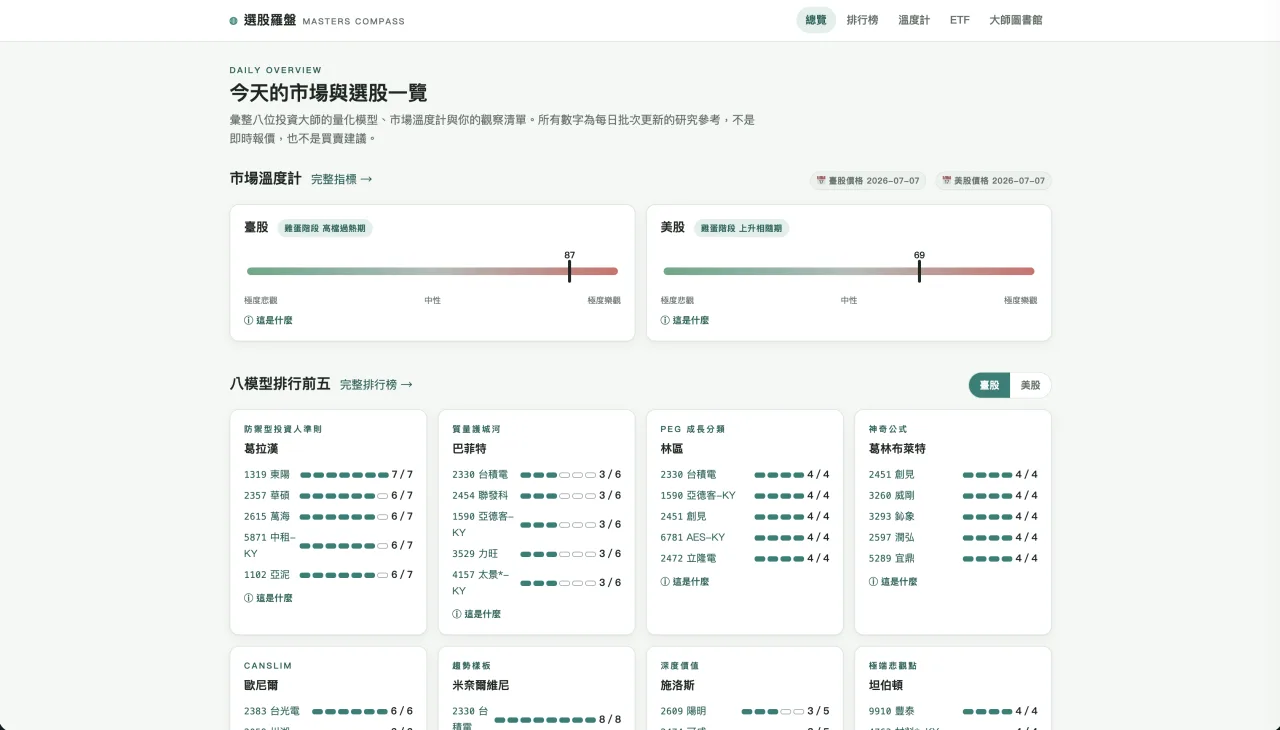
*▲ Stock Picking Compass’ “Today’s Market and Stock Picking Overview”: All numbers are research references updated in daily batches, not real-time quotes, nor buying and selling recommendations. *
Its design is actually based on the literal practice of Teacher Giga’s words. I don’t want a machine that announces signs, but I want a compass that can be used by many pairs of eyes at the same time. Therefore, I wrote down the principles of sixteen investment gurus, eight of which are models that can be quantified and scored:
- Graham’s principles for defensive investors: the three lines of defense of scale, financial constitution, and price, seek undefeated first
- Buffett’s quality moat: a good business with high ROE, high gross profit, low debt, and long-term positive cash flow
- PEG growth classification of forest areas: first classify according to growth rate, and then use PEG pricing
- Greenblatt’s magic formula: double ranking of earnings yield and return on capital, cheap and profitable
- O’Neal’s CANSLIM: Earnings burst and price strength, operating in the direction of the market
- Minervini’s Trend Sample: Eight Moving Averages and Relative Strength, Buy Only the Second Phase of an Uptrend
- Schloss’ deep value: unpopular asset stocks with low price-to-book value ratio and low debt, diversified and waiting to return
- Templeton’s extreme pessimism: Compared with his own ten years of history, he is a bargain but still alive.
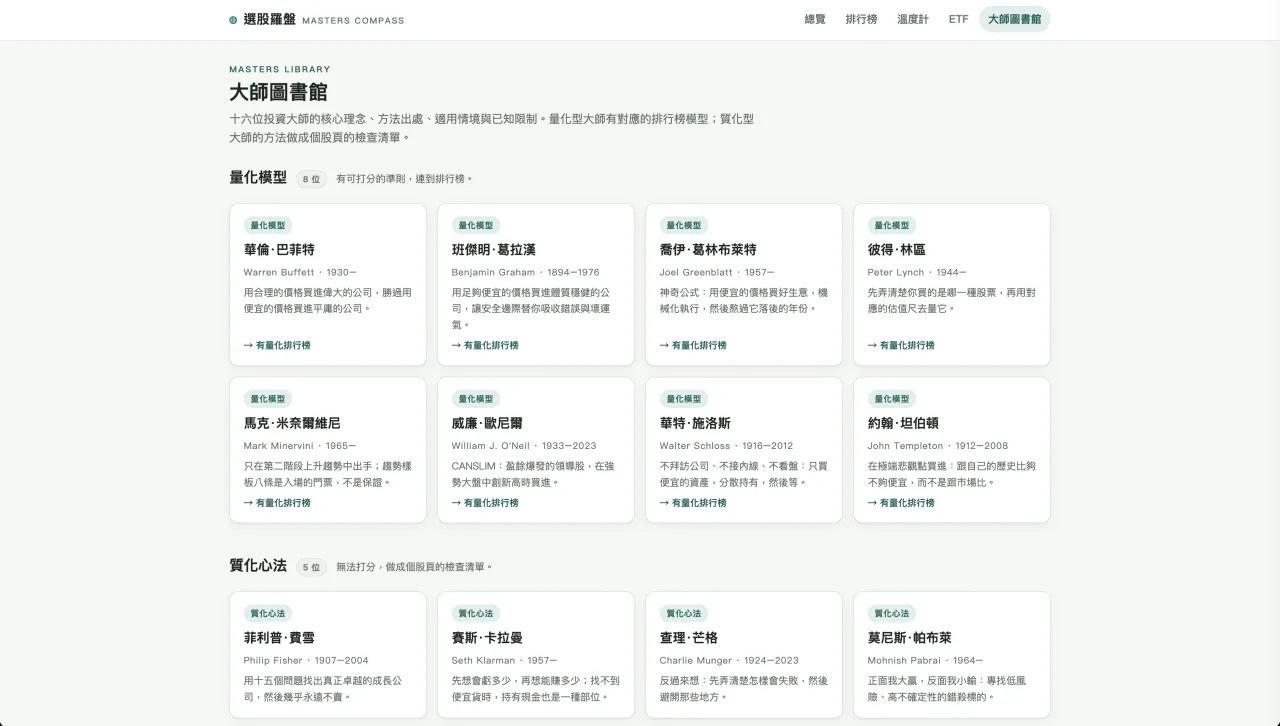
*▲ Master Library: Quantitative masters have corresponding ranking models, and qualitative masters’ methods are made into a checklist for individual stock pages. *
For the thermometer, I borrowed Marx’s pendulum (from extreme pessimism at 0 to extreme optimism at 100) and Kostolany’s egg cycle to see where the market is roughly currently in terms of sentiment. The ETF section pays tribute to Berg. All Taiwan stocks listed on the counter are scanned, plus the S&P 500 and Nasdaq 100 of the US stocks, and are updated in fixed batches every day.
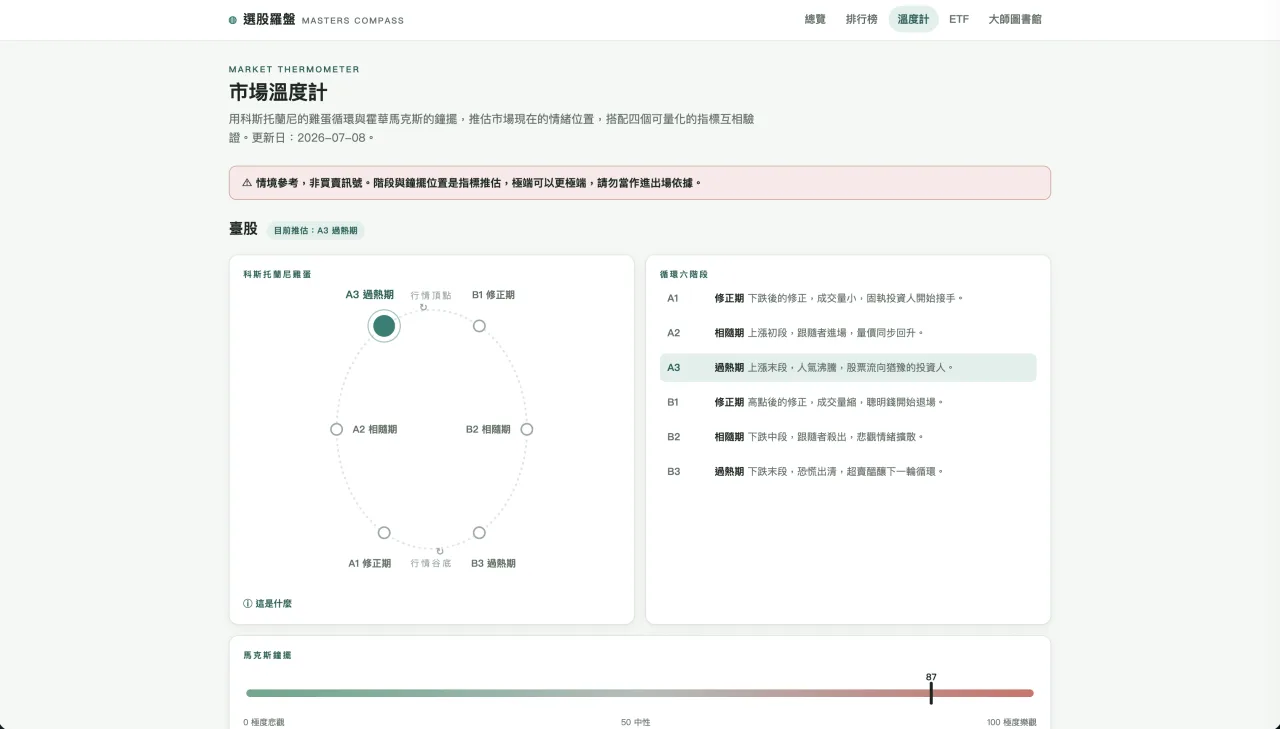
*▲ Market Thermometer: Use Kostolany’s egg cycle and Max’s pendulum to estimate the current emotional position of the market. This is a situational reference, not a trading signal. *
Let me make it clear: every number on the compass is a research reference, not an instant quote, nor a buying and selling recommendation. It doesn’t tell me “buy this.” What it does is lend me the eyes of eight masters, allowing me to use their respective standards to see clearly on the same day and the same stock. In the same category of TSMC, Minervini’s trend model received a perfect score of eight points, but Buffett’s moat only received three points. This gap itself is information. Understand the gap, and the decision-making is still my own.
Want to learn hands-on AI with me? See upcoming courses →
The same mentality works on another battlefield.
Teacher Giga is talking about investment, but “using AI as a co-pilot and keeping judgment in your own hands” is applicable to any professional battlefield. Taking research and writing, which I am most familiar with, as an example, the principle is exactly the same: AI can help you speed up document collection and help you revise manuscripts, but the core problem awareness and insights still have to be developed by you. I have fully discussed this set of ideas in “Don’t Just Learn AI Tools: How Researchers Can Create a Repeatable Academic Co-Pilot”.

*▲ If your battlefield is papers and research, welcome to my AI Empowered Academic Research and Writing Practical Workshop (opens in a new tab): Use AI Agent (Claude Code/Codex) as a research co-pilot to run through the complete workflow from methods, literature collection to manuscript revision. Emphasize assistance rather than ghostwriting, and the core thinking still comes from yourself. *
Write at the end
Why do it yourself? Because I feel that after practicing it myself, I can better understand the details; and then I can learn more by subscribing to a professional service like Dr.Bull (opens in a new tab).
In this way, two things that I believe in are brought together. Teacher Giga said that when investing, you need to establish your own values and use AI to create your own signboard; and the spirit of vibe coding, to put it bluntly, is: it is up to you to define what the tool looks like, what information it collects, and who it serves. Start by doing vibe coding first, and learn to write your own judgment line by line. Teacher Giga has a good saying: The real asset is not just money, but also your knowledge. Therefore, for me, this stock picking compass is not so much a stock picking tool as it is the process of forcing myself to understand how the eight masters view the world. In the moment of development, I learned more than it calculated. This also confirms what I often say: 〈AI is a magnifying glass, not a magic wand〉, it will only honestly magnify what you already have.
It is true that investment is a subject that you and I cannot avoid in our lives. Since you can’t escape, use a compass you polished yourself and move forward slowly. If you also want to turn AI into a digital asset that can compound interest, welcome to take a look at the physical courses and workshops (opens in a new tab) I opened at solo.tw.
Next step
Bring this topic to your team
Vista Cheng speaks and runs workshops on AI workflows, writing and content systems for companies, schools and public agencies.