Book review of "Open to Work": When AI starts to take over your job, what value will you have left?

In recent years, when I teach in companies, I often encounter an interesting phenomenon.
Obviously everyone knows that AI is important and has begun to use generative AI tools such as ChatGPT and Claude. But whenever I ask, “How do you think AI will change your work?” there is always a brief silence.
Some people worry that their jobs will be replaced, while others believe that as long as they learn to use AI, they can remain competitive. Some people hold a more optimistic attitude and feel that they are engaged in work that requires professional experience and interpersonal interaction, and they should not be greatly affected in a short period of time.
However, I increasingly feel that these ideas actually ignore a more fundamental issue.
When AI has begun to change the tasks we perform every day, even if our job titles have not changed, have our jobs already become different?
I recently read “Open to Work: How to Get Ahead in the Age of AI (opens in a new tab)” (published in Traditional Chinese as 《工作大重組》), which gave me a deeper thought on this issue.
The book is written by LinkedIn CEO Ryan. Ryan Roslansky and Minister of Economic Opportunity Anish. Co-written by Aneesh Raman, the Chinese version was translated by Wu Kailin and published by Tianxia Magazine.
Compared with books that generally talk about AI trends, this book’s approach is quite interesting. The two authors do not simply tell us what new tasks AI can accomplish based on technological development, but rather try to answer a question that is closely related to everyone through the changes in the global workplace observed through the LinkedIn platform:
When the rules of work are being rewritten, how can we re-understand our own value?
After reading it, my biggest feeling is that this is not just a book discussing how AI affects the job market, but more like an invitation to remind us to re-evaluate our life assets.
Because in the AI era, what really needs to be reorganized is probably not just resumes, but our entire understanding of work, majors, and careers.
Your job is not your job title, what really matters is what you do every day
In the past, I served as a media editor and product director, and also worked in business management and content marketing. Now, in addition to writing books (opens in a new tab) and operating content platforms, I am often invited to serve as corporate lecturers and consultants, and I also teach at universities and conduct academic research.
If someone asks me: “Teacher Vista, what do you do?”
To be honest, it may take me a while to give a more complete answer.
However, these seemingly different work experiences in the past made me particularly impressed by a point in the book when I read “Open to Work”.
That is: your job is not your job title.
We are accustomed to using professional titles to understand a person’s professional abilities. When someone tells us that he is a financial analyst, we probably think of financial statements, budget preparation and data analysis; if he is a marketing manager, we think of market research, advertising and brand management.
However, if you think about it carefully, is it really only analyzing financial statements that a financial analyst does every day?
He may also need to explain the business significance behind the numbers to his supervisor, coordinate resources with other departments, and even make recommendations related to business operations with incomplete information.
Likewise, a marketing manager’s job isn’t just about writing copy, creating newsletters, or operating advertising platforms. He also has to understand market changes, grasp consumer psychology, coordinate cross-department cooperation, and make resource allocation decisions within a limited budget.
Although these tasks belong to the same position, they require completely different abilities.
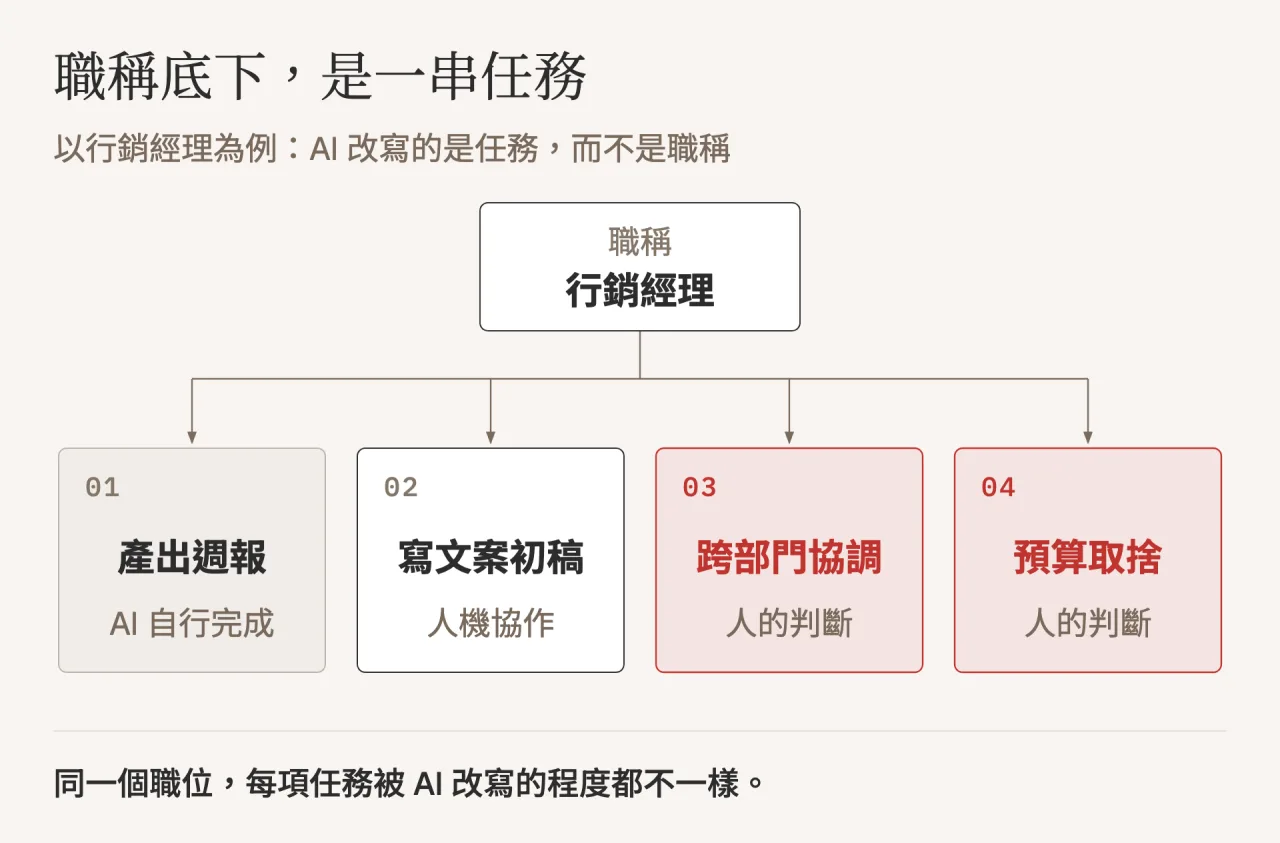 *▲ Under the same professional title, each task is rewritten by AI to a different extent. *
In the past, companies used job titles and job descriptions to define employees’ work scope, as if each person was a fixed piece of the organization’s puzzle. But the emergence of AI is breaking this position-centered division of labor.
AI doesn’t care whether you are a manager or not, and it won’t be particularly polite to your work content just because you are a senior employee. What it changes is the tasks you actually perform every day, and changes in these tasks will gradually reshape your position.
I think this is why we shouldn’t just ask: “Which professions will be replaced by AI?” (I have written about “The Beauty and Sorrow of PM” before, talking about the same thing: the job title is still there, but the jobs in it have been changed a long time ago.)
What’s more worth thinking about is: “In my current job, which tasks can already be handed over to AI? Which tasks need to be redesigned? And which tasks should I invest more time and energy in?”
Once this question is asked correctly, our anxiety about AI will have the opportunity to be transformed into more concrete actions.
The most alarming thing is not that AI replaces jobs, but that you still use old methods to prove your worth.
The book proposes a practical “three-category task framework” and recommends readers to first list the twelve most important tasks in their daily work, and then classify them according to the degree to which AI can participate.
The first category is tasks that AI can complete by itself, such as producing standardized reports, organizing structured data, performing fixed rule checks, or answering common questions.
The second category is tasks where humans can collaborate with AI, such as using AI to analyze market data, and then marketers determine which signals are worthy of attention; or let AI assist in producing the first draft of copy, and then the author integrates his or her own experience, brand personality, and understanding of the reader.
The third category is the tasks highlighted in the book that require unique human strengths, including building trust, handling complex interpersonal relationships, making ethical judgments, and making decisions in situations full of uncertainty.
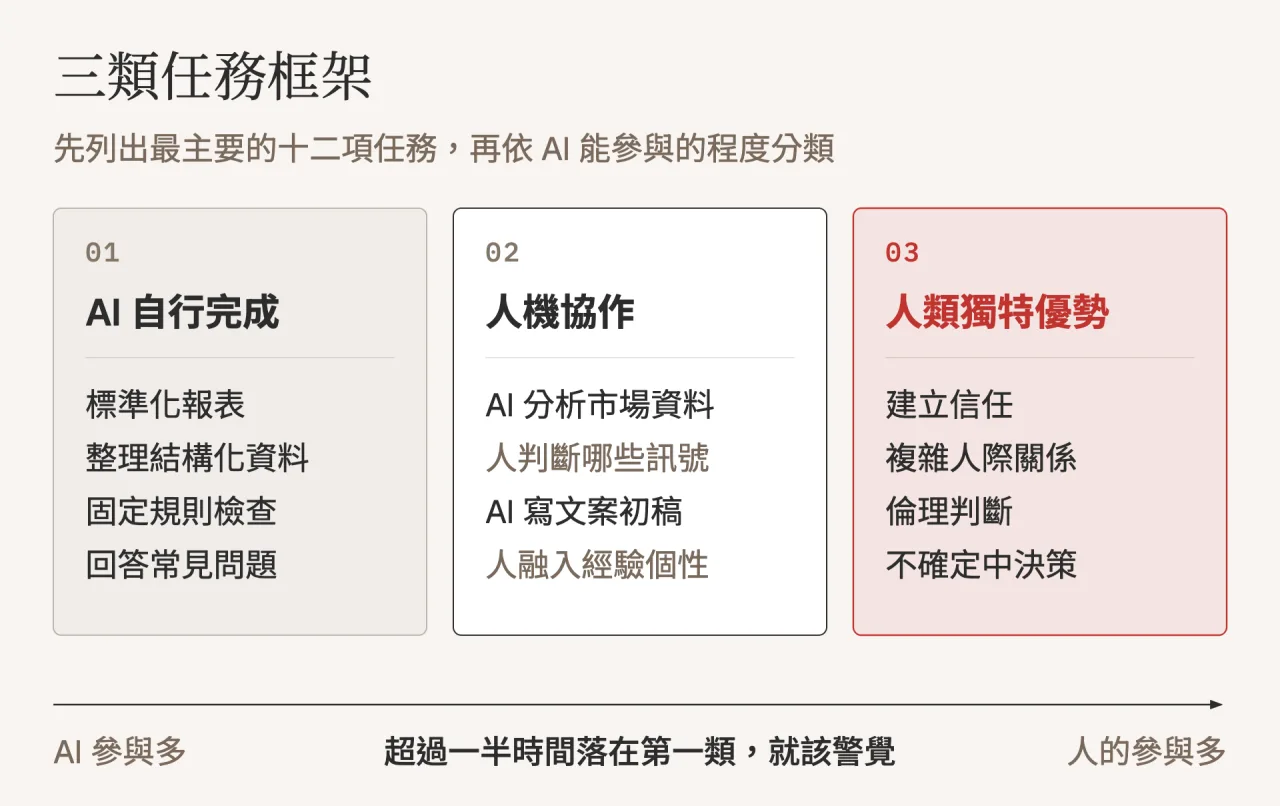 *▲ First list the twelve tasks, and then see which column your time falls on. *
This set of categories reminds me of my own work transitions over the past few years.
Take writing a business column as an example. In the past, I might have spent a lot of time collecting information, organizing research reports, comparing information from different sources, and then slowly coming up with the structure of the article.
Now, I can ask AI to help search and compile research clues, analyze data, suggest possible directions for discussion, and even help check whether there are logical loopholes in the article.
Of course, the information and references provided by AI still need to be checked, but compared to the past, the entire workflow has indeed changed a lot.
However, here comes the fun part.
When AI can quickly produce a business article with a complete structure and smooth writing, what value is left for me as a writer?
Is it typing speed? no.
Is it possible to write 3,000 words in a short time? Probably not.
I think the things that are really worth investing in are the things that the AI can’t easily decide on its own.
For example, why is this issue worth discussing now? Does a seemingly beautiful research data hide a questionable premise? Does a successful case of a foreign company really have reference value when placed in the business context of Taiwan’s small and medium-sized enterprises?
More importantly, when everyone is talking about the same trends, can I offer a different perspective based on my media experience, corporate consulting work, and academic research?
These questions are the abilities that I think writers should continue to hone.
The book warns against heavy reliance on the first type of tasks. If more than half of a person’s working time is spent on routine, predictable tasks, it’s worth thinking carefully about future job risks.
But I would further add that just because tasks can be automated, it does not necessarily mean that entire positions will disappear.
Whether an enterprise introduces AI is still affected by factors such as cost, quality, regulations, organizational culture, and customer trust. Even if certain jobs can technically be automated, it doesn’t mean companies will immediately eliminate relevant positions.
Therefore, we do not necessarily view the three-category task framework as a formula for accurately predicting unemployment risk.
It is more suitable as a mirror to help us see where our working time is spent and the direction in which we can adjust it in the future.
For me, what we really need to be vigilant about is not how many tasks we still have that can be taken over by AI, but whether we are still clinging to old work habits when these tasks have new ways of completing them, and continue to use past output to prove our professional value.
When AI makes answers cheap, judgment becomes an asset worthy of long-term investment.
This book reminds me of a concept that I often share when I teach in companies recently:
As answers become cheaper, judgment becomes more worthy of our long-term investment. (I have a more complete explanation of this concept in “When the answer becomes worthless, judgment is your only compound interest asset”.)
In the past, companies often hired professionals because they had knowledge that others did not have or could do things that ordinary people could not do.
For example, you know how to write programs, analyze financial data, create beautiful presentations, or have professional knowledge in a specific industry.
Of course, these capabilities will not suddenly lose all value just because of the emergence of AI. But as tools become more ubiquitous, it may indeed become more difficult to maintain a competitive advantage solely by relying on the operational capabilities of a certain technology.
Take Vibe Coding (opens in a new tab), which I recently invested in, as an example.
In the past, if I wanted to develop an online tool to help marketers check copywriting, I might first need to learn a programming language, be familiar with databases, or find an engineer to help develop it.
Now, through AI program development tools, I can use natural language to describe product requirements, work with AI to design functions, modify programs, and gradually transform ideas into products that can be actually operated.
But this does not mean that as long as I can talk to AI, I can make tools with commercial value.
The really difficult thing actually happens before writing the program.
I must first understand what difficulties users encounter in the copywriting process, determine which problems deserve priority, design a reasonable usage process, and confirm through actual testing whether the product can really help users.
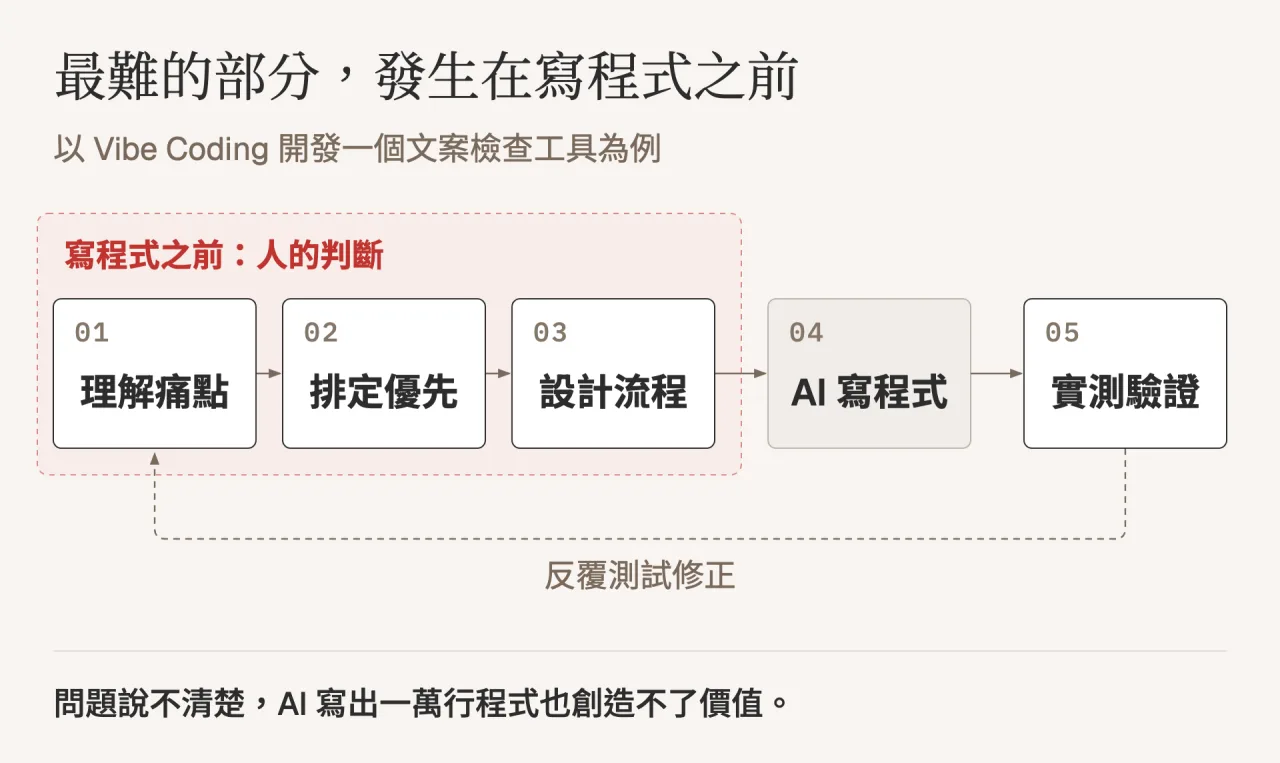 *▲ Among the five steps, only one step is actually handed over to AI. *
If I can’t even explain what problem I want to solve, even if AI can help me write 10,000 lines of code, it may not be able to create any real value.
This is another point I particularly want to emphasize when reading the three types of tasks proposed in this book.
AI can help complete more and more things, but we cannot ignore our own ability to understand problems.
In fact, AI can even help us analyze problems, propose strategies, and simulate different viewpoints. The so-called unique human abilities should not be understood as a list that will never change.
What really matters may be whether we can continue to improve our ability to understand situations, evaluate evidence, identify risks, and take responsibility for final decisions with the assistance of AI.
Tools can help us expand our capabilities, but they shouldn’t make us stop thinking.
What needs to be re-understood most in the AI era may be those abilities that used to be called “soft skills”
Another thing that impressed me about “Open to Work” is that the two authors put human capabilities back at the core of work change.
In the past, when companies talked about talent development, they often divided skills into hard skills and soft skills.
The former includes abilities such as programming, data analysis, and financial management that can be measured through specific technologies and knowledge; the latter includes abilities such as communication, collaboration, creativity, empathy, and problem solving.
In many workplace situations, hard skills are often easier to see and more easily become the basis for evaluation during recruitment and promotion.
However, when AI can help handle more and more professional tasks, those abilities that were originally regarded as bonus points may actually become an important factor in determining work results.
The book specifically proposes the “5C Human Advantages” to remind readers to pay attention to human capabilities in the AI era. These five Cs are curiosity, courage, creativity, empathy and communication. I have broken them down one by one in “Five Things AI Can’t Do: 5C Framework Taught by LinkedIn CEO”.
For me, a person who has been engaged in teaching and business consulting for a long time, this point of view is particularly worth pondering.
I discovered in class that even if two students use the same AI tool and enter similar prompt words, the final results may still be very different.
The reason is not necessarily that one person is more familiar with the tool, but that they have different levels of understanding of the problem.
Some students just want AI to help them get things done; some students will continue to ask: Why do we do this? What assumptions goes into this answer? Is there a solution that is more suitable for your company?
The latter usually have a better chance of turning the AI’s output into real results.
Let’s take corporate consulting work as another example.
When a small and medium-sized enterprise hopes to introduce AI, the real difficulty is often not that the tool is not powerful enough, but that supervisors and employees have different imaginations about the introduction goal.
The boss may want to improve efficiency and reduce costs, but employees are worried that their jobs will be replaced. The information department is concerned about data security, while the business department hopes to see results as soon as possible.
In this case, simply introducing an AI system does not guarantee a successful transformation.
You also need someone who can understand the needs of different stakeholders, help build consensus, redesign work processes, and make organizational members understand the purpose of the change.
These capabilities are difficult to fully measure with a technical certificate, but they may directly affect the success or failure of an AI introduction project.
Therefore, I believe that future talent cultivation should not only focus on teaching employees which AI tools to operate.
We also need to help them develop communication skills, critical thinking, problem definition, and the ability to make judgments in complex situations when working with AI.
The so-called soft skills are not called soft skills because they are not professional enough.
On the contrary, when the threshold for technical operations is gradually lowered, these abilities that require long-term experience accumulation are more worthy of being re-viewed. (Extended reading: 〈Taste × Judgment: Two weapons for professionals in the AI era to refuse to be reduced to machine OEMs〉)
Career is no longer a ladder, but a climbing wall where you can re-choose your direction.
I really like another metaphor in the book: Career is no longer a ladder that can only be climbed up, but more like a climbing wall.
In the past, our imagination of a successful career was usually a relatively clear straight line.
From junior employees to senior specialists, then to managers, directors, and finally to senior management. Higher professional titles and more people under management seem to mean more and more successful career development.
However, real life does not always follow this path.
Some people originally worked in the media and later turned to brand marketing; some worked as corporate executives for many years and finally decided to devote themselves to teaching and consulting; and some returned to school to study for a degree after accumulating rich industrial experience.
If viewed through the lens of a traditional career ladder, these transitions may appear inconsistent or even considered a detour.
But from the perspective of the climbing wall, the situation is different.
Climbers don’t necessarily have to go straight up; sometimes they have to move sideways to find a new fulcrum before continuing forward. (When Honnold was free-soloing Taipei 101 earlier this year, I also wrote an article titled “Learn career ladder thinking from extreme athletes”, which you can read as a reference.)
Similarly, a person’s career development does not have to be limited to the same department, the same position, or even the same industry.
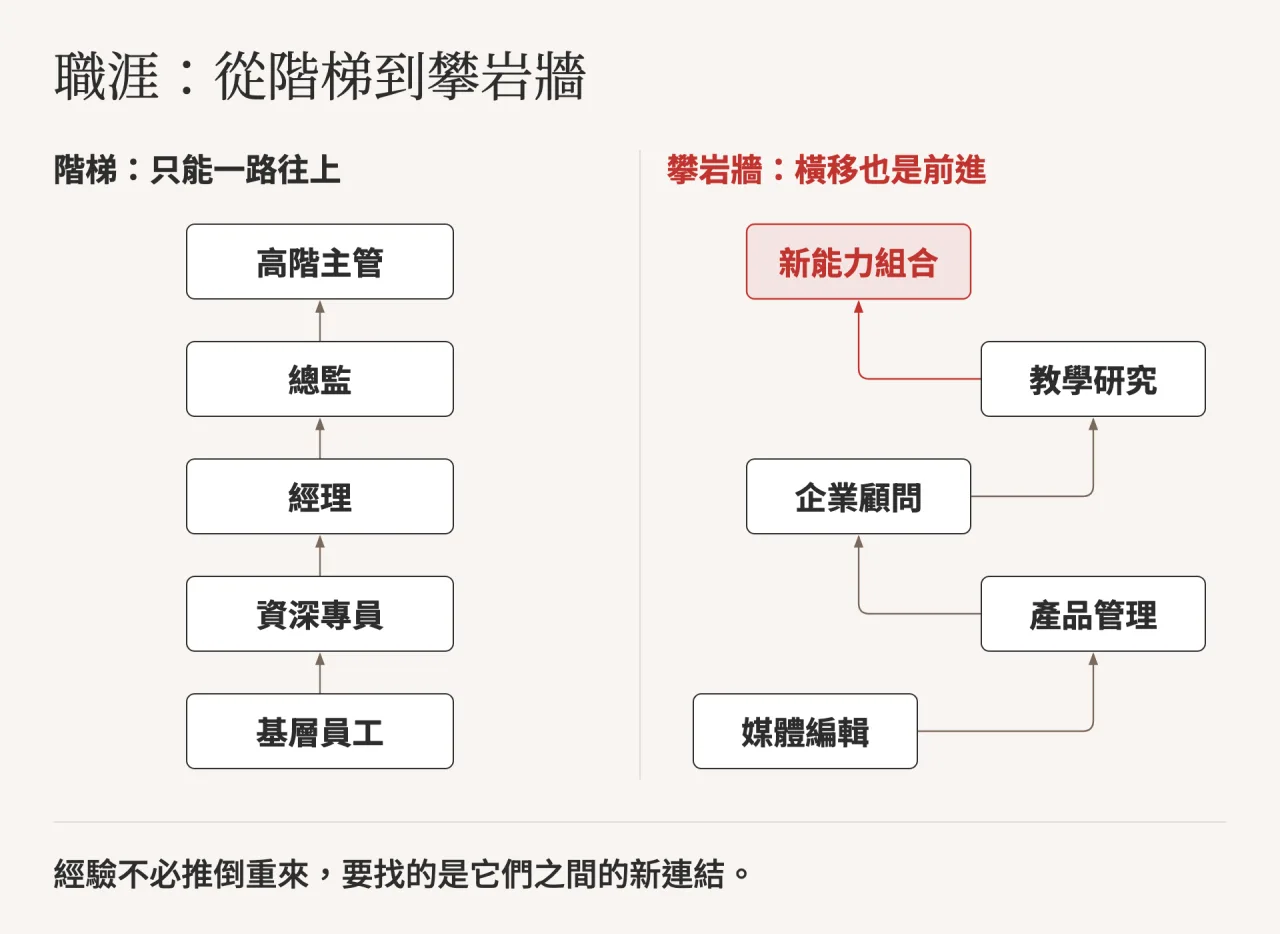 *▲ The right side is my own route. Every time I move later, it becomes a new fulcrum. *
Looking back on my career, I feel particularly fond of this metaphor.
From media editing and product management to content marketing, corporate consulting, teaching and academic research, these experiences may not necessarily seem to belong to the same career path at first glance.
However, when I began to study the applications of generative AI, I found that these seemingly scattered experiences were creating new connections.
Media work allows me to understand how information is selected, organized, and disseminated; product management experience allows me to pay more attention to user needs and work processes; corporate consulting work gives me the opportunity to observe business issues in different industries, and academic research reminds me that I cannot draw conclusions about complex phenomena based on intuition or a few cases.
When these experiences are combined with AI tools, I am able to understand the same problem from a different perspective.
Therefore, I increasingly believe that future career competitiveness may not come from how far you go on the same path, but may also come from whether you can transform the experience accumulated through different paths into a new combination of abilities.
This perspective is especially important for friends who have been working for ten, twenty, or even longer years.
We don’t necessarily need to overthrow all the experience we have accumulated in the past, and we don’t have to think that we can’t participate in the work revolution in the AI era just because we don’t have an information engineering background.
On the contrary, the industrial knowledge, interpersonal network, management experience and professional judgment accumulated in the past may become important fulcrums for us to reposition our careers.
The key is whether we are willing to break away from our original job titles and re-see the connections that can be made between these experiences.
From organization chart to work chart: Enterprises cannot just require employees to learn AI without changing the way they work.
This book is not only suitable for personal reading. I think it is also worth the time for business leaders and human resources departments to consider the organizational perspective.
In particular, the book shifts from organization charts to the concept of work maps.
In the past, when companies planned their work, they usually decided which departments were needed, how many employees they would need, and what tasks each position would be responsible for.
For example, the marketing department is responsible for branding and advertising, the business department is responsible for customer development, the customer service department is responsible for handling customer problems, and the information department is responsible for maintaining the system.
This division of labor is necessary, but as AI can assist in completing tasks across different positions, companies also need to rethink: Which tasks should be done by humans? Which ones are suitable to be left to AI? Which ones require redesigning the way humans and AI collaborate?
I once encountered a common situation when teaching in companies.
The company spends a lot of budget on AI education and training, and employees also take classes seriously and learn to use various tools. However, after returning to the work site, the original operating procedures, performance indicators, and supervisor’s management methods have not changed at all.
As a result, although employees have learned AI, they don’t know how to actually use it in their daily work.
There are even some people who are already very busy and are now required to study additional AI, which in turn increases their workload.
This reminds me that companies cannot reduce AI transformation to an education and training program.
If a company hopes to use AI to improve the content marketing process, in addition to teaching employees to use generative AI, it must also rethink the division of labor between content planning, data collection, first draft writing, fact checking, review, and publishing.
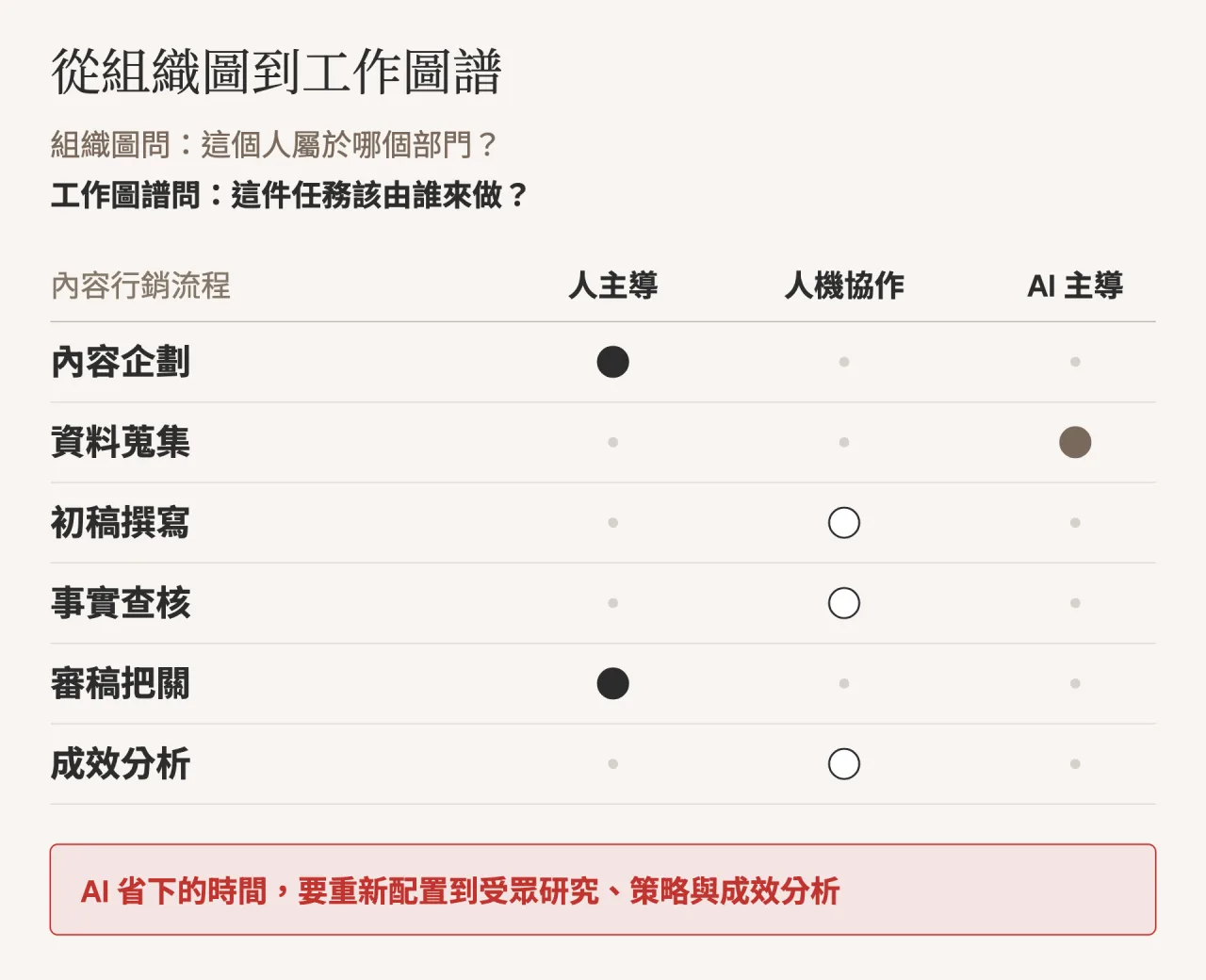 *▲ The organization chart looks at which department people are in, while the work map looks at who should do everything. *
If AI can already help organize research data and produce first drafts, should marketers devote more time to audience research, content strategy and performance analysis?
Should supervisors also adjust their performance evaluation methods and no longer simply use the number of articles produced and the number of pictures produced per week as the main basis for measuring work performance?
Similarly, when an enterprise introduces an AI customer service system, it should not only count how many messages the system automatically replies.
It is also necessary to think about which problems can be safely handed over to AI, which situations must be transferred to human customer service, and how to allow employees to devote more time to solving complex problems and operating customer relationships.
From this perspective, the real difficulty in AI transformation is not to purchase a new set of software, but to redesign the way of working. (When reading “Inverse Division of Labor”, I had a similar experience: when one person can command an AI team, the unit of division of labor is no longer a department, but a task.)
I even think that an important ability that future business leaders need to cultivate is to understand the organization from the perspective of work tasks, rather than just thinking about resource allocation in terms of department establishment and number of employees.
Of course, job mapping shouldn’t just be about finding out who can be replaced by AI. Enterprises also need to consider employee training, workload, career development and responsibility attribution in order to truly transform technology introduction into organizational capabilities.
An academic certificate is no longer enough, but learning cannot just be about chasing the latest tools.
As someone who continues to be involved in academic research and also teaches in companies, public sectors, and universities, I am also very touched by the part of this book that discusses education and talent cultivation.
The book reminds us that the past model of completing school education first and then working for decades relying on the knowledge learned is facing new challenges.
This is not to say that academic qualifications are no longer important, but that the knowledge base established by school education may not fully cover the changing work needs in the coming decades.
I often meet some very serious students at the teaching site.
They subscribe to several sets of AI tools, participate in various online courses, and continue to track the latest technological developments. However, when I asked them further: “After learning these tools, what specific changes have occurred in your work?”
Some people find it harder to answer.
This got me thinking, why do some people spend a lot of time studying but are not necessarily able to transform knowledge into work results?
I think one of the reasons is that we are too accustomed to understanding learning as the continuous accumulation of new knowledge, but rarely look back to check whether this knowledge has actually changed our actions.
Learn a set of AI tools today, and a new product with more powerful functions will appear tomorrow. If learning is just about constantly chasing the update speed of tools, we can easily fall into the anxiety of never finishing learning. (I talked about how to get out of this cycle in “Don’t Just Collect AI Tools: Four-Step Design Workflow”.)
Therefore, I prefer to understand learning in the AI era as a process of continuous accumulation of abilities.
It’s not about learning ten prompt words today and memorizing twenty operational skills tomorrow, but starting from the problems you really need to solve and through repeated practice, gradually building up the ability to span different tools and situations.
For example, a marketer learning AI should not stop at letting the tool help generate social posts.
He can also further think about how to use AI to help analyze customer needs, design content strategies, evaluate marketing results, and accumulate his own understanding of the market and consumers from practical operations time and time again.
Such learning outcomes will not be completely tied to a specific set of tools.
Even if more powerful AI models emerge in the future, he can still transfer his accumulated professional knowledge and methods to new work situations.
I think this is the learning compound interest worth pursuing in the AI era.
Really valuable learning not only allows you to know a little more today than you did yesterday, but also allows you to have more abilities that you can use when facing different problems tomorrow.
How would I turn this book into an experiment in AI work reorganization?
When I read the thirty-day, sixty-day, and ninety-day action plans proposed at the end of this book, I especially thought of my own teaching work.
In the past, many corporate AI courses tended to focus on tool introduction and operational exercises. Students are easily surprised when they see the various functions of AI in class, but when they return to work, they may not know how to start changing the original way of working.
If I want to transform the views of “Open to Work” into a practical learning plan, I would like to design a ninety-day “AI Work Reorganization Experiment.” This is not to ask everyone to learn all AI tools in ninety days, but to help students re-examine their work, find out what is worth changing, and gradually build new capabilities through small-scale experiments.
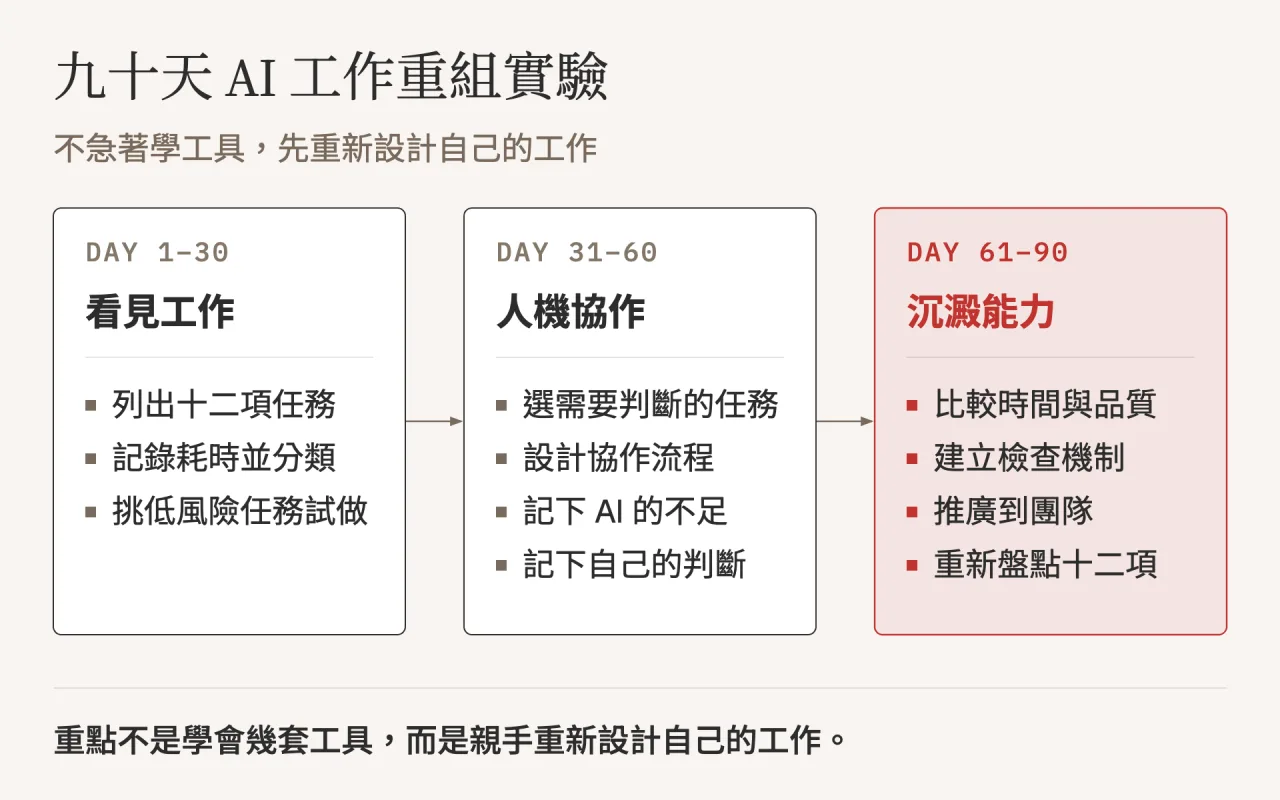 *▲ Three months, three stages, only doing a few things in each stage. *
Phase 1|Days 1 to 30: See your work instead of rushing to learn tools
First, students are asked to list their twelve most important daily work tasks, record the approximate time required for each task, and then classify them according to the degree to which AI can complete it by itself, human-machine collaboration, and requires a high degree of human participation.
Next, pick a highly repetitive, relatively low-risk task and try to use AI to improve the process. For example, organizing meeting minutes, summarizing frequently asked questions from customers, or assisting in the production of standardized reports.
The goal at this stage is not to save a lot of manpower immediately, but to first establish an understanding of your own work process and identify areas worthy of priority improvement.
Phase 2 | Days 31 to 60: From single tool operation to complete human-machine collaboration
In the second month, you can further choose a job that requires professional judgment and design a new AI collaboration process.
For example, let AI assist in analyzing market data, and then let marketers determine how to adjust brand strategies; or let AI assist in analyzing customer service records, and then let the service team discuss how to improve customer experience.
At this stage, I will specifically ask students to record what shortcomings the AI output has, what areas need manual correction, and what experience and judgment they have used in the process.
Because the focus of human-machine collaboration is not just to let AI do more things, but also to re-understand where humans should play a role.
Phase 3|Days 61 to 90: Transform experimental results into new capabilities that can continue to operate
In the third month, you should look back and review the results of the previous two stages.
In addition to comparing whether working hours have been shortened, it is also necessary to evaluate output quality, error rates, customer satisfaction, and whether employees have more time to devote to high-value work.
If the experiment is effective, you can further organize the new workflow, establish the necessary inspection mechanism, and consider whether it is worth promoting to other members of the team.
Finally, students are asked to re-examine their twelve work tasks to see what changes have occurred in work content and ability requirements after the ninety-day experiment.
I believe that this kind of learning method has a better chance of truly integrating AI into daily work than simply requiring employees to learn a number of AI tools.
Because when a person personally completes the work reorganization experiment and sees that the way he works has indeed changed, he no longer just passively waits for the company to tell him what to learn, but begins to have the ability to proactively design work.
This is the long-term value I hope AI education and training can bring.
After reading this book, I want to ask more: To whom will the efficiency dividends brought by AI flow in the end?
Although “Open to Work” provides a quite positive view of career transformation, I think that in addition to how individuals can improve their competitiveness, there are several issues worthy of further consideration.
First of all, when AI can significantly improve work efficiency, will the time saved give employees the opportunity to engage in more valuable work, or will the company further increase output requirements?
The book mentions that according to research conducted by Microsoft and LinkedIn (please refer to the “2024 Work Trend Index (opens in a new tab)” jointly conducted by both parties), interviewed workers who use AI said that AI can help them save time, focus on important work, and stimulate more creativity.
These results are indeed promising, but we cannot ignore another possibility.
When a marketer used to only be able to complete two articles a day, but now can complete six through AI, will the company allow him to invest the extra time in market research and strategic planning, or will he be required to produce twelve articles a day?
If management methods do not change, the efficiency improvements brought by AI may not directly translate into a better work experience.
Secondly, when companies increasingly emphasize that employees must continue to learn AI, who should bear the time and cost of learning?
For professionals with ample resources, it may be relatively easy to subscribe to tools, attend courses, and invest time in researching new technologies.
But for people who must work shifts, have family care responsibilities, or whose work environment lacks digital resources, continued improvement of AI capabilities may come at a higher cost.
If we only tell everyone that they must speed up their learning, but do not provide corresponding training resources and work support, is it possible that the existing gap in the workplace will further expand? (This also echoes my observation in “AI is a magnifying glass, not a magic wand”: What AI magnifies is often the original gap.)
Finally, I also want to remind myself that all career risks in the AI era cannot be attributed to an individual’s willingness to learn.
In addition to depending on one’s own ability, a person’s job opportunities are also affected by factors such as industrial development, corporate investment, labor system and the overall economic environment.
Although individuals can take the initiative to learn and reposition themselves, companies and institutions also need to take responsibility and create conditions that allow more people to participate in transformation.
To me, these problems do not weaken the value of this book’s emphasis on proactive actions. Instead, they allow us to see more clearly that the reorganization of work in the AI era is not only a competition to upgrade personal capabilities, but also a deep change in how corporate management and social opportunities are redistributed.
Redefining your own value may be the most important career lesson in the AI era.
After reading “Open to Work”, I remembered the process of constantly trying new tools, investing in academic research, and starting to develop various AI applications in the past few years.
Looking back, none of these attempts seems to have followed a very clear path.
Sometimes, I am studying how AI affects the construction of media issues; sometimes, I teach students in corporate classes how to use AI to improve work processes; sometimes, I sit in front of the computer and try to turn a sudden idea into a gadget that can be actually used.
In the past, I might have felt that these things were too scattered and that I should focus more on a certain area in order to establish a clear professional positioning.
But after reading this book, I began to understand these experiences from a different perspective.
Perhaps, in the AI era, what really matters is not whether we can summarize our job title in one sentence, but whether we can continue to discover the connections between different experiences and transform them into the ability to solve new problems.
This also reminds me that when I gradually shifted from media work to content marketing, teaching and consulting work, I had no idea in advance what kind of person I wanted to be in the future.
Many times, just because you encounter an interesting problem, you invest in research; you find that a new tool can solve things that you couldn’t do in the past, and you start to try it.
These seemingly accidental choices eventually gradually accumulated into who I am now.
Therefore, for those friends who are thinking about the next step in their careers, what I want to share is not the anxiety-creating slogan of “Learn AI quickly or you will be eliminated.”
Instead, I would like to invite everyone to find a quiet time to reorganize their work and life experiences.
Think about it, what do you spend the most time doing every day? Which of these can already be done by AI? When you no longer need to devote so much time to repetitive tasks, what really important things do you want to focus on?
Furthermore, could those experiences in the past that you felt were incoherent or even wasted become important assets in repositioning yourself in the future?
I believe there is no one-size-fits-all answer to these questions.
Some people may choose to continue to deepen their original major, some may try to develop across fields, and some may decide to leave a familiar working environment and start running their own business.
No matter which path we choose in the end, at least we can try not to place our value entirely on a professional title, an academic certificate, or the ability to operate a specific tool.
Because job titles may change, tools will continue to be updated, and the workflows that are familiar today may be completely new tomorrow.
But our past accumulated experience, our ability to understand problems, the way we build trust with others, and our attitude of continuous learning and adjustment in the face of uncertainty can still be an important foundation for starting over.
What is truly worth pursuing in the AI era is not that you will never be replaced, but that you always have the ability to re-create value.
This is also the reminder that I most want to take back to my own work and teaching scene after reading “Open to Work”.
When AI begins to take over the tasks we are familiar with, instead of asking ourselves what is left, we should think further:
Now, can I finally free up time to create values that I never had the chance to realize in the past?
Perhaps, this is what is really worth looking forward to in the work reorganization.
Further reading:
- Five things that AI cannot do: LinkedIn CEO personally teaches the 5C framework and becomes irreplaceable in the AI era
- Reflections on reading “The Supervisor’s Strongest Work Technique”: When AI can give answers, why do supervisors have to define their own questions
- After 1000 days, I care more about what kind of person we become: read “The Next 1000 Days”
- When answers become worthless, judgment is your only compound interest asset
📚 Book purchase link: “Open to Work: How to Get Ahead in the Age of AI” (Traditional Chinese edition: 《工作大重組》) (opens in a new tab)
Next step
Bring this topic to your team
Vista Cheng speaks and runs workshops on AI workflows, writing and content systems for companies, schools and public agencies.