Zhang Qiongwen, director of Tuka Power Plant, talks about the application of Tuka design in educational marketing
[ ](https://blogger.googleusercontent.com/img/b/R29vZ2xl/AVvXsEjIYnzkyaULRVBpzHhZsm8qbTefYIqqdI_IENTgPD2R-sNZslQYnbTBsj8wXulmF1SQrskMD29xbf35TQElAGG28rr twnZNEagiryCvxW7KMW8fOFYlgIcgQDSYMEBybEUxOd8sQkaCiQ_rxVm4dLBHpWrSgPEQ-u6sYn3x qq1z0-N4IU8sZvIRB3msXGaS/s2938/CleanShot%202023-07-16%20at%2017.39.29@2x.png)
Speaking of picture cards, I quite like them. They are a very good medium for disseminating knowledge. In several of my recent my works, the concept of picture cards has also been incorporated. So when I learned about today’s “[Trigger Design - Kuaiyi Meituka Educational Marketing](http://www.ttbf.org.tw/assets/pdf/web/viewer.html?file=/assets/uploads/monthly/month ly64994cbebe996.pdf)” lecture information, I originally thought of [Knowledge Graphic Card] (https://www.vistacheng.com/2020/12/knowledge-graphic-card.html), which I have dabbled in before. Later, after listening to Zhang Qiongwen, the director of Tuka Power Plant, I realized that this Tuka was not Bituka. Although the uses and attributes of these graphics cards are different, in addition to being eye-catching, beautifully designed education marketing graphics cards can also have a communication effect and are worthy of learning and promotion by interested friends.
This was the first time I heard the sharing from the director of Tuka Power Plant [Zhang Qiongwen] (https://www.facebook.com/profile.php?id=100082758276416), and then I realized that she has been working in the field of education for a long time, and her other identity is the curriculum supervisor of the Early Childhood Education Section of the Education Bureau of the Taichung City Government. I am very happy to hear this wonderful sharing on Sunday afternoon. Although I have never met Director Zhang, I still want to express my gratitude here.
Speaking of Tuka Power Plant, this is a cross-county and city-wide public welfare community focusing on topics such as educational marketing, graphic card production, and presentation of presentations. Director Zhang has served as a new media marketing lecturer for education Tuka in several county and city government education bureaus, and has actively tried to develop Tuka’s education marketing model by coaching teams, leading online communities, and running Facebook fan pages.
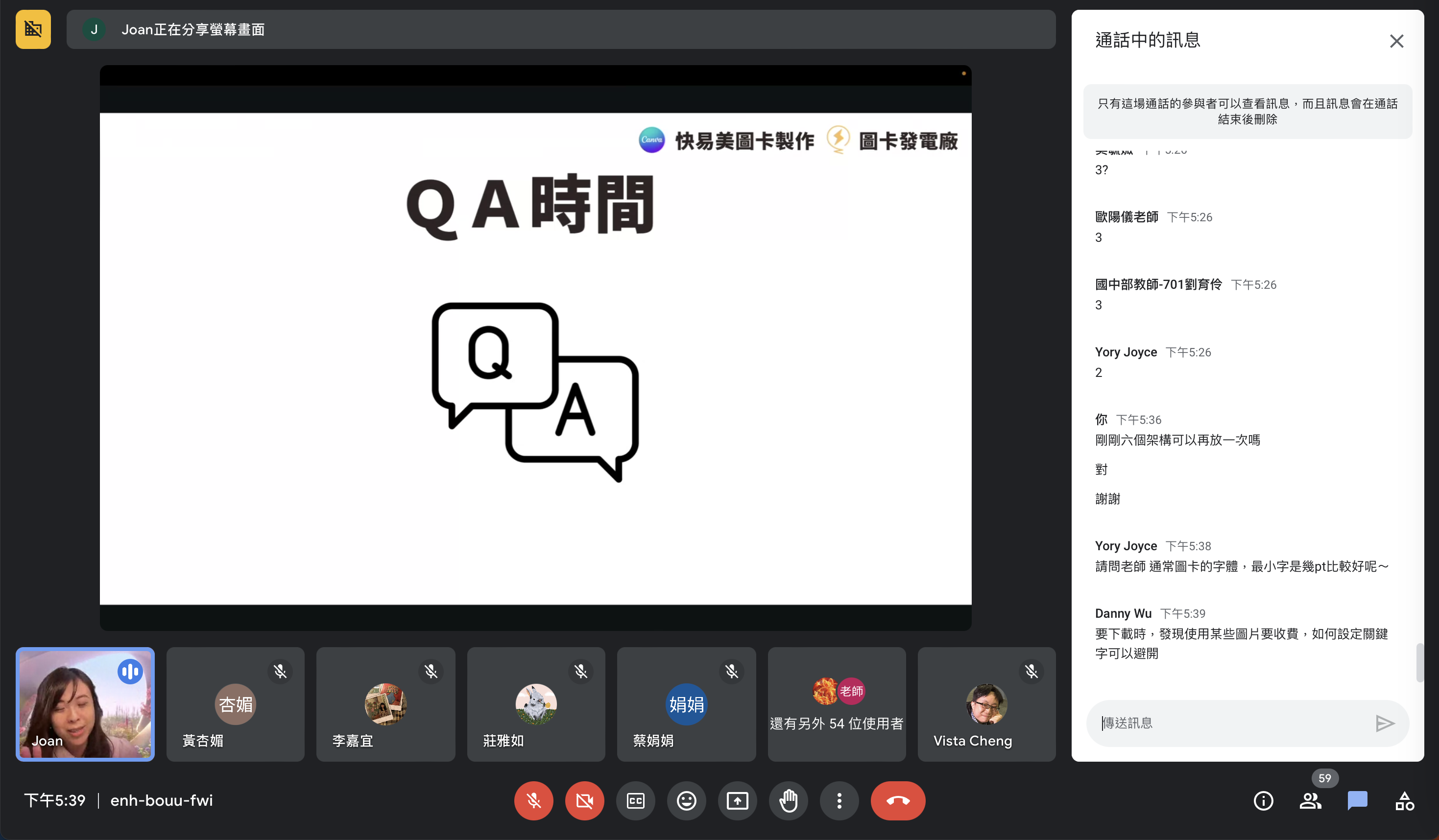
Director Zhang’s sharing in the afternoon today demonstrated the operation through online implementation. In the lecture, which lasted more than an hour, she taught everyone how to use the software Canva to create easy-to-use graphics cards. To put it simply, it means to quickly produce a picture card that allows the target audience to quickly grasp the key points.
She pointed out that the key point of the design of the picture card is not only to be easy to absorb and understand, but also to have an aesthetic feeling that can make everyone’s heart beat at the first sight and make them willing to stay on your picture for a few seconds longer.
The reason why she recommends everyone to use Canva to design picture cards is because it is a very good online tool that can not only be used by yourself, but can also be used to collaborate with multiple people. Canva also has several obvious benefits. In addition to being easy to use, its data is stored in the cloud, and it has a large amount of materials, which can be said to be quite convenient.
Director Zhang mentioned that he mainly uses Canva for drawing and making picture cards. She also mentioned that teachers can even use it as teaching aids or to design many beautiful pictures or presentations.
Regarding the design of picture cards, I believe that friends attending the meeting today have learned a lot of skills from Director Zhang. But the part that impressed me the most was how she deconstructed common graphics cards and applied them in the field of educational marketing.
In this era of information explosion, there are actually quite a variety of media available for people to spread knowledge. So why do we still make picture cards? Director Zhang pointed out that the graphics card is not only fast to produce and easy to use, but also has the advantage of cross-channel and cross-vehicle communication, so it is very suitable for use in public administration, business, advertising, education and other fields.
In addition, humans are originally visual animals, and the brain absorbs images 60,000 times faster than it absorbs text. Image-based content attracts 94% more eyes than plain text. According to statistics, humans can absorb 80% of the content from image messages and only 20% from text messages. These are also the advantages of picture cards compared with text messages.
[ ](https://blogger.googleusercontent.com/img/b/R29vZ2xl/AVvXsEjsAGcsJrkZ2zNB5N0m-rDbToG-WQt-hQSIt9Gqm5MJ1E2sUzlxXO_fOfHLSD5SSOQUst2Xzwkelz7nyNvyYfwn0yxC Xv4nYwOh0Qa-JU80rUDb7uERNnwXCE0pc9QlGmq1RtCTKhcB8ym4inW1is426ChJyYMBywNtpywo p5N03zZPp6T5jaQ988fla9JI/s1772/CleanShot%202023-07-16%20at%2017.35.32@2x.png)
In addition to the just-mentioned features of picture cards, such as fast production, ease of use, and aesthetics, Director Zhang specifically mentioned that in today’s social era, information about picture cards can be easily and quickly shared through social media such as Facebook and Instagram (https://www.instagram.com/vista/).
Think about it carefully, when we get a beautifully designed picture card, you may immediately repost it to your Facebook without thinking, or use LINE to send it to your relatives, friends, and partners. The benefit of picture cards is not only eye-catching. After we look at a certain picture card for a long time, you may be left with an impression of this picture card, and you may even identify with what it wants to express.
Through the design of picture cards, the target audience can move from eye movement, heartbeat to action.
When it comes to educational marketing graphics cards, they can be roughly divided into three categories: policy, achievement and news graphics. For those who are interested, I recommend that you read Director Zhang’s [masterpiece] (http://www.ttbf.org.tw/assets/pdf/web/viewer.html?file=/assets/uploads/monthly/monthly639983dbb094f.pdf).
Before officially starting to design the picture card, Director Zhang suggested that everyone think about a question first: Where does your information come from? I accidentally discovered that this is somewhat similar to the short video “Start with the end in mind” strategy mentioned by Director Shi.
For school teachers or civil servants, the information readily available often comes from public sector propaganda or policy white papers; for ordinary professionals, much of the information will come from industry activities.
Director Zhang said that each county and city actually has its own different sources of information. For example, the press release issued by the Education Bureau is a good source of information. For example, she likes to get inspiration from press releases issued by relevant bureaus and offices, and then transform vague ideas into concrete and practical graphics cards.
I also agree with what Director Zhang said. Don’t underestimate press releases and think that they are just standard information or stereotyped stuff. You know, press releases often contain a lot of practical information. I still remember that when I helped many companies and public departments do [training on media communication and press release writing] (https://www.tiandiren.tw/product/c1083), I would also remind students to pay attention to these parts.
When we started designing the picture card, Director Zhang suggested that everyone think about it first: Faced with so much information, what do you most want to present in the picture card to the target audience? There may not be a standard answer to this, but it will be closely related to your positioning, including: your object positioning, content positioning, and effect positioning.
Director Zhang reminds everyone that after you find a suitable source of information, don’t rush to make it into a picture card, but first conceive the theme. You must know that the information on the picture card must be refined, that is, it must be extracted and then transformed; in this way, the information you place on the picture card will be more likely to leave a deep impression on people and increase its value.
In other words, the key information on the picture card is very important, the overall layout needs to be properly designed, and the amount of information should not be too large to avoid cognitive bias caused by out of focus.
[ ](https://blogger.googleusercontent.com/img/b/R29vZ2xl/AVvXsEjGrpqZFTucqz_WO72WyFLmIBnbXhsB4jWm0RjSm9fCCEL9cY2W5py5lruIm_7_KZVtIsJr3izjsYg_Xrr8_D8_ghGg JL7H1wci1PAcj0YtELTEYAQ3AzunGO1wwCw5BRgGCmV1inBBgG5Sivu51xc_06h4_iBPKQ37bRJP 9d4qT09UIxAuWNmm8tWldMuq/s1774/CleanShot%202023-07-16%20at%2017.36.27@2x.png)
When you want to start designing a picture card, there is no rush to turn on your computer or mobile phone right away. Director Zhang recommends that you first construct a picture card structure in your mind. If you follow what I say, you must first have an information blueprint or image.
A complete picture card, in terms of structure, must have a main label, sub-labels, content and an identification system. There should be no special explanation for the main label, sublabel and content, but what is the identification system? Director Zhang specifically mentioned that if you are an editor at a certain school or a lecturer, then this identification system is very important! Because through this identification system, others can contact you through the above keywords and even think of you quickly.
When I think back to my past experience in designing knowledge graph cards, many sweet memories always come to my mind. I think that as long as we design according to the picture card structure suggested by Director Zhang, and pay attention to relevant details such as layout configuration and information density, I believe that everyone will be able to design beautiful picture cards that are both eye-catching and have added value.
Seeing this, are you eager to give it a try? Let’s learn how to design drawing cards with Director Zhang!

★ “1-Minute Stunning ChatGPT Popular Copywriting Bible”
★ To comprehensively improve your writing skills, welcome to sign up for “Vista Writing Companion Program”.
★ Do you want to write copywriting that can be monetized? Come and take a look at “Copywriting Power is Your Copywriting Ability”.
★ Photo Credit: Zhang Qiongwen
★ Welcome to buy me a cup of coffee and cheer me up! You can express your support by sponsoring multiple times, thank you.
★ Want to learn content marketing techniques? Welcome to register for the online course “[Content Power: The Super Power of Building Brands] (https://hahow.in/cr/content-power)”.

If you are interested in [personal brand](https://www.vistacheng.com/search/label/personal brand), [content marketing](https://www.contenthacker.today/2019/07/content-marketing-from-zero-to-he ro.html), Copywriting or Good Book Recommendations are interested, please subscribe to “Vista Newsletter”! Thanks.
Further reading
- Former “Health” magazine editor-in-chief Huang Huiru talks about the writing method of long articles
- Work Hack Director Shi talks about how to use short videos to grasp online business opportunities in the post-epidemic era
- Former “former health” magazine editor-in-chief Huang Huiru talks about how to write concise essays (content input)
📖 深入探索相關主題