A "but" ruins an entire good sentence: My reading experience from "Colleagues who are good at communicating have secrets" and learn the invisible lessons that no one teaches in the workplace

A “but” covers up all the good words in front of it
“I like this team very much, but I would like to negotiate a salary increase.” There is nothing wrong with this sentence in terms of grammar, but it is often a bad thing in the workplace. Eileen. McGough (opens in a new tab) reminds us in “Colleagues who can communicate have secrets (opens in a new tab)” that as soon as “but” is spoken, the goodwill in the first half of the sentence is wiped out; replace it with “also hope”, and the same appeal immediately becomes two coexisting things instead of an exchange.
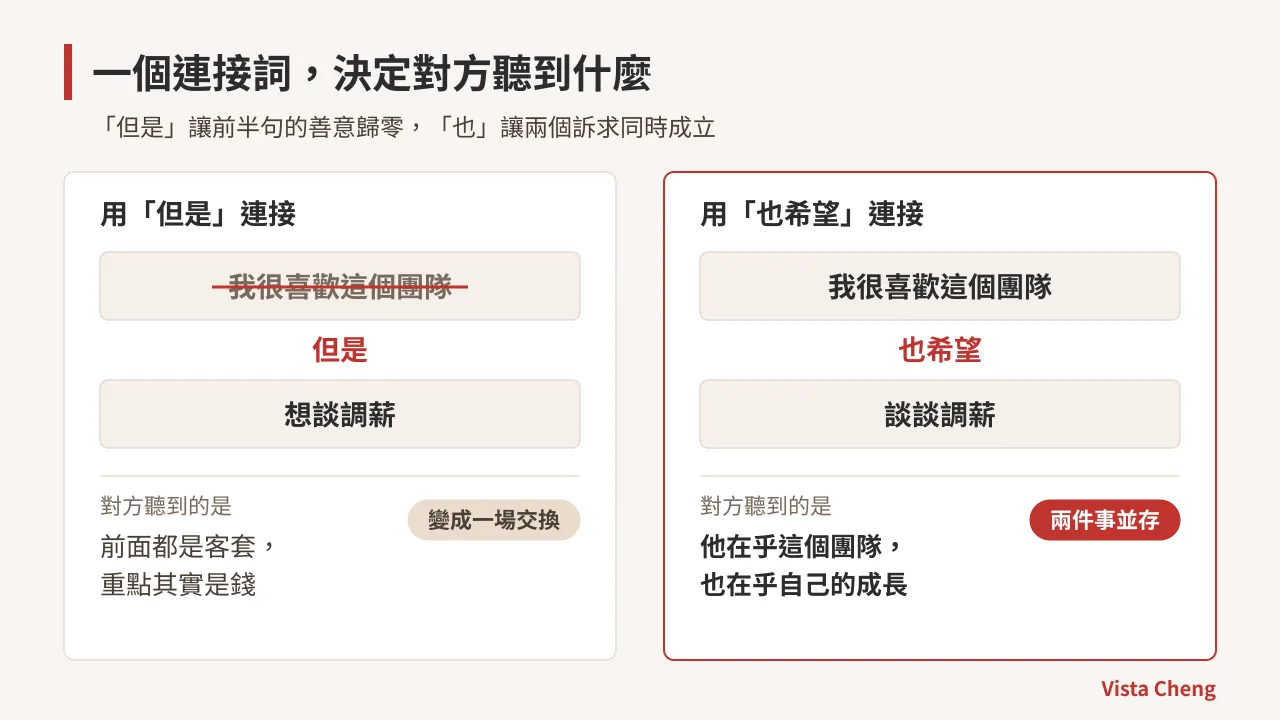
▲ “But” makes the goodwill in the first half of the sentence zero, and “also” makes both demands valid at the same time
Reading this, I drew a line next to the page. Over the years, in corporate internal training and classrooms, I have seen too many people with moderate abilities put themselves in a disadvantageous position as soon as they speak. What they lack is often not eloquence, but that no one has told them: There is an unwritten language in the workplace. Those who know it don’t speak it out, and those who don’t can only learn it by running into walls.
To put it simply, what this book wants to do is very simple, which is to spread out this language and demonstrate it to you sentence by sentence.
Invisible courses: not taught in school, but tested every day in the workplace
The author calls this language the “hidden curriculum.” This statement is accurate because it points out one of the most unfair things in the workplace: rules exist, but there are no textbooks. Some people learn it naturally from their families, teachers, or early good supervisors, while others have to pay years of tuition.
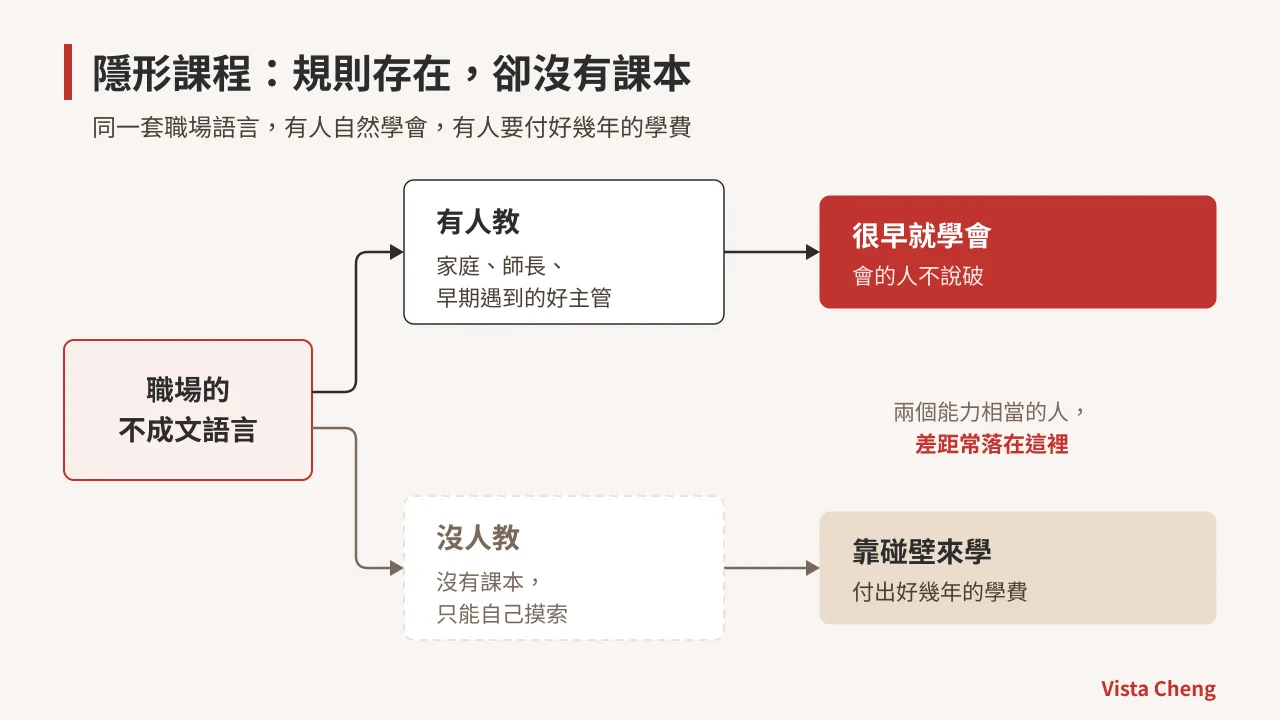
▲ Some people learn the same workplace language naturally, while others have to pay several years of tuition
She summarized in the book that the hundreds of questions that flooded into her mailbox every day were all kinds of strange on the surface, but at the core they all had the same question: “How should I tell someone about something?” How to negotiate a salary increase with the boss, how to ask for an extra week of leave for a wedding, and how to ask colleagues to stop using their mugs. The problems may be big or small, but the structure is exactly the same.
This observation reminds me that we often attribute workplace difficulties to the system, personality or luck, but rarely realize that many obstacles are actually just problems at the language level. Two people of equal ability, one has a mediocre career and the other is brilliant, the gap often lies here. Narrow the problem down to “how to say it in one sentence” and the dilemma suddenly becomes manageable. I have written before Building Persuasion in the Workplace: How to Impress Your Colleagues Before the Briefing Starts? 〉, they are actually talking about the same thing: many wins and losses are decided before you officially open your mouth.
Ask yourself what you want first, then decide how to ask.
The foundation of the entire book is a concept called “desired results.” The author borrows Covey’s habit of “Begin with the end in mind” (opens in a new tab) and advocates clarifying before speaking: What do I want things to be like when this conversation ends? Desired outcomes can be big, like getting your dream job, or they can be small, like getting your supervisor to approve a sabbatical.
This sounds like common sense, but it’s actually the most commonly skipped step. When we speak when we are emotional, it is mostly to “get the words out” rather than to “make things happen.” The former is catharsis, the latter is communication.
After having the desired results, the author proposes four variables that must be done correctly at the same time:
| Variables | Questions to answer | Examples from the book |
|---|---|---|
| What to say | What information should be given and what should not be given | There is no need to explain to the supervisor what you are busy with at night |
| Sequence | Affirmation or request first | Say you like the team first, then talk about salary increase |
| Method | Which word to use, what tone to use | ”What is this technique?” instead of “Why do you do this?” |
| Timing | Say now, better wait | Urgent shipment at 8pm, confirm again the next morning |
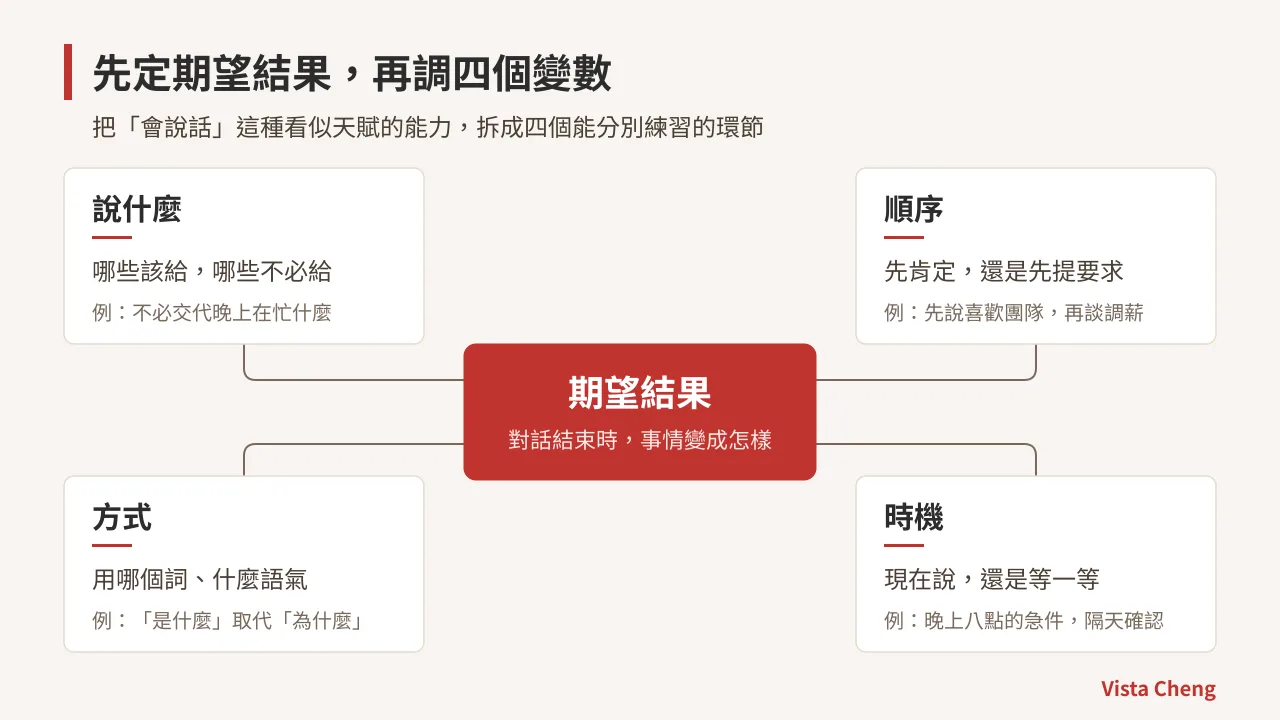
▲ Divide the seemingly innate ability of “speaking” into four parts that can be practiced separately
I particularly like this method of dismantling, because it reduces the seemingly innate ability of “being able to speak” into four links that can be practiced separately. Talent cannot be copied, but links can.
The five scenes are actually the same kind of thinking.
The examples in the book span interviews, salary negotiations, rejections, boundaries, and resignations. If you only memorize them as words, you will soon forget them; but if you look closely, you will find that they share three underlying actions.
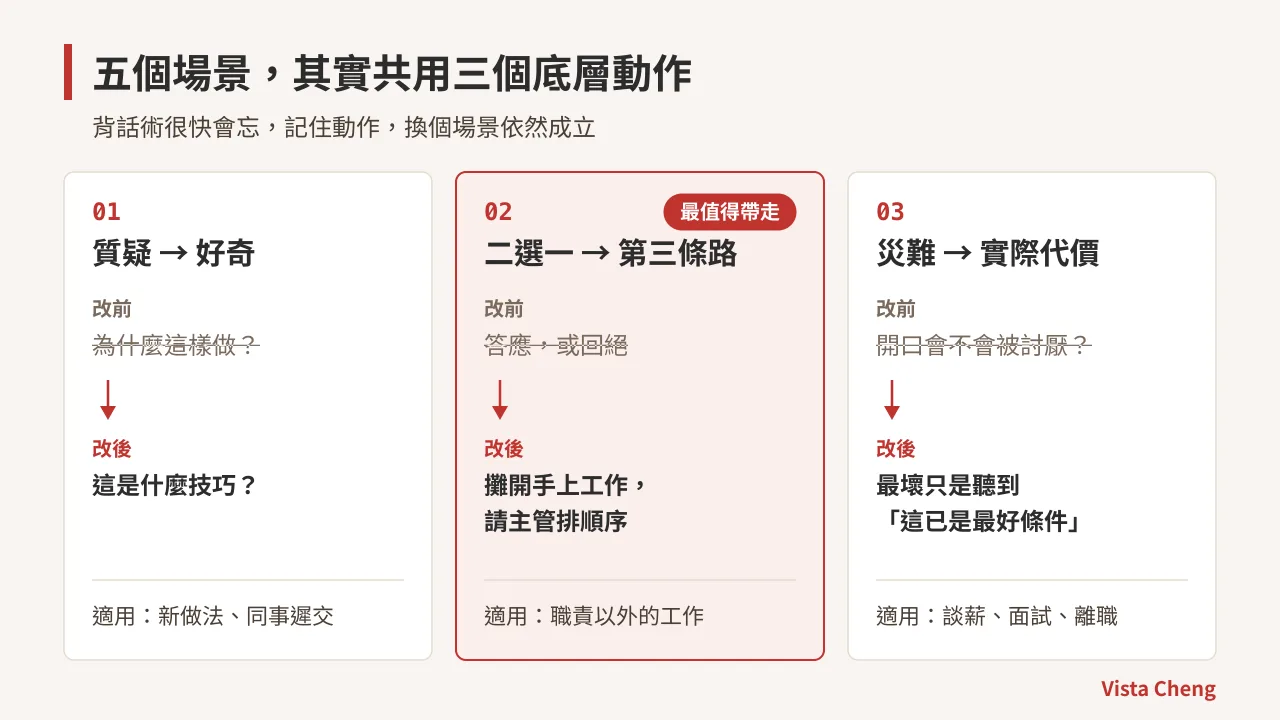
▲ You will soon forget the art of memorizing words, but if you remember the actions, it will still hold true if you change the scene
The first action is to change doubt into curiosity. You have never seen what your colleagues are doing. Asking “Why do you do this?” is like interrogating, and asking “What kind of technique is this?” is asking for advice. A colleague is always late in submitting his work. Instead of complaining, it is better to first ask if something happened. The semantics are almost the same, but the other party’s perspective is completely opposite.
The second action is to turn the second choice into a third way. When tasks beyond our responsibilities are thrust into our hands, we intuitively have only two options: agree or refuse. The author’s approach is to spread out the work at hand and ask the supervisor to decide the order. You didn’t complain or hold on, you just handed the decision-making power back to the person who should make the decision. I think this move is the most worth taking away in the whole book. In the early years, I wrote “How to refuse unreasonable requests?” ](/blog/how-to-refuse-unreasonable-requests)〉, the answer at that time mostly stopped at “how to say no”. Looking back now, the third way is more mature than simply refusing.
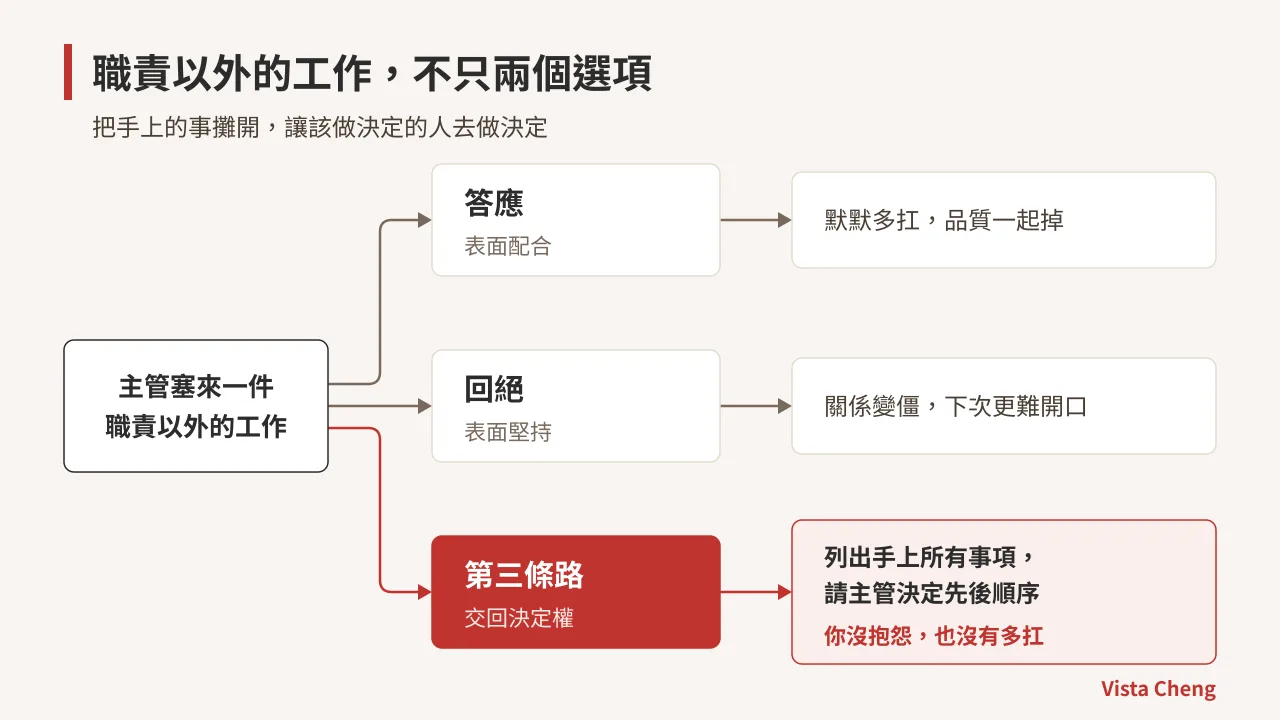
▲ Let go of what you are doing and let the person who should make the decision make the decision
The third action is to convert imagined disasters into actual costs. The worst outcome of negotiating salary is for the other party to say, “This is already the best condition.” You can’t answer weird questions in interviews. The only real mistake is to say “I don’t know” because the other person is looking at how you think. As for condolences when resigning, the author bluntly said that nine times out of ten it is not worth considering, because the reason for wanting to leave is usually not just salary.
Curiosity, the third way, and the cost of conversion. These three actions are more durable than any sentence example because they still hold true in different contexts.
The Limits of Scripting and Translation in Taiwan’s Workplace
Frankly speaking, this book is not without its issues.
First, the script is just the starting point. A beautiful statement without a corresponding foundation of work performance and trust will only sound like a trick. The author himself reminds that in addition to communication, you still need professional skills, punctuality and a good work attitude. Words can amplify strength, but they cannot replace strength.
The second is the cultural gap. The context of the book is the American workplace. Telling the salary figures directly and asking the supervisor the next morning if he needs a reply that night may not be possible in Taiwanese organizations where power distance is large and people and seniority are important. My suggestion is to keep the structure and adjust the temperature: the expected results remain the same as the logic of the third path, and the wording should be based on the supervisor’s style and the company’s atmosphere.
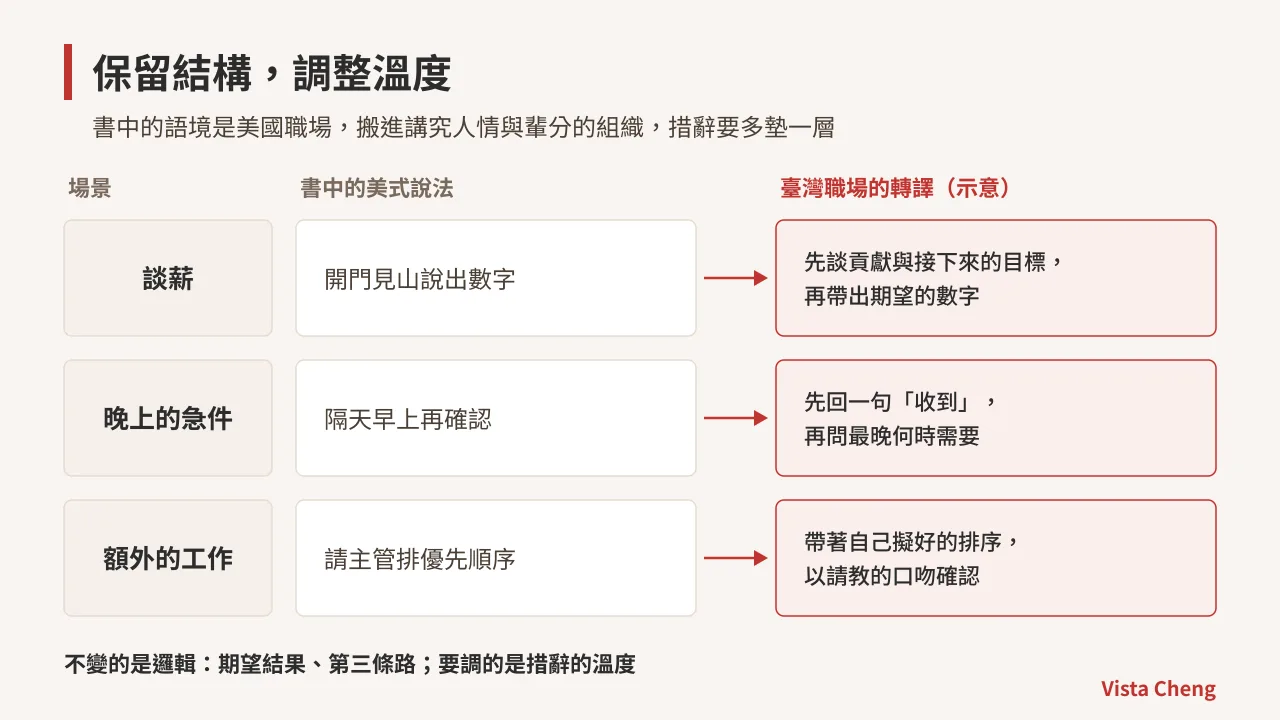
▲ The logic remains unchanged, but there is an extra layer of wording: the right column is my translation, the actual statement still depends on the atmosphere between the supervisor and the company
Third, the author said that “introversion is just a story you make up for yourself.” This sentence is very encouraging, but it is also a bit too strong. Introversion is a real temperament and does not need to be denied. A fairer statement may be: being introverted does not prevent you from speaking the right words, because this language relies on preparation in advance rather than excitement on the spot. For introverts, having a script to follow can be an advantage.
In the AI era, why should we learn to talk to people?
The author half-jokingly remarks in the first chapter that until robots take over the world, your bosses, co-workers, and customers will still be human. This sentence is particularly interesting to read today.
When AI can already write letters, organize briefings, and produce reports for us, the threshold for “getting things done” is rapidly lowering. In contrast, it is still up to people to decide who to say, when to say it, and where to stop. These decisions involving relationships and proportions still have to be made by people. This is what I want to say in “Taste × Judgment: Two weapons for professionals in the AI era to refuse to be reduced to machine OEMs”: The stronger the tool, the more valuable the judgment.
I even think that writing prompts and communicating in the workplace are the same kind of training: both require you to think clearly about the desired results before arranging the content and sequence of the information. The only difference is that AI doesn’t hold grudges, people do. Regarding this point, I have a more complete discussion in the two articles “Prompt words will expire, you will not” and “Intention-centered communication model”.
This set of techniques of “first setting the expected results, and then arranging the content and sequence” is also applicable to academic writing. When graduate students and teachers face AI, what often gets stuck is not the tools, but the inability to explain what they want. If you are writing a paper or doing research, the “AI Empowering Academic Research and Writing Practical Workshop (opens in a new tab)” I opened will take you through the research workflow from literature collection to manuscript revision using AI Agent. It emphasizes assistance rather than ghostwriting, and also includes academic ethics and AI disclosure.
If you only want to take away three things after reading this, I would suggest starting like this:
- Before your next important conversation, write down your desired outcome in one sentence
- Check commonly used sentences and replace “but” with “also” and “why” with “what”
- When you encounter additional work, practice speaking out the matters at hand and asking your supervisor to prioritize them.
You don’t have to be a dancer. Say the right thing at a critical moment, and things can often move forward. The greatest value of this book is that it changes this matter from a tacit understanding of a few people to a lesson that everyone can practice.
Further reading:
- Building persuasion in the workplace: How to impress your colleagues before the briefing begins?
- How to refuse unreasonable requests?
- Reflections on reading “The Supervisor’s Strongest Work Technique”: When AI can give answers, why do supervisors have to define their own questions
- Taste × Judgment: Two weapons for professionals in the AI era to refuse to be reduced to machine OEMs
📚 Book purchase link: “Colleagues who are good at communicating have secrets (opens in a new tab)”
Next step
Bring this topic to your team
Vista Cheng speaks and runs workshops on AI workflows, writing and content systems for companies, schools and public agencies.