Reading experience of "At Fifty Years Old, I Walked to the Wujiang River": A writer reads half of another person's life
I received a letter a while ago, and the sender was an author I have never met, whose pen name is Mu Fan.
He said in the letter that after seeing that I continued to share my reading experience and writing observations, he wanted me to read his first book “At the age of fifty, I walked to the Wujiang River (opens in a new tab)” to see if it would be suitable for my readers. The letter was written very politely and clearly: not to mention the cooperation fee, it is up to me to decide whether or not to write it and how to write it.
I receive quite a few such invitations a year, and most of them I have to decline. But the letter attached a trial reading of Chapter 7. Originally I just wanted to turn a few pages, but ended up reading all the way to the last line. After closing the computer, I sat at the desk for a long time.
Hence this article. It should be noted that the author did not pay me any fees. The following are my own feelings.
A person walks from the countryside of Henan to the Wujiang River
Let me first briefly introduce this book.
Mu Fan grew up in a poor family in rural Henan. He interrupted his studies at the age of fifteen and started as an apprentice in a lumber factory. He later worked in sales, purchasing, and department management, and then opened a company in Shanghai. Now he lives with his family in Southern California, USA.
The book has fifteen chapters, starting from when he ran away from home during the Spring Festival when he was seven or eight years old, and continues until he was fifty. He slept in the kitchen and did housework at home for a long time. He never understood why his parents treated him and his younger brother so differently. Later came marriage, raising a son alone, starting a business, sending his son to study abroad, a second marriage, and moving to the United States.
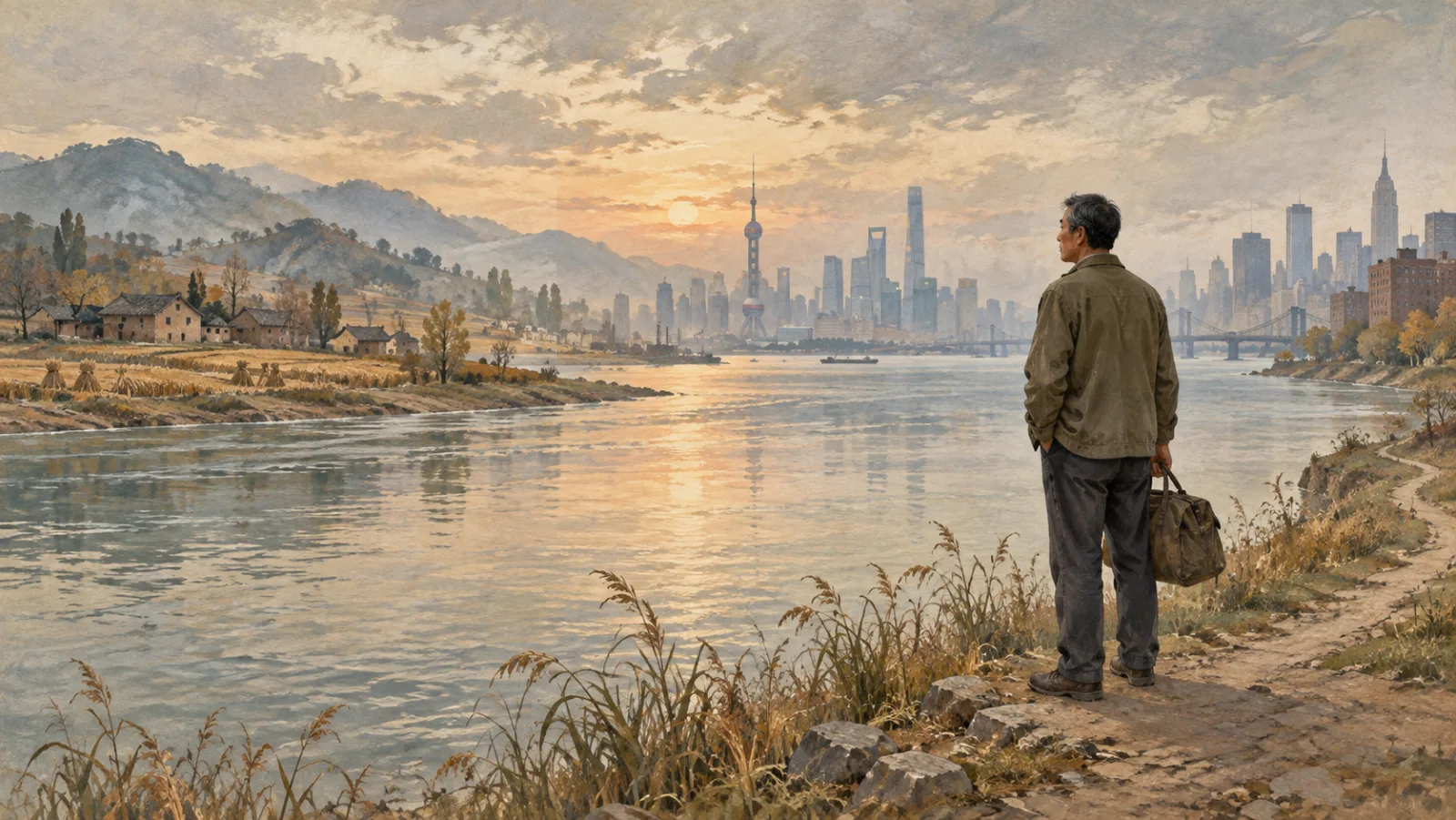
The Wujiang River in the title of the book is an allusion to Xiang Yu. A person who has always worked hard to make money, shoulder responsibilities, and want to change his destiny will, at the age of fifty, look back and feel that he is surrounded by enemies.
This book does not give a satisfactory answer. The author himself said that this is a record of a person looking back on half his life in deep difficulties. But because of this sentence, I wanted to read more.
Chapter 7: Whose son am I?
The seventh chapter of the trial reading is about his experience of taking a paternity test when he was in his twenties.
At that time, he had just divorced. He was alone with his two-year-old son and had no income. He wanted to go out to work and asked his mother to help take care of the child, but he was rejected. All the unspeakable grievances I had felt since I was a child came flooding back at that moment. For the first time, he asked his mother: Am I your biological child?
Mother only replied:
I raised you so much, and now you say this.
Later, he walked into his parents’ room, knelt at the end of the bed, cried and kowtowed, and begged them to accompany him to draw blood. He wrote that his head hit the ground again and again, “at least six or seven times. It hurt.” His father never said a word from beginning to end.
The identification results showed that he was his mother’s biological son, but not his father’s biological son. This was an answer he had never imagined. He later found his possible biological father through his uncle. The two met on the side of the road in the county town. The other person walked over from a distance. He understood before he opened his mouth because both of their eyes were drooping.
I read this and stopped to take a sip of water.
What makes me most uncomfortable is the next part. He asked his mother again, thinking that she might be sad or apologize. The mother’s expression was very calm and she only said:
Why are you so stupid? You are so stupid.
Then turned around and left.
At the end of this chapter, he even took his two-year-old son to draw blood to confirm whether the child was his. He wrote about his heartache when he saw the needle piercing the child’s body. He also wrote that he once thought, “If it wasn’t my son, I wouldn’t want to continue raising him.”
This kind of thought, if it were me, I probably wouldn’t dare to write it down.
As a writer, what do I admire most?
I have been writing for thirty years since I published my first book in 1995. I have written reference books, novels, columns, copywriting books, and taught many people how to write. To be honest, I rarely touch memoirs myself.
The reason is simple: writing about yourself is too difficult.
When writing other people’s stories, you can keep your distance; when writing about methodology, you can hide behind the framework. But when writing about your own life, you have to go through every scene again, and you have to decide whether you want readers to see you in your most embarrassing state.
Most people will start to polish it when they write this. Make yourself feel aggrieved, write others in a bad light, or add the sentence “Later I figured it out” after each paragraph. This is human nature and I would do it too.
Mu Fan did not do this.
His writing is very plain, with almost no adjectives and short sentences, as if a person is sitting across from you and slowly finishing things. He wrote about his mother’s indifference, as well as his doubts about his wife and son; he wrote about his biological father’s evasion, and also about his lack of courage to ask more questions at the moment. He did not cast himself as the victim, nor did he pass judgment on anyone’s behalf.
This way of writing seems simple, but is actually the most difficult. Because you have to be honest with yourself first before you can write such a sentence.
I often tell students that good nonfiction writing requires readers to draw their own conclusions. The author is responsible for handing over the scene, leaving the judgment to the reader. This chapter is pretty much a demonstration.
Writing is a way to bring yourself back to the world
While reading this book, I also thought of a period in my own life.
Those were the years before my father passed away. Things were not going well at work, I was not going well in graduate school, my family was in a bad situation, and my father was sick. Several things happened at the same time. I felt that I had accomplished nothing. What supported me during that time, apart from my family, was writing.
For me, writing is a way to connect myself back to the world.
I guess Mu Fan wrote this book partly for this reason. A man who left school at the age of fifteen and spent half his life struggling to make money decided to sit down and write his life from scratch when he was fifty. He also wrote fifteen chapters and officially published it. This requires not only writing skills, but also courage.
He left several questions at the end of the book: How will the lack of love in childhood extend to the choices in adulthood? Where is the line between taking responsibility for your family and neglecting yourself? When a person strives to change his destiny, in addition to courage and dedication, what kind of understanding and preparation is needed?
I can’t answer these questions for you. But I believe that many readers will see themselves or their parents in this book.
Why I recommend you buy this book
I would like to give three reasons.
First, this is a great reference book if you also want to write your own story. It demonstrates how to use the simplest language to write the most difficult scenes. You don’t need fancy writing, you need honesty.
Second, if you are a parent or taking care of a family member, this book will make you rethink the distance between giving and self. Mu Fan did not remarry for fifteen years because of his son, but in the end he found that his son no longer needed him that much. Many middle-aged people have experienced this gap, but few speak out about it.
Third, I want to support authors like this. An amateur author with no publishing house and no marketing budget spreads out half his life for strangers to see, and is willing to write letters one by one, asking people to read them. As someone who has been writing for many years, I know how much determination it takes.
This book is currently available as an e-book and paper book in Simplified and Traditional Chinese. The e-book in Traditional Chinese can be purchased on Amazon:
👉 “At fifty years old, I walked to the Wujiang River (opens in a new tab)” Traditional Chinese e-book
Don’t expect to feel healed after reading this. It is more like a stranger speaking to you for a long time by the river. After listening, you may want to call a family member you haven’t heard from for a long time, or you may want to pick up a pen and write your own story.
Either way, I think it’s worth it.
Further reading
Next step
Bring this topic to your team
Vista Cheng speaks and runs workshops on AI workflows, writing and content systems for companies, schools and public agencies.