Read "Inverse Division of Labor": The productivity revolution in the AI era, when one person starts to own an AI army
There are some books that you will keep nodding your head while reading, because they explain things clearly to you that you feel vaguely but have not yet been able to explain clearly. “Reverse Division of Labor (opens in a new tab)” co-written by my two friends Lin Zhichen (opens in a new tab) and Cai Qiyan (opens in a new tab) is such a good book.
I myself have been promoting the concept of “Unmanned Company (opens in a new tab)” in the past two years. The so-called no one does not mean that there is no one, but that you add an AI army. In the past, it took a whole team to handle the task, but now one person with the right tools can do it from start to finish. I don’t think about this, I do it every day: writing, research, marketing, Written with AI to deploy websites and reconciliation, all behind the scenes are the AI I schedule. So when I read the sentence in the book, “From a screw in the process to a super individual who can support a team,” I felt a sense of solidity. This is not a deduction in a laboratory, this is reality that is happening right now.
Reverse division of labor: Ten thousand years of division of labor, reaching the theater of absurdity
The most severe and accurate attack in this book is on the division of labor.
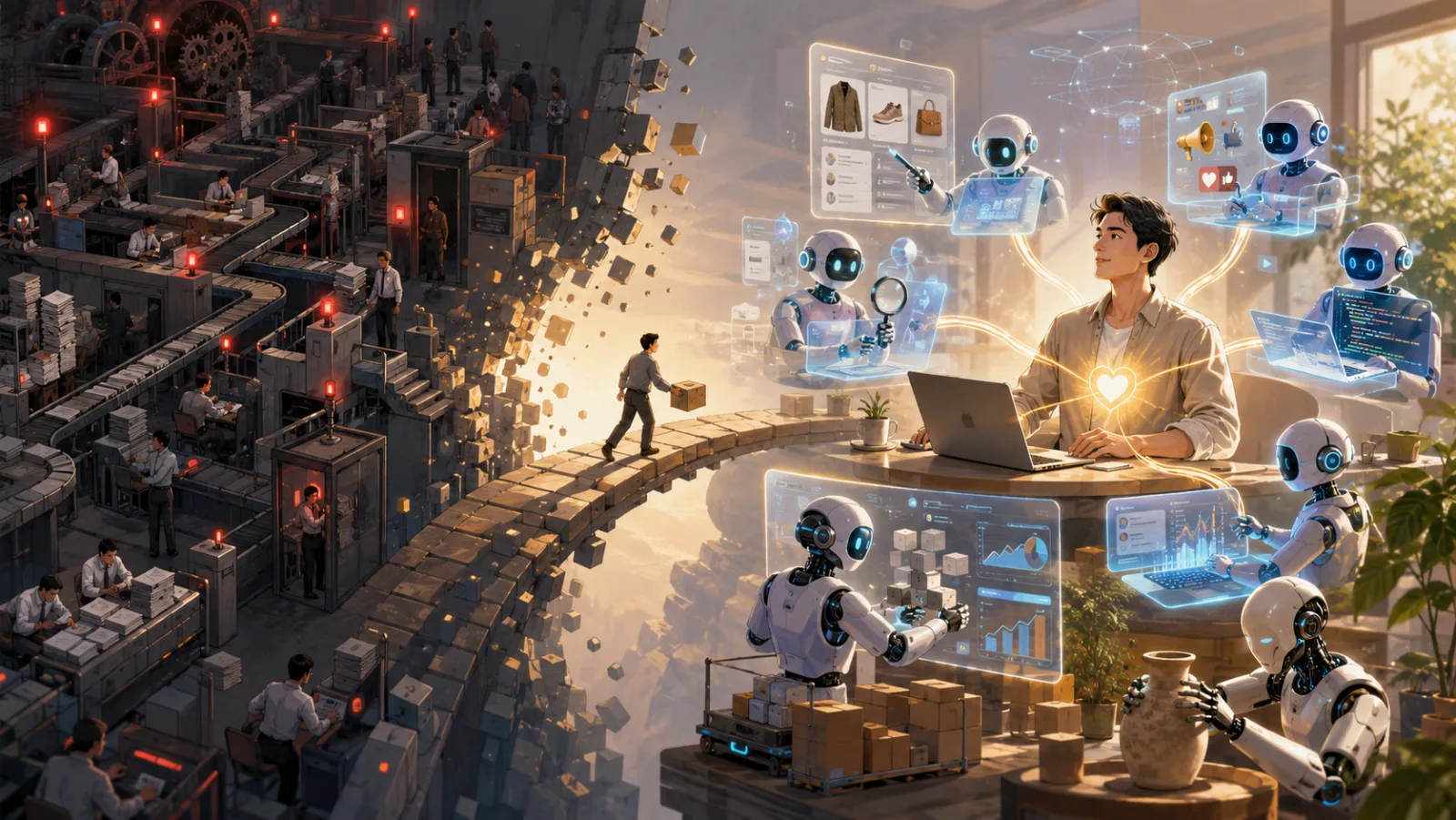
We have been taught since childhood that the finer the division of labor, the higher the efficiency. Adam Smith’s pin factory, Ford’s production line, and the entire industrial civilization were built on this belief. However, the author pointed out something that many people know but dare not talk about: the division of labor has evolved into a theater of absurdity to this day. There are too many meetings, sign-offs are too slow, and department walls are too thick. Everyone is busy, but the output is not necessarily more. I like Professor Lu Xipeng (opens in a new tab)’s metaphor very much in the recommendation preface: Every employee holds an AI Ferrari in his hand, but the company’s process is still full of traffic lights.
The problem is never the tools, it’s the organization. This also answers one of the questions I am most frequently asked: Why do others import AI to triple their production capacity, but our company uses a lot of AI but doesn’t feel it? The answer is that you’re just shoehorning AI into an old process, rather than redesigning the process with AI. The former is to optimize the traffic lights, and the latter is to directly build the bridge across the bridge without traffic lights.
The meaning of reverse division of labor is that AI gives us the first opportunity to reintegrate the work that has been chopped up for ten thousand years back into one person.
Comb type talent: The framework I most want to recommend to anxious people
If I were to pick one concept from the entire book to share with all my friends who are worried about whether they will be replaced, I would choose the comb-type talent.
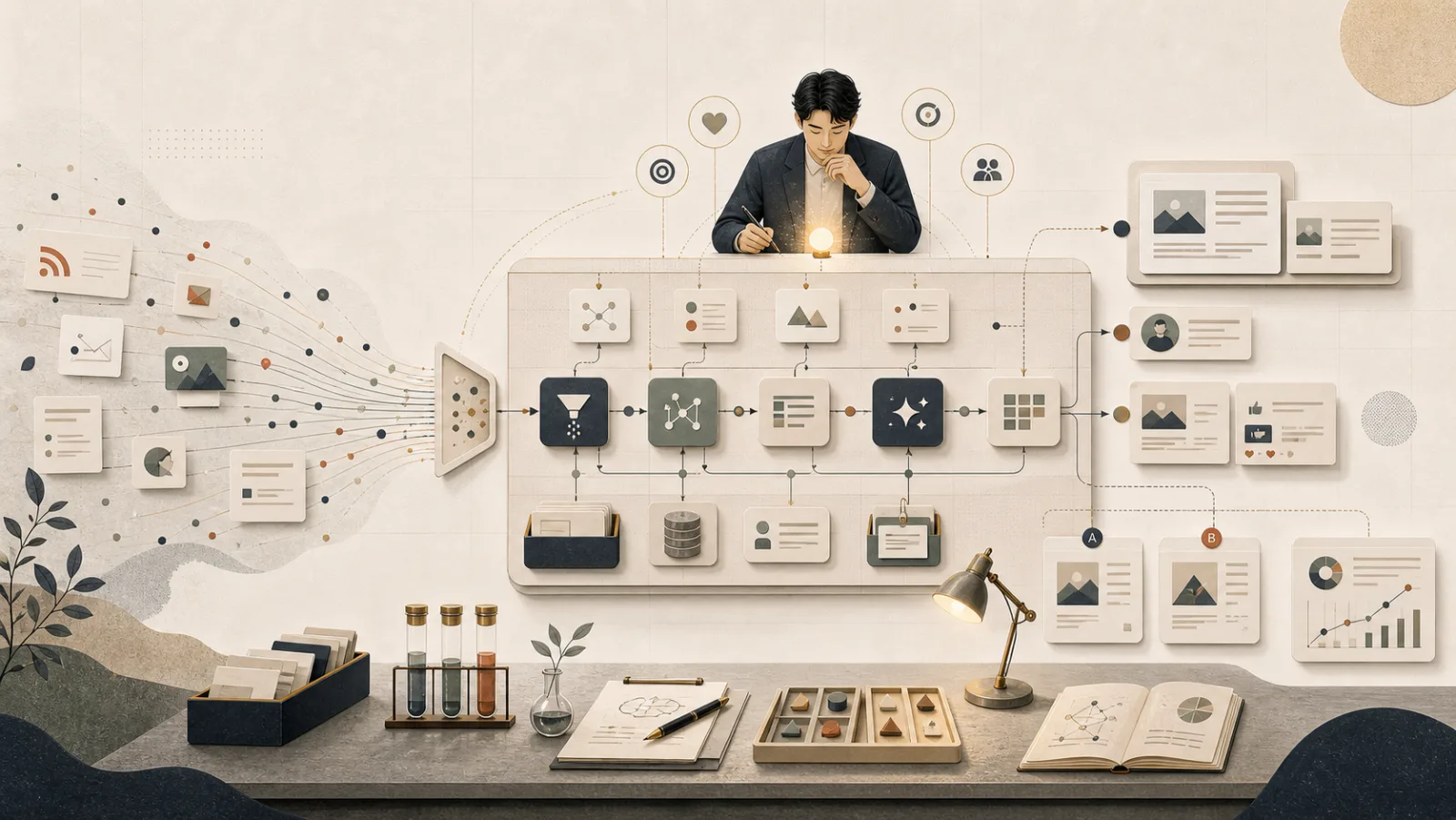
In the past, when we talked about T-shaped talents and π-shaped talents, we all talked about how many legs you have to grow. The types of combs are different: the handle of the comb is your cross-field judgment, your taste, sense of context and integration ability; the teeth of the comb are AI Agent (opens in a new tab) professional abilities that can be plugged and used and grown as needed. You don’t have to know how to program, design, or do legal work. What you need to know is to judge when to call which comb tooth, and to actually get things done.
This is connected with the rewriting of the logic of talent pricing. The book borrows a distinction from psychology: In the past, we paid for crystallized intelligence, which is your accumulated experience and existing knowledge; in the future, what will be valuable is fluid intelligence, which is your ability to adapt and reconnect in the face of new situations. Experience will be picked up by AI one by one, but the ability to reconnect the fragments into a complete judgment is still in the human body. I think every office worker should copy this on the first page of their notebook.
The most specific tooth of the comb is actually “research and writing.” In the past, it took a whole set of training and time to check literature, organize information, and write a long and logical article; now you can use AI as an on-the-go research co-pilot and rearrange the entire process. I wrote this approach in an article AI co-pilot system for researchers, which will be very interesting if you are struggling with a paper, report or research.
AI Comprador and AEO: The battlefield changes from persuading people to persuading algorithms
The second trend is directly related to my business of making content and marketing, and I was particularly impressed by it.
The author said that in the future, it will no longer be you who will compare, negotiate, and place orders for you, but your AI agent. When the entrance to consumption changes from humans to machines, the target companies want to please has also changed. In the past, you made your web pages beautiful to impress consumers. In the future, you will face the calm and emotionless algorithm behind consumers. Traffic no longer flows to the website, but to the agreement; orders no longer come from human impulse, but from whether the data is transparent and structured enough.
This is what the book talks about AEO, and the survival rules for winning robot orders. People who have done SEO should feel a chill down their spines when they hear this: the rules of the game we are familiar with are being replaced. From now on, your content will not only be written for people to read, but also for machines to understand and quote. I also agree with the sharp point that the author reminds: when free AI may sell you at any time due to commission, what is truly scarce is a real comprador willing to stand on your side. Trust will become the most expensive thing.
Software as Labor and Embodied AI: From the Screen to the Real World
The third circle, Software as Labor, talks about the upgrade of software from tools to employees. In the future, measuring the size of a company will no longer just look at how many people you have, but how many digital workers you have. This sentence is an opportunity for operators and a warning for workers. I recommend that people in both identities read it carefully.
The fourth circle of embodied AI is the most beautiful flip in the book in my opinion. In the past, robots were subject to Moravec’s paradox: computers can play chess and solve equations, but they have difficulty walking and grabbing things like humans. But when AI begins to have common sense, it knows that eggs will break, and that eggs are more likely to break when placed on a metal table than on a soft cushion, then robots can truly enter the physical world. For Taiwan, which has advantages in semiconductors, servers, sensors and precision manufacturing, the author believes that this is likely to be the next industrial second curve. I am willing to bet on this judgment.
My reservations, and the sentence I want to leave behind after reading this
I can’t just nod my head, I also have to express my reservations.
The credibility of this book comes from the first-hand experience of Taiwan Mobile, which is its biggest advantage, but we must also look at it honestly: the reverse division of labor that can be run by a large enterprise with tens of thousands of people and abundant resources may not be able to be transferred intact to small and medium-sized enterprises or individuals. The tissue-to-bone path in the book is very useful for large companies where dinosaurs have turned into amoeba. Practitioners like me, who are originally one-person companies, read another way: you don’t have to tear down the old tissue, but don’t grow fat from the first day. The same principle is used by large companies to lose weight, and by small companies to strengthen their bodies. Although the directions are not exactly the same, they are still worthy of their respective positions.
In addition, Professor Lu Xipeng and I agree on the timetable for the four waves to arrive sequentially in three decades: I am afraid it will be faster. It’s both good and bad news, the bonus window is shorter than you think.
But what really made me close the book and not put it down for a long time was the final chapter. In the end, the author did not give the answer to AI, but to Kant: people are the purpose, not the tool of production. When the productivity singularity comes and the world is so good that it no longer requires our hard work to function, will it be liberation or another more refined control? There is a sentence in the book that I agree with: AI can produce a beautiful poem, but it has never lost love, has never been afraid of death, and has never truly loved someone in a body that will eventually grow old.
Therefore, this book talks about productivity on the surface, but in fact it talks about re-pricing of value (opens in a new tab), and what is finally re-priced is why people are still important.
If you have a vague feeling that the world is changing its underlying logic, but you still can’t tell what has changed, then “Inverse Division of Labor” will be a good map. Only those who understand the map have the chance to reach the future first. And I would like to add one more thing: Don’t just finish reading it, but also reassemble the self that was chopped into parts into a complete person ten times stronger.
Well, in my opinion, this is what the two authors of this book really want everyone to do.
“Reverse Division of Labor: The Productivity Revolution in the AI Era, Reconstructing Organizations and Markets to a New Game of Economic Survival” is published by Tianxia Magazine, Click here to go to the blog to purchase the book (opens in a new tab). If you also want to truly integrate AI into your own workflow, you are welcome to go to solo.tw (opens in a new tab) to take a look at the online classes and workshops I have organized for creators and independent workers.
Next step
Bring this topic to your team
Vista Cheng speaks and runs workshops on AI workflows, writing and content systems for companies, schools and public agencies.