Fasten your seat belt first, then talk about driving - Understanding Lin Wenqin’s investment and business-building philosophy from a forwarded letter in 2007

Starting from a letter from nineteen years ago
In order to write about my experience watching this video, I went back to Gmail. The first letter I exchanged with Vincent (Lin Wenqin) (opens in a new tab) was dated July 18, 2007. That was an iPhone excerpt he forwarded to me. That summer, the first-generation iPhone had just been launched in the United States, and the mobile Internet was still a future that everyone was hotly discussing but no one was sure about.
In those years, I first worked as a reporter and later as the editor-in-chief of “Digital Times”, focusing on innovation and e-commerce. At that time, the atmosphere in the startup community was not yet lively, and what everyone was talking about was Web 2.0, online advertising, and blog marketing. I went to large and small online gatherings and press conferences, and got to know many entrepreneurial teams who later split up. Vincent was a well-known e-commerce blogger in the industry at the time. He went by the pen name “V Weiker” and wrote his “weird stories about e-commerce” on his blog.
Together we have run the “Online Business Forum”, a communication community for e-commerce practitioners, and have discussed countless online business ideas. Later, he decided to go to Shanghai and join a B2C e-commerce company as the vice president of marketing. Not long after Vincent arrived in Shanghai, he wrote to me. The letter said: “Find a way to come to China. Really, the market is too big.”
Eighteen years later, I heard him talk about the two suggestions that Zhan Hongzhi gave to young people in “Charlie’s Entrepreneurial Compound (opens in a new tab)”: go online and go to China. He listened to both. At that moment, I realized that the urgency in that letter was that of a man standing on the wave, looking back and shouting to his friends.
In this interview, what I hear is not the legend, but the method
Vincent’s resume is almost a chronicle of cross-strait Internet industries: PChome, Yahoo, Yihaodian, JD.com, Tencent, DJI, and has experienced many IPOs and mergers and acquisitions. But what’s most worth chewing over in this episode is not the eye-catching logos, but the several methods he uses over and over again that can be dismantled.

▲ “Charlie’s Entrepreneurial Compound” exclusive interview with Lin Wenqin, the complete interview can be viewed directly here
Next, I tried to organize them into five keywords.
Safety Belt: Prevent retracement first, then discuss remuneration
As soon as the show started, he said the most important sentence in the whole episode: buckle your seat belt first before you can enjoy the fun of driving. The operation is very specific: high-risk early-stage investments only account for less than 5% of the amount that can be invested. In this way, even if a certain case is cleared, the entire part will not be damaged. He admitted that at first he did not understand why those fund masters would “cut their positions into very small pieces”, but later he understood: As long as you do a good job of preventing drawdowns and steadily earn more than ten or twenty percent every year, over time, compound interest will make you a winner.
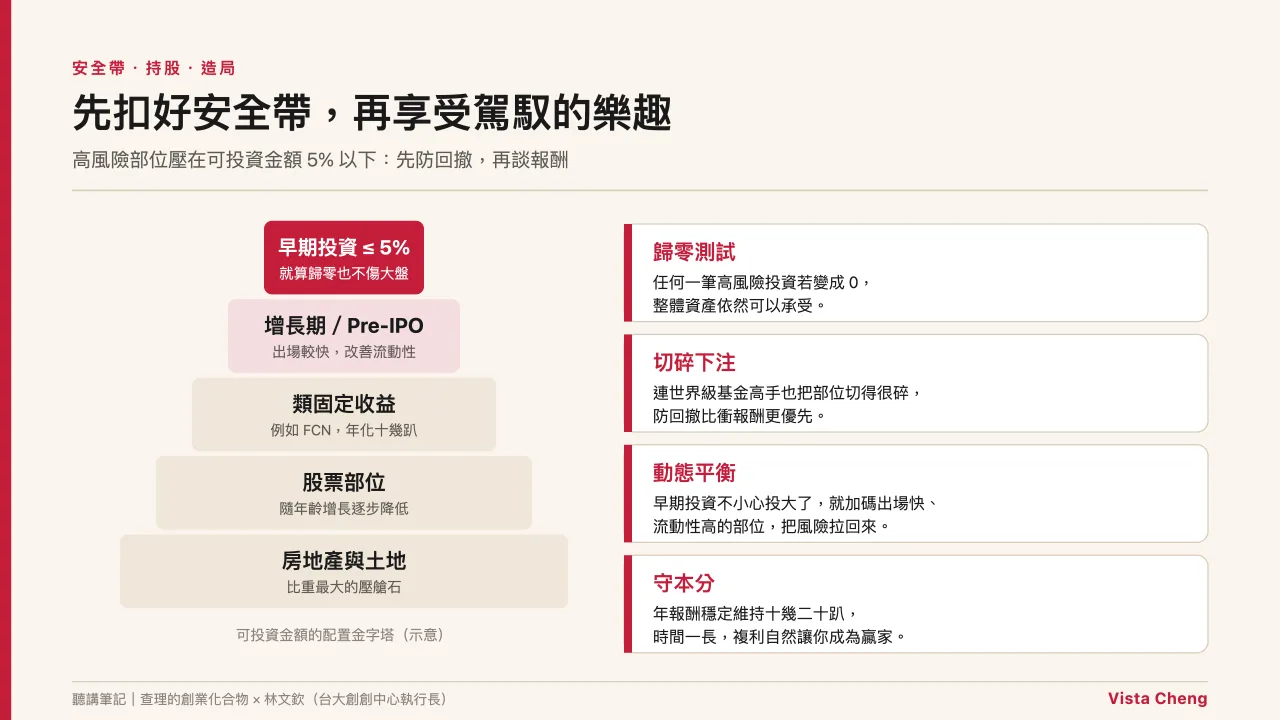
▲ High-risk early-stage investment only accounts for less than 5% of the amount that can be invested, and returning to zero will not hurt the entire position
His allocation is a pyramid: real estate is the most, stocks are second, and early-stage investments are the least. If he accidentally invests too much in the early stage, he will increase the proportion of the growth period or Pre-IPO, because these two types of exits are faster and can improve the overall liquidity. This is actually the same thing as the discipline I learned in Asset Allocation Course.
What I find most insightful is his addition to “concentration.” He reminded that many people only listen to half of what they are told. Most people do rely on concentration to get rich, but concentration does not always lead to success. Some people just get lucky and hit the mark. After you win, you have to change your logic: keep money and seek stability. This is actually a stage theory. Getting rich and staying rich are two different games. The most dangerous thing is to play the second game the same way you played the first game. He gave the example of a former subordinate who used leverage of 100 to 200 times and said, “I didn’t even have to ask about his performance.” That sentence may sound like an understatement, but it carries a lot of weight.
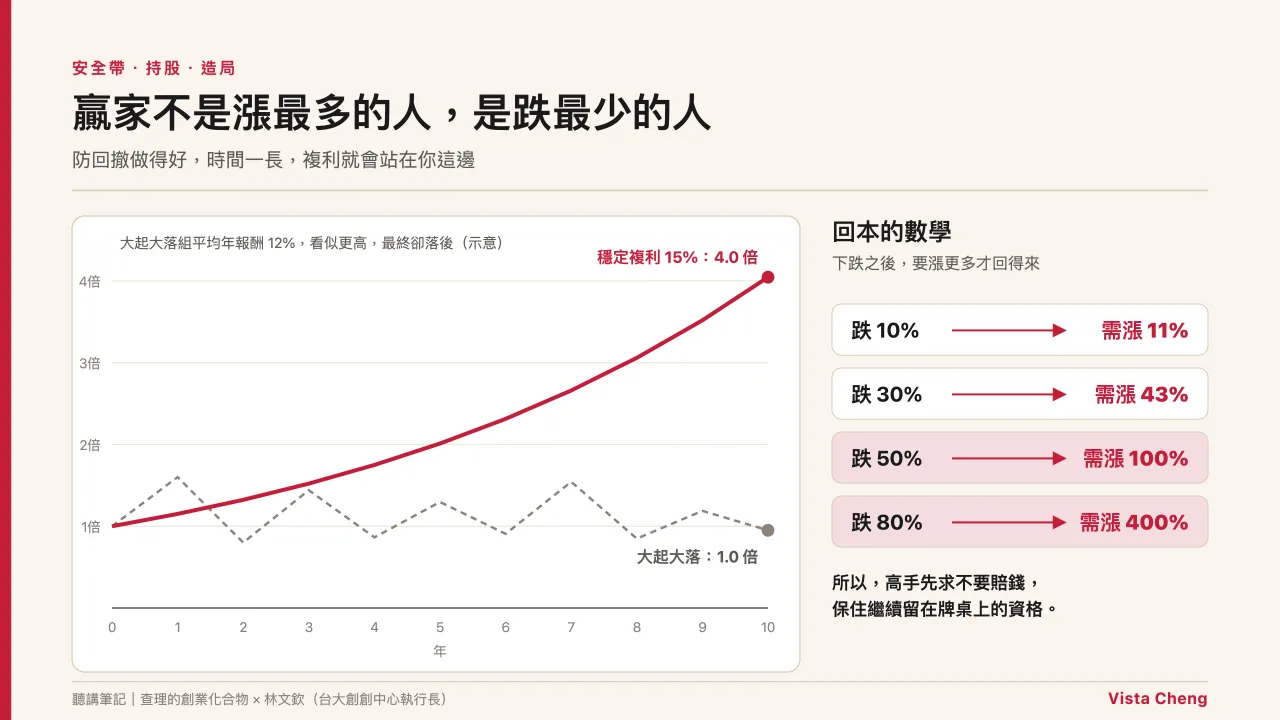
▲ Getting rich depends on concentration, staying rich depends on stability. The most dangerous thing is to play the second game with the same style of play in the first game
This is similar to Buffett’s “The first rule is not to lose money” and Duan Yongping’s “Keep your duty”. True risk management is not about lowering returns, but about preserving your ability to stay at the poker table.
Shareholding: Not doing pure work
Vincent’s career choice seems to follow a fixed pattern: pick a company that is popular and has potential, but is not very good at the moment, and then find a way to hold shares. If the company doesn’t give it to him, he will pay for it himself. He put it very bluntly: A good company does not have stocks, you only get a business card that is easy to show off.
This mentality is also learned over and over again. When PChome went public, he felt that he had created a lot of value but did not hold many shares. When he arrived at the next company, he began to acquire the stocks of his departing colleagues. Later, at that online supermarket in Shanghai, when the company was about to fail and lay off a large number of employees, he instead took the initiative to ask for money. Looking at the time, that company should be the B2C e-commerce company he wrote to me from Shanghai.
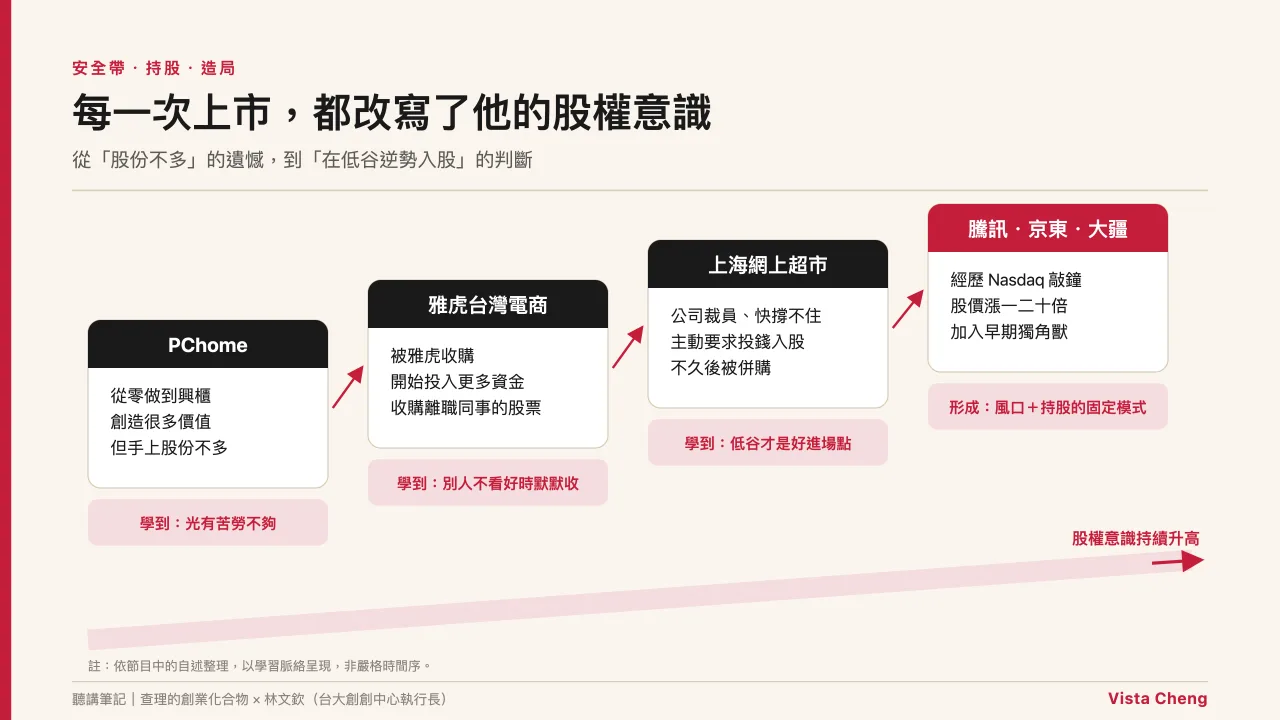
▲ From the listing of PChome to the online supermarket in Shanghai, every experience makes him care more about the equity in his hands
Interestingly, he said that he would not go for excessive compensation. When investing in real estate, he thought that as long as he sold it without losing money, he would be able to earn the rent for these years. The reward was low, the investment was promised, but in the end, the employee received excessive reward. It’s a paradox worth pondering: reward is often a by-product of doing things right, rather than the direct target.
For knowledge workers, equity is not necessarily stocks. It may be the copyright of the work, a community you run, a methodology that can be reused, or a personal brand that will increase in value over time. Asking yourself “Will this investment bring back equity?” is a good career check question.
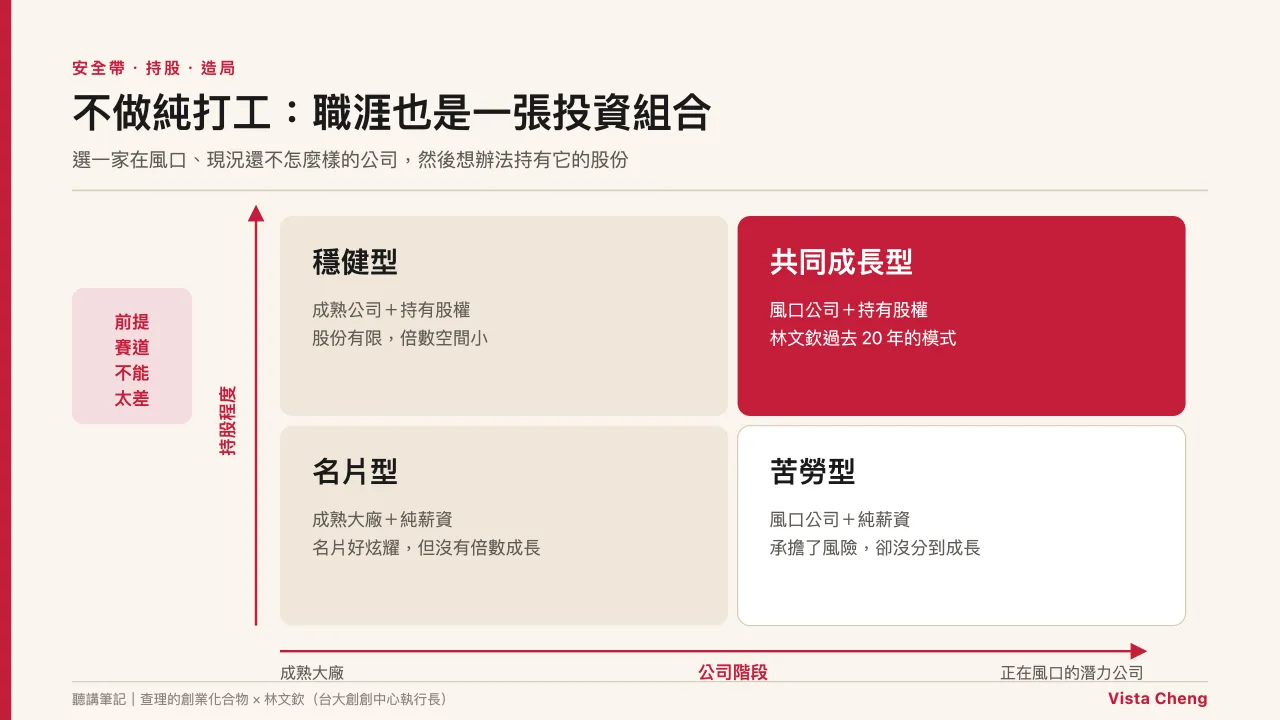
▲ Copyright, community, methodology and personal brand are all equity interests that knowledge workers can hold
Reset: Every airborne landing is proven from scratch
He has been airborne many times, but his seemingly glorious career has also experienced many challenges. In Shanghai, when everyone in the conference room deliberately spoke Shanghainese, he would write emails in English. When he arrived at Tencent, he was surrounded by academic masters with master’s and doctoral degrees, and he brought out things that the other party did not have, such as industrial experience, connections, and 4A brand operations, using differentiation to win trust.
His reminder was very pragmatic: “Politeness is not an achievement” and we must win the battle as soon as possible. At the same time, we should also make others feel less insecure and turn achievements into teamwork for everyone to enjoy together.
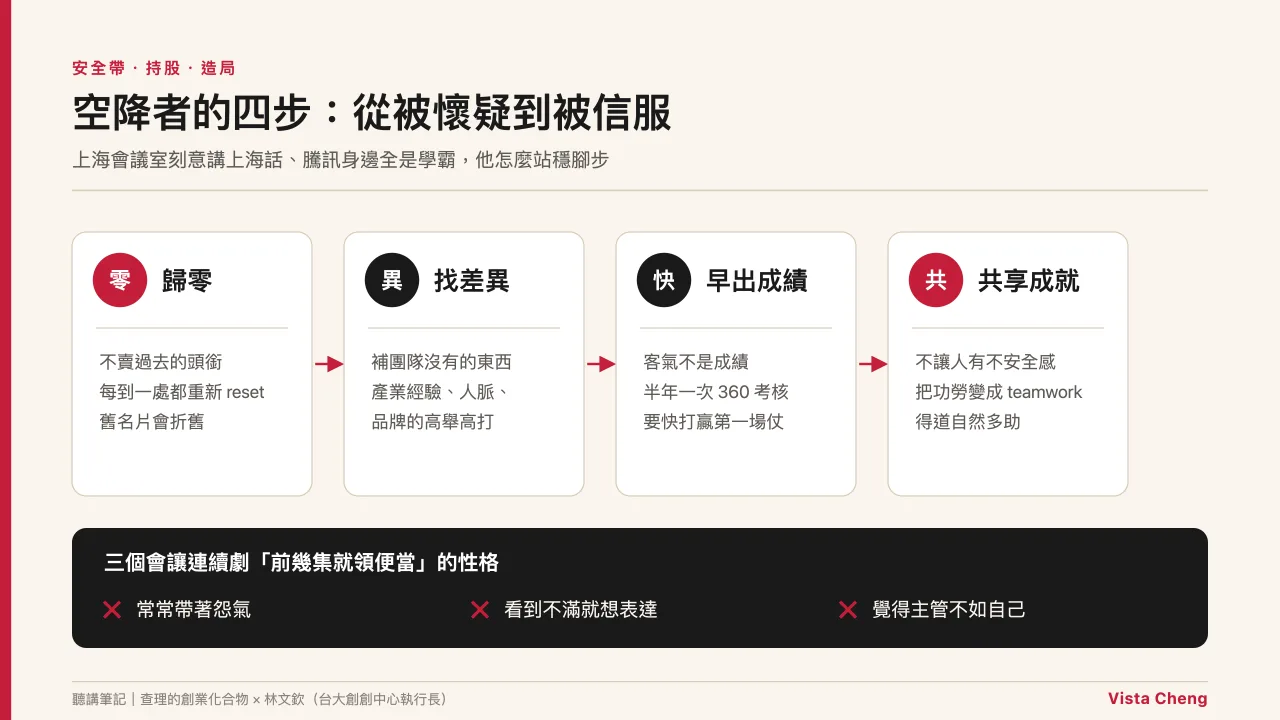
▲ Use differentiation to win trust, win the battle early, and then turn your achievements into everyone’s
What resonates most with me is his attitude towards business cards. His wife asked him why he didn’t bring out the business cards of former Tencent executives? He said, what is there to be ashamed of using the newly created consultant business card? In a few years, it might be somebody. Business card assets will depreciate, and competency assets will compound interest.
(opens in a new tab)
Create a situation: set up a stage to let others shine
After hearing this, host Charlie and I both made the same discovery: What he is doing now has already been done once at Tencent. Back then, Tencent had a culture of product managers, and marketers were looked down upon. He held the “Tencent Marketing Voice” lecture and the “Tencent Marketing Award”. Later, this award became a company-level award, and even big technology bosses who originally looked down on marketing came to talk about it. When he returned to Taiwan, he saw that many people were badmouthing new innovations, and the mentality of “change if you don’t like it” came back. As a result, there is a New Venture Investment Association (opens in a new tab) with more than 50,000 people, and one of the few New Venture Investment Annual Conference (opens in a new tab) in Taiwan that sells paid tickets.
There are clear steps in how he builds his game. The first step is to start from the circle of angels you are most familiar with and influence them group by group. The second step is to rely on word of mouth and slowly extend to Series A, Series B, Pre-IPO, and then to newly listed entrepreneurs. The third step is to start inviting founders of Korean unicorns this year to go global. He always thinks about the venue two years from now and uses this image to inspire the team. He will also muster up the courage to help big-name speakers modify their PPTs, and deliberately invite “hidden version” speakers who are not known to many people but are truly wonderful.
He likened the annual meeting to a container: when the container is good enough and good talents are willing to put it in, extended momentum will be generated. Some audience members became LPs of the fund, and some people joined the angel organization. There was also an audience member who grabbed tickets in the middle of the night. A few years later, his company was listed on the market.
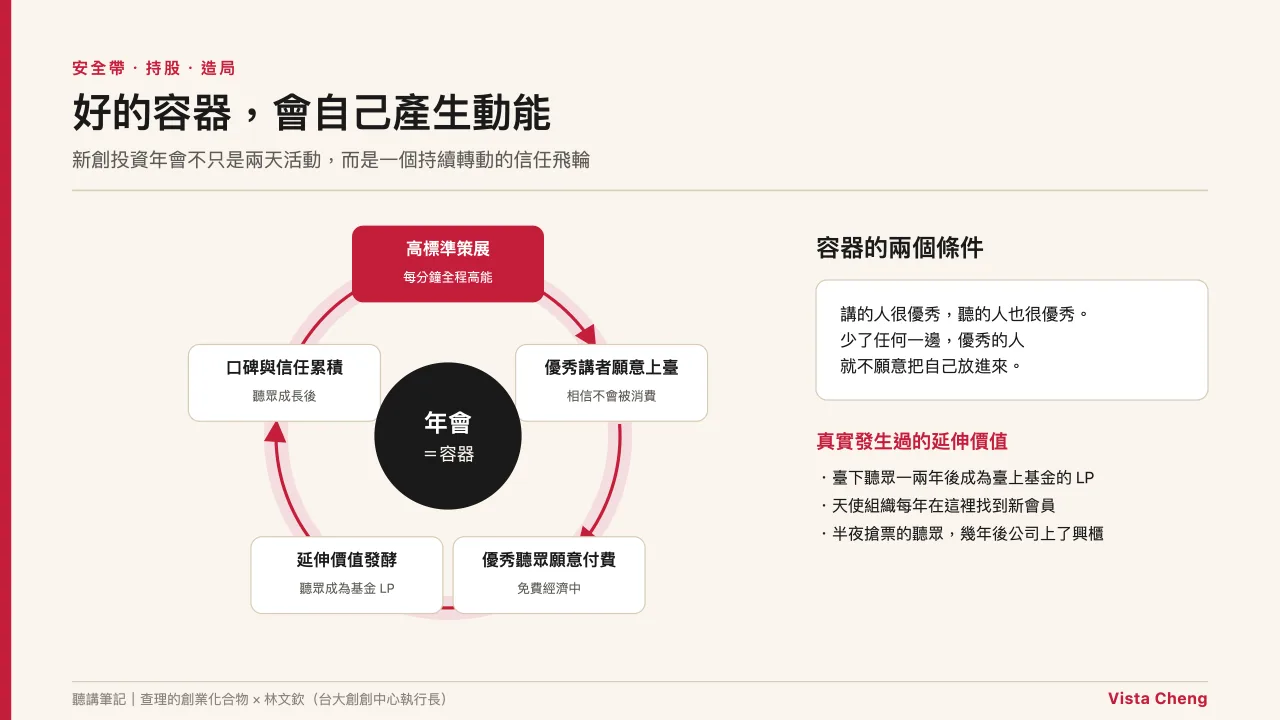
▲ If the container is good enough and good talents are willing to put it in, the kinetic energy will grow on its own
The core ability of a game maker is not to have many connections, but to make people feel reassured: adhere to high standards, not consume other people’s reputation, and fulfill their promises every year. Trust can be designed and accumulated.
From 0 to 100: first see 100, then go to 100
“Not everyone will think of 100 when they see 1.” He said that there are many people holding small gatherings, but he wants to hold a big gathering. Scale is value in itself: Sponsors would rather sponsor one big event than spread out their sponsorship over ten smaller venues. After moving to another battlefield, you can get rid of the competition in the industry and enter a scarce position, just like a singer who will eventually stand on the Hung Hom or the Arena.
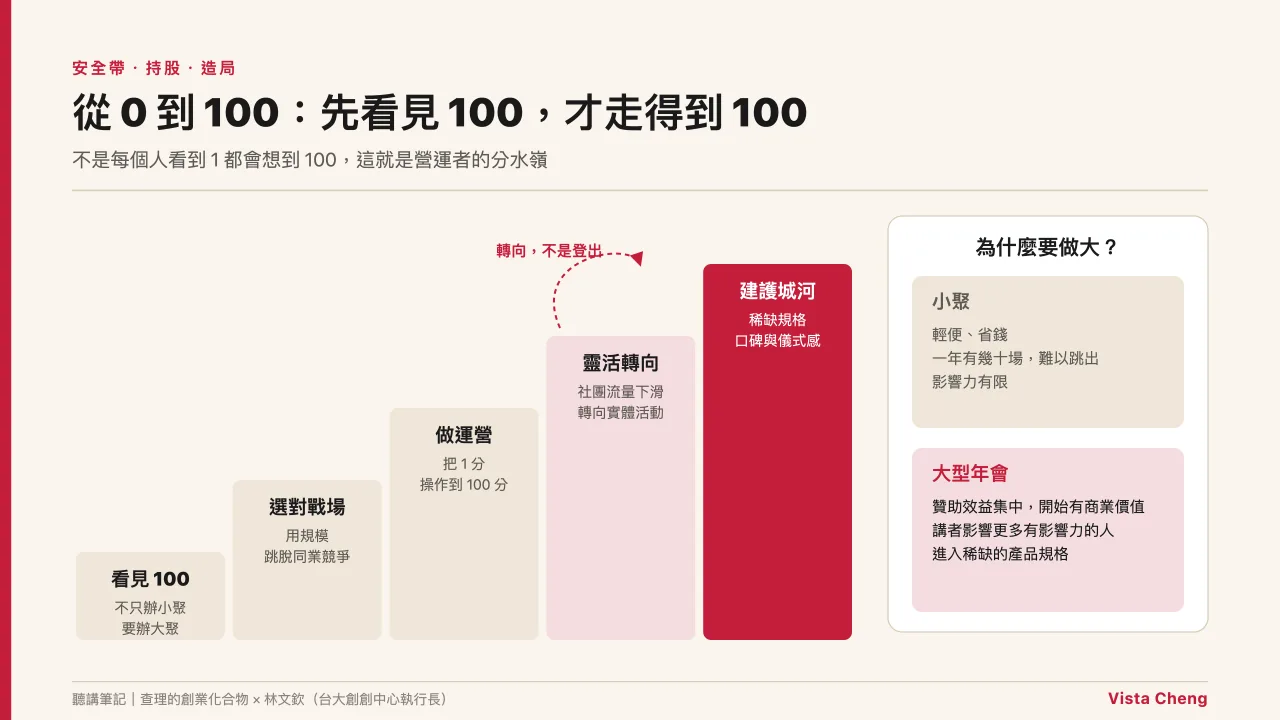
▲ Scale itself is value. Only by moving to another battlefield can you enter a scarce position
But the road to 100 isn’t a straight line. He noticed the decline in Facebook traffic early on and switched from online clubs to physical activities. He also shared a reminder from a senior: If you run hard but can’t run well, why not try swimming instead? Diversion is OK, as long as it is not “logout”. Shareholders are not afraid of you changing direction, but they are afraid of you walking away.
Between Two Worlds: Capital and Founders
There is a passage in this episode. If I had heard it when I was running for startups, I would probably have written fewer reports complaining that “there are no angels in Taiwan.” He said that founders think about their own technology and the problems they want to solve, while capital thinks about investment, exit, and returns. These are two worlds. Investors are also responsible for the LP behind them. Just because they don’t appreciate you doesn’t mean they are wrong.
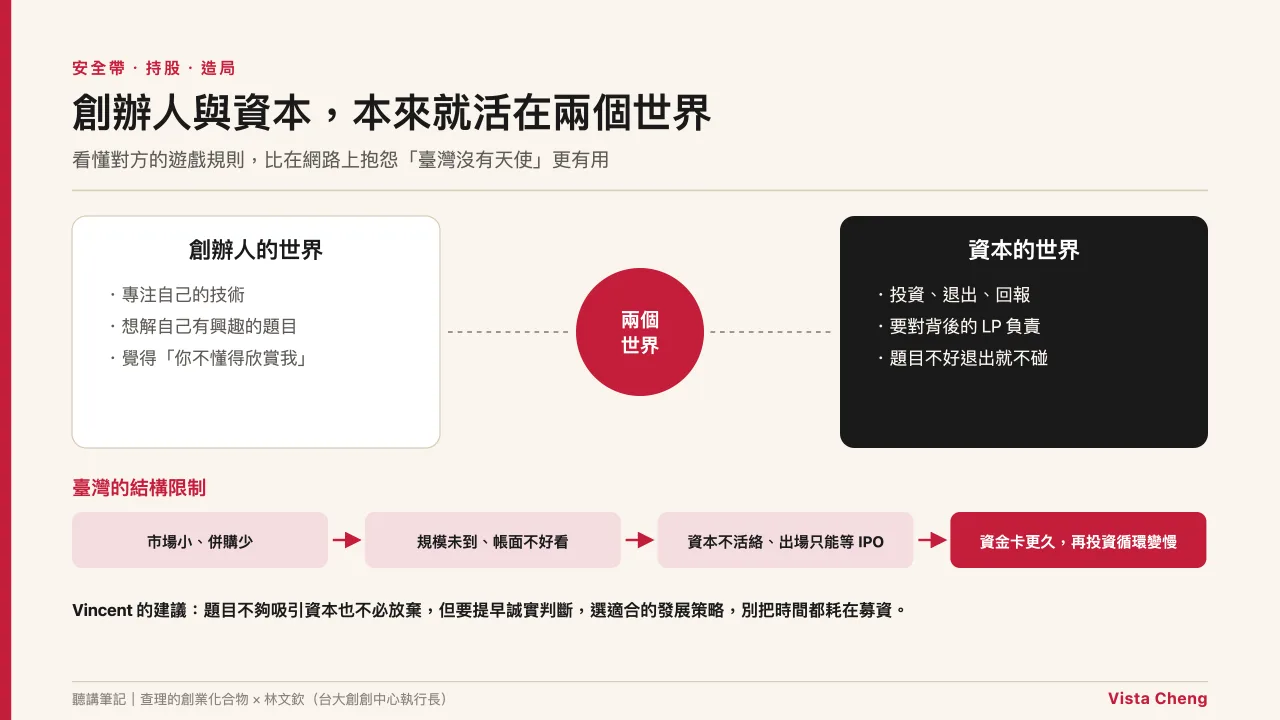
▲ What the founder thinks about is the topic, what the capital thinks about is exit and return. If he doesn’t appreciate you, it doesn’t mean he is wrong
Taiwan’s structural limitations are also very clear: the market is small, economies of scale have reached their peak before they are reached, the book numbers are not good-looking, and capital is naturally inactive. More importantly, there are too few mergers and acquisitions. Many founders in the United States can gain wealth early through mergers and acquisitions, and then turn around and invest in the next generation of new ventures, forming a good cycle. In Taiwan, most companies have to wait for the IPO to get out of the market, and funds are stuck for even longer.
Therefore, he will honestly tell the founder in advance: Capital may not be interested in your topic. This does not mean that you should give up, but that you should change to a more suitable development strategy and stop wasting time on raising funds. This reminder can be read together with the entrepreneurial reality I discussed in the recommended preface of “Let the Elephant Fly”. As for how investors view people, he listed several characteristics: flexible thinking, analytical thinking, unconventional ideas, leadership ability to convince the team and investors, and will become stronger after failure. Integrity is a rule of heaven and cannot be compromised. Because what the founder will do five years from now will definitely not be what is discussed in today’s briefing.
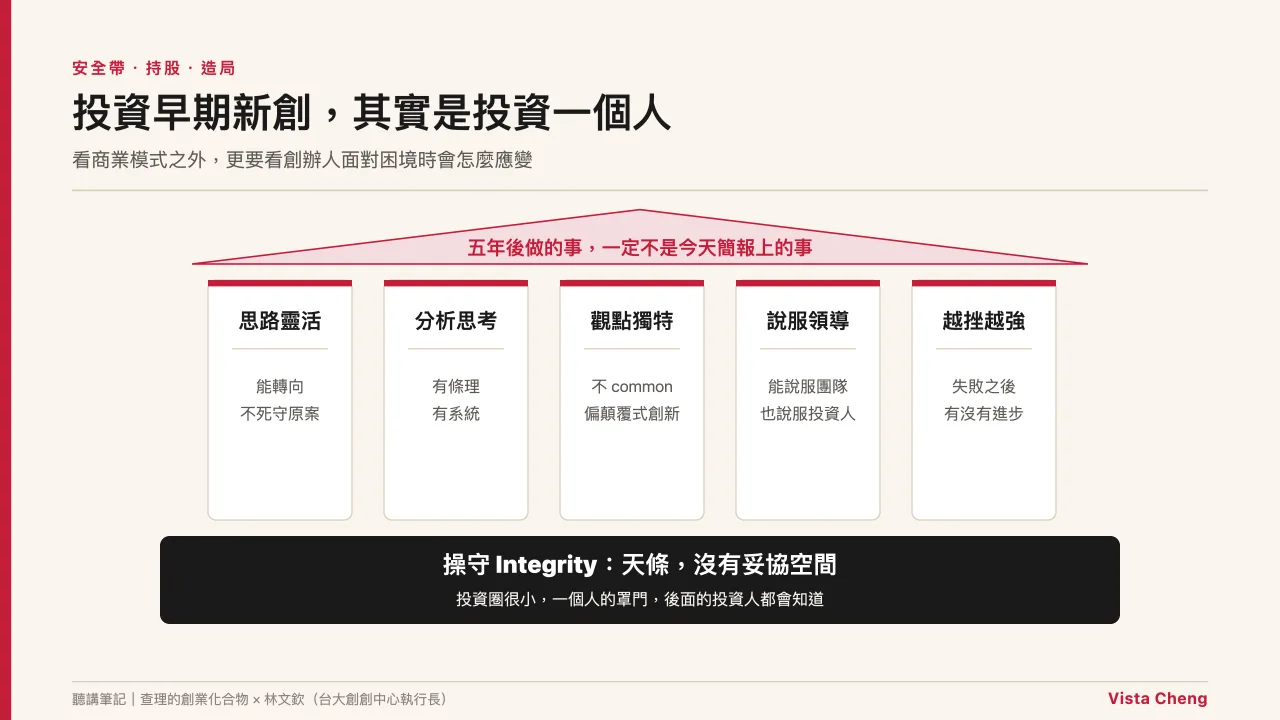
▲ The business in five years’ time will definitely not be what it looks like in today’s briefing, so what investors are really betting on is people
My three extended thoughts
First, content workers need safety harnesses, too. We allocate not only funds, but also time and attention. I would divide it into three tiers: most of the energy is invested in the core business that stably generates revenue, some is invested in growing products, and about 5% is left for high-risk experiments, such as: new platforms, new formats, new collaborations. If the experiment fails, it will not harm the body, but if it succeeds, it may be the next ten years. This is also the smart trial and error I advocate in “Low-risk slash for freedom”.
Second, writing is the earliest way to create a situation. From V-Geek’s blog, to the 50,000-person club, to the annual meeting, every step Vincent takes is based on the content credit accumulated in the previous step. He mentioned in the program Lin Zhichen’s daily blog (opens in a new tab), which later became the source of energy for AppWorks. When I was looking through my mailbox, I also saw a letter from him at the end of 2008, with the title “you are what you write.” He said that the power of interviewing two hundred people is completely different from that of interviewing one thousand people. There is no technical difficulty in this matter. What is difficult is perseverance. Regarding what long-term writing can bring, I wrote in How to write a good column? 〉There is also more discussion.
Third, there are several sets of tensions hidden in this method, which are worth facing honestly. High standards will make it harder for the team, he himself admits. How can the amoeba-like agility of one person coexist with the scale of holding an annual meeting for one or two thousand people? Concentration and decentralization, not chasing excess returns and getting excess returns, may seem contradictory, but they are actually differences in stages and mentality. Being able to handle contradictions in the same person and operate freely may be the true meaning of “adaptability”.
Time flies, and more than ten years have passed in the blink of an eye. Nowadays, I mostly see his footprints on social media, but I know that the way my old friend does things has never changed: buckle up your seat belt first, then boldly go for it, and every few years, you are willing to reset yourself to zero. At the end of the program, Vincent quoted a potato chip advertising slogan: “Life is more interesting when it has twists and turns.” Looking back at this friendship that spanned nearly two decades, I think I feel the same way.
(opens in a new tab)Next step
Bring this topic to your team
Vista Cheng speaks and runs workshops on AI workflows, writing and content systems for companies, schools and public agencies.