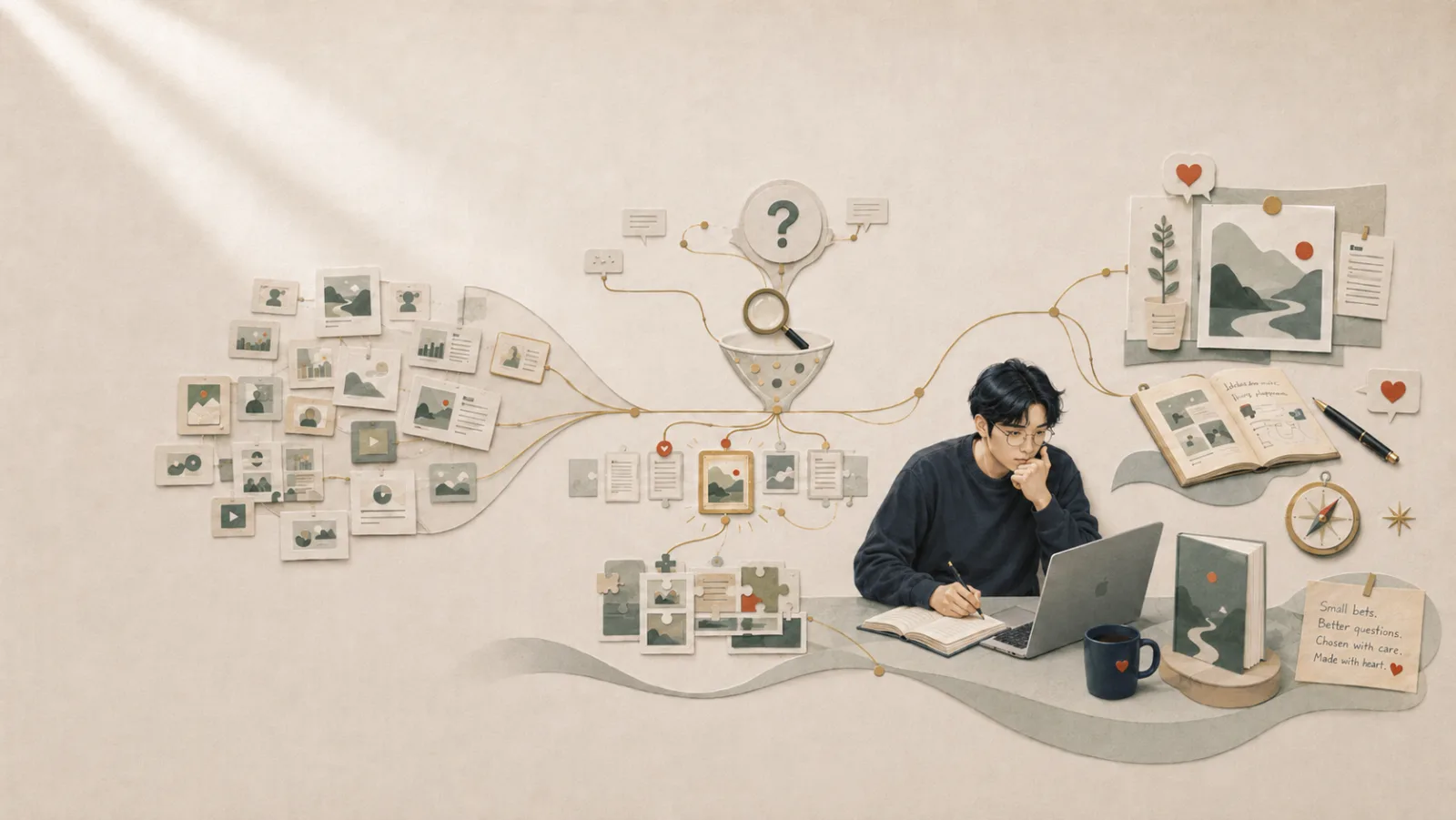
This is how all my Vibe Coding ideas grow: Four sources behind 40 AI tools

*This article was originally published in “Vista Newsletter” No. 127 (original link (opens in a new tab)). *
Last week, my AI Lab (opens in a new tab) quietly launched its 40th tool. I didn’t open the champagne, I just made a cup of coffee and scrolled through the list for a long time.
In recent years, the most frequently asked question in class is: Where do you get so many ideas? The person asking usually sounds a little envious, but also a little ambivalent. Well, I can understand that feeling. Because now the technical threshold for making an AI gadget is incredibly low: a moving thing can be produced in just one afternoon and a few rounds of conversations. Vibe Coding makes it easier and cheaper to do this.
So the really scarce things quietly changed their positions. The hard part is no longer making it, but knowing what to do?
In this article, I want to tell you the complete story of how I found ideas for Vibe Coding. Not some pretty story that comes with a torrent of inspiration, but four sources that I use every day that you can refer to today. And instead of just talking, I will use these 40 tools from the AI Lab as evidence and point you one by one where they come from?
Source 1: Your own friction, that is, the thing that annoys you for the second time
More than half of the tools in the AI lab were seeded by my own friction.
For example, the starting point of AI Subscription Discontinuance Physical Examination (opens in a new tab) was when I checked my bills one month and found that the hand paying was much faster than the hand canceling. I couldn’t remember the last time a bunch of subscriptions were actually opened. The starting point of Lecturer Quotation Health Checker (opens in a new tab) was when I applied for a case and realized that hidden costs such as lesson preparation, teaching material authorization, video authorization, transportation and accommodation were all omitted, which was equivalent to wasted work. Blind Spot Inspector (opens in a new tab) is more direct: I asked the AI to change something, but it was still wrong after the tenth time. I was so angry that I realized that the problem was not that it was stupid, but that I didn’t make it clear from the beginning. Should this matter be handed over (opens in a new tab) also came from the same path. I carried everything by myself until I got stuck in my growth, and then I forced myself to face what things I shouldn’t do by myself at all?
Well, did you find out? The above-mentioned things are not that I came up with a cool idea, but that I tripped over the same thing again!
So, I’ve developed a stupid, but potentially effective habit: every time something annoys me a second time, I write it down. Annoyance is the most honest demand signal. You won’t spend an afternoon working on an imaginary pain point, but you will stay up all night working on your real pain point. And the first user of it is yourself, which almost guarantees that it will not be something that no one wants, because at least one person, that is, you, is really waiting for it.
If you are thinking about starting Vibe Coding but don’t know what to do, don’t force yourself to find inspiration yet. Look back at this week and see what happened that made you roll your eyes, sigh, and curse in your mind. There is a tool buried in that sighing place.
Source 2: The same thing you have said to three people
Some ideas don’t come from pain, they come from repetition.
I often teach students how to ask clear research questions in class, but later I find that I repeat the same set of four boxes every time: role, context, task and format. Since it talks about the same thing every time, let’s just turn it into a Research Questioning Shelf (opens in a new tab) and let people fill it in by themselves, looking at the context while filling it out. I am often asked if you can teach me that unique skill, but the oral explanation is always incomplete and misses the point, so I have Specialty Skill Recipe Card (opens in a new tab). Answer a few questions and produce your own recipe card in ten minutes, with a prompt that can be directly pasted into ChatGPT.
Here, I would like to share a useful criterion: if you have said the same thing to three people, it is worth turning into a tool.
The reason is simple, because your repetition is a shortcut for others. Having said that, the process you talked about getting tired of is probably golden for people who haven’t touched the door yet. Consolidate it into something that will actively ask you questions and help you complete the tasks, and you will go from being able to teach only one person at a time to being able to help a hundred people at a time. This is why I later even made Output Note Maker (opens in a new tab) and Content Pillar Planner (opens in a new tab), because those are things that I talked about badly, but found that many people didn’t have a system for them.
Source 3: Translate the methodology that you admire after reading it into a hands-on tool
The third source is to translate the methodology that I read and sincerely admire into a hands-on tool.
Future Press Release Generator (opens in a new tab) follows Amazon’s reverse working method: for a project that has not yet started, first write a press release from the future, forcing yourself to clearly explain the vision from the customer’s perspective, and add a countdown to the date. Story Generator (opens in a new tab) combines the Hero’s Journey, Pixar’s Story Spine, and StoryBrand, using a story compass designed by myself to help you turn a piece of material into a touching story. Behind Ten Ideal Mes (opens in a new tab) is something I have always believed in: Vague wishes cannot fool the brain, nor can they guide today, so I multiplied my heartbeat by two rulers and forced it into a four-quadrant table.
Good methodologies often get stuck in the same place: I nod my head while reading, but I really need to use it, but I don’t know where to start. What tools are best at doing is turning me from knowing that this is important into me taking this step now.
So next time you read a framework, mindset, or list that makes your eyes light up, don’t just save it. Ask yourself: Can I make it into something that asks me questions step by step? If you can, that’s an idea. You don’t need to invent new methods, you just need to make good methods doable. The value of this thing is no less than originality.
Source 4: Cutting big ideas into one afternoon
The first three are about how to find ideas, and the fourth is about how not to be drowned in ideas.
People who want to learn Vibe Coding often die when they choose too big a project for the first time. I wanted to build a platform that could help all creators manage all content, but I got stuck on the third day, and I decided that I was not suitable for programming. There is a Vibe Coding Project Selector (opens in a new tab) on the AI Lab, and the logic is just to handle this: you only need to answer three starting questions, and select a small enough, self-use, and visible project from nine types of projects.
Only when it is small enough can you finish it; only when you use it for yourself can you have a real user, that is, yourself; only when it is visible can you have a sense of accomplishment when you have finished it, which will support you to the next step.
I always ask myself before starting work on every tool I use: Can it be finished in an afternoon? If you can’t cut it, don’t do it yet, or just do it on the most painful part. Inspiration Passbook (opens in a new tab) In the beginning, I wanted to make it a complete second brain. In the end, I only left the core of throwing it away, labeling it, and picking it up when I want to write. Did you know? In fact, many people never lack inspiration. What they lack is the discipline to condense a big idea into a completed small project. The first little thing you complete is more valuable than the ten great ideas in your mind.
What is truly scarce is not technology, but judgment
Looking back at these 40 tools, I found one thing in common: none of them were developed because they were technically feasible. In fact, it’s all because someone really has a need or is stuck somewhere…and that person is often myself.
It’s true that AI makes it cheaper to do it. Things that are so cheap that you know them are no longer scarce, and things that you can do are no longer scarce. The only thing left that is still scarce is judgment: whether it is worth doing, who to do it for, which part to do first, and which functions are actually redundant…
Later, I followed the advice of Mr. Innovation and split the idea-finding process into four eyes that take turns looking at it: Detective, ask what the real problem is here instead of rushing to add functions; Judge, judge whether it is worth doing; Artist, think about what this experience should look like; Warrior, decide which step to take first.
For example, I first wanted to make the Blind Spot Inspector a tool to help you check whether the AI output was correct. After asking again with the eyes of a detective, I found that the real problem was not in the AI output at all, but in the person’s failure to explain clearly at the beginning. The problem is redefined, and the tool becomes completely different and more useful.
Most of the tools that are abandoned half-way are not dead because they cannot be made, but because they fail to ask clearly from the beginning who exactly solves what? Because of this, I actually cut more ideas than I made. He knows how to find ideas, half of them are born, and the other half is ruthless enough to kill the unworthy ones.
If you already have a stuck work in hand
If you already have a half-finished work, or a problem that has been stuck and you feel like there is a chance but you can’t explain it, I would like to recommend you to sign up for the “Tool Innovation Design Power in the AI Era (opens in a new tab)” workshop hosted by innovative Mr. Chen Jianming.
He organized the above method of how to judge which ideas are worth doing into a workshop.
Vibe Coding helps you create works, and innovative thinking makes the works truly needed.
On the afternoon of September 12, there was a three-hour small class with a maximum of 12 people at Guting in Taipei. Mr. Innovation will lead you to use the rules of the inspiration machine to condense the vague ideas in your hands into your own “AI Tool Innovation Design Book”: problem diagnosis, who is the user, value proposition, function trade-offs, and redesigned processes. When you walk out of the classroom, what you take away is not just another function, but a work that has been clearly thought out and for whom it is made.
After all, the tools will get better and better, and what is really scarce is the judgment.
Registration and complete details are here: https://ai.innovators.tw/courses/ai-innovation-tool-design/ (opens in a new tab)
(The current early bird price is NT$3,300 for a single person and NT$3,000 for two people traveling together. There are only 12 places.)
If you want to feel it yourself first, you can directly experience the 40 tools in my AI Lab (opens in a new tab), and many of them are the finished products of this idea. By the way, which tool is your favorite? Feel free to write to me.
See you in the next issue!
Sincerely, Vista
📮 This article is adapted from “Vista Newsletter” No. 127. If you like this kind of content, welcome to free subscription to “Vista Newsletter” (opens in a new tab) and receive my observations and methods first-hand every week.
Next step
Bring this topic to your team
Vista Cheng speaks and runs workshops on AI workflows, writing and content systems for companies, schools and public agencies.