Leave blank space in advertising: change the finished product into a semi-finished product and allow the audience to participate in the creation
This article was originally published in “Economic Daily (opens in a new tab)”.
Have you ever seen a great ad and couldn’t help but like it, but five minutes later you couldn’t remember the brand name? The problem is often not that the creativity is not good enough, but that often the audience is just a bystander.
We are in an era of information explosion, and it is difficult for brands to leave memories by just being “seen”. The direction that is really worth trying is to change the advertising from a finished product to a semi-finished product: the brand sets the stage first, leaving the last step to invite the audience to make up their own choices, stories or versions. When a person completes content, he not only receives information, but also begins to participate in the formation of brand meaning.
Here’s a piece of digital marketing inspiration that came to mind recently: designing creative spaces.
1. Stop asking the audience whether they like it or not. Let them have something to change.
Many manufacturers engage in interactive marketing and like to hold polls, messages and draws. These mechanisms do increase numbers, but they don’t necessarily increase memory because what the audience is doing is not directly related to the brand proposition.
I have written before How fan pages can make full use of voting activities. That kind of mechanism is still useful today, but its ceiling is also very clear: when the voting is over, the interaction is over, and nothing is left in the hands of the audience.
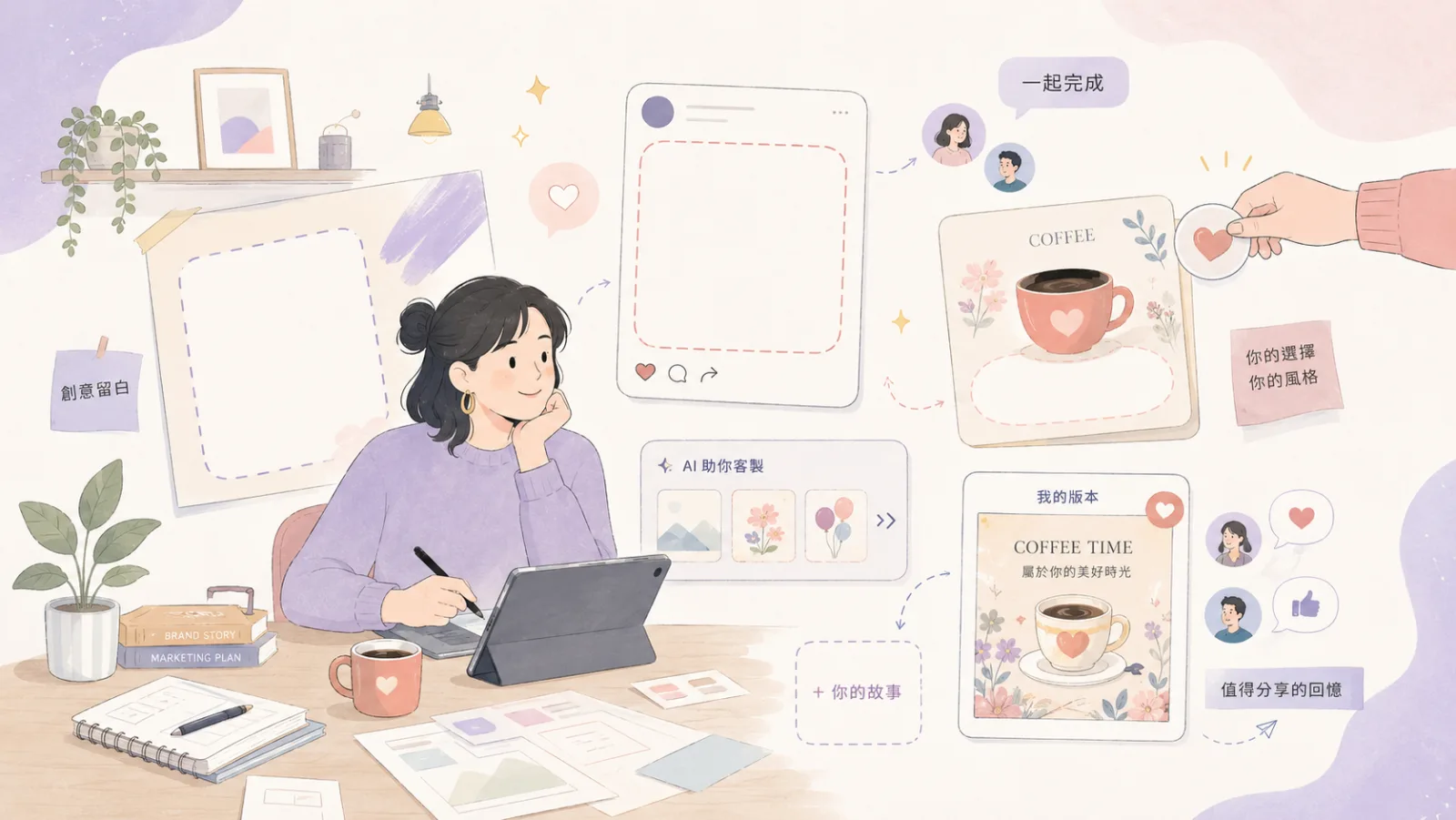
Creative spaces are different. It requires the brand to retain an unfinished position. For example, coffee brands no longer need to ask people to leave a message “Which flavor is your favorite?”, but can provide a morning recipe card that allows users to choose the time to wake up, their mental state and what they want to accomplish today, and generate a cup of exclusive coffee and a self-reminder. What is shared is not a discount coupon, but “me today”.
Good interaction is not about pressing buttons one more time, but letting people express themselves one more time.
2. The core of creativity, from what the brand says to what users can take away
Traditional advertising is accustomed to focusing creativity on a slogan, a video or a main visual. Creative Space starts from another question: After the audience participates, what results can be obtained that can be saved, shared, and reused?
It could be a personalized poster, a piece of sound, a list of options, or a new product named by the user. The outcome does not have to be complex, but it must bear the traces of the participants. As long as there is “my version” in the content, people will have more reasons to collect it and be more willing to repost it.
The best demonstration in recent years is actually Spotify’s Wrapped (opens in a new tab) annual review at the end of each year. It didn’t ask anyone to help promote it, but it allowed tens of millions of people to take the initiative to post the brand page on their own communities, because the picture said “what I listened to this year”, not “how easy to use Spotify is.”
At this time, sharing is no longer just about helping the brand spread, but about users using brand materials to express themselves. Only when the brand is touched and the user gets the work can the exchange between the two parties be established.
From another perspective, this is also the most easily skipped section in the Customer Experience Journey: from “knowing you” to “trusting you”, it requires a truly his own participation.
3. AI makes personalization cheaper, but insights still cannot be outsourced
Generative AI is well suited to support this approach. In the past, it would have been prohibitively expensive to produce hundreds of visuals and copywriting; now, brands can generate different versions in real time based on user input.
But tools only solve the problem of output and will not automatically bring about creativity. If a brand just puts names into the same picture, or generates a vague compliment for each person, it is still changing the soup without changing the medicine. I have talked about it before, AI is a magnifying glass, not a magic wand, it will not help you gain insights you don’t have, it will only honestly magnify what you already have.
Where people are really needed is to find the space worth filling.
Sports brands can ask: “What milestone do you want to reach this year?” Travel brands can ask: “If you had three more days, where would you like to be?” Bookstores can ask: “Which recent book has expressed your unfinished feelings?”
If the questions are well chosen, the AI will have the materials to turn the answers into works. This is why I have always believed that prompt words will expire, but questioning power will not. The real technical content is not how the back-end is generated, but what is asked on the front-end.
To ask accurate questions, the premise is that you really know who the other person is. There are no shortcuts to this matter. You have to go back to the most basic homework: Set a precise target audience, and Start writing by understanding the other person’s voice. As for how to transfer roles, tasks, context and format to the model, I have compiled Four Elements of AI Copywriting, and you can follow it directly.
4. Turn an event into a creative database that can be accumulated
Creative white space has another layer of value. Every time he participates, the customer tells the brand in his own language: what he cares about, how to describe his needs, and which part of himself he is willing to disclose.
This content should not be used solely for event closing reports. After obtaining consent and proper de-identification, brands can organize common sentence patterns, emotions and usage situations, and then go back to improve product pages, e-newsletters, community topic selection, and even develop the next service. In this way, the marketing campaign is not just a single exposure, but a continuously updated customer language library.
I got the information in <, but what next? 〉 talked about something similar: when the threshold for collecting information becomes zero, what is valuable is no longer the information itself, but the judgment of reading people’s hearts. This is especially true for the things collected in the creative space, because they are the original words voluntarily written by customers, which are closer to the truth than any questionnaire options.
Of course, those involved in the design must respect privacy and make it clear how the data will be used. If the cost of interaction is handing over too much personal information, no matter how beautiful the generated results are, people will be put off.
Three check points: Are your spaces in the right place?
The length of the column is limited, so here are the three hurdles I will pass when making judgments.
**First, after removing the brand, will the results still hold? ** If the thing created by the user can be replaced by any competing product, then what you leave is not a space, but a template. The blank space should be stuck in your brand proposition and cannot be filled in by others.
**Second, would he want to keep it? ** Discount coupons will expire, but the works will not. If the output of participation is deleted after three days, it means that what you have given is an inducement, not a meaning.
**Third, are you ready to recycle? ** Many brands end the interaction after the interaction, and no one is responsible for sorting out the responses. Think clearly in advance who will read, how to classify, and which decisions will be fed next season. Only after this step is done will the activity become an asset.
If you pass all three levels, you will be left with a blank space; if you only pass the first level, it will probably still be a relatively fancy advertisement.
The brand should be left blank, provided the subject is clear enough
However, there is a premise that is easily overlooked.
White space exists because the rest of the picture is clear enough. A brand that cannot clearly tell who it is will leave not a blank space but a blank space: the audience will not know what to fill in after reading it, nor what to do after filling it out.
This thing is even more cruel to personal brands. I have seen too many people who are good at everything: they have a lot of ideas, have learned a lot, and have a long list of ideas, but they still cannot develop a self that is memorable. They have no shortage of content and are outputting all day long. What they are stuck on is the Positioning level. There are too many things to choose from, and often it’s not that I don’t know how to choose, but that I just can’t bear to part with them.
If you are stuck here, I recommend the second issue of “Positioning Convergence Workshop (opens in a new tab) by solo.tw. This class is taught by social content strategist Susie Li. She has a master’s degree in psychology and many years of media experience. She deals with the most difficult and valuable link of “convergence and trade-offs”: from inventorying assets and looking at market positions, all the way to designing products and launching monetization.
- Time: September 26, 2026 (Saturday) Taiwan time from 15:00 to 18:00, a total of three hours
- Format: Online, limited to 20 people
- Fee: NT$4,500
- Things to take away: one sentence positioning, a main product direction, and a monetization path that can start testing
Similar one-on-one positioning services overseas can cost as much as NT$40,000. This class incorporates the same method into a three-hour workshop. There are only 20 places. Interested friends are welcome to register directly (opens in a new tab). Concentrate yourself into one sentence first, and then you will know which space to leave blank, whether it is advertising or blank space.
As for how to take inventory of the scattered assets on hand, I have written an article before Start with inventory of resources and precise positioning, which can be used as a warm-up before class.
(opens in a new tab)
Write at the end
The difficulty in advertising is never how beautifully you say it, but whether the other party is willing to do something after you say it.
What needs to be replaced in the creative space is actually the long-held default position: the brand is responsible for production, and the audience is responsible for watching. When you are willing to hand over the last step, what you lose is part of the control, and what you get back is the few minutes that the other party really invests. And people will only remember what they have participated in.
This matter is in the same direction as what I talked about before Using Humanity to Fight Algorithms. After the content is so cheap that it approaches zero, whether it can be remembered does not depend on the output, but whether the other party has a place in it.
The next time you hold a marketing meeting, you might as well ask a different question: Which space should we leave to the audience in this event?
It doesn’t matter if you can’t think of the answer, it usually means you have to go back and think clearly about your position first. And this is exactly what the workshop will do with everyone.
Next step
Bring this topic to your team
Vista Cheng speaks and runs workshops on AI workflows, writing and content systems for companies, schools and public agencies.