Think about your retreat before you dare to move forward: Experience from reading "The Start-up of You", use the ABZ plan to treat your career as a new venture
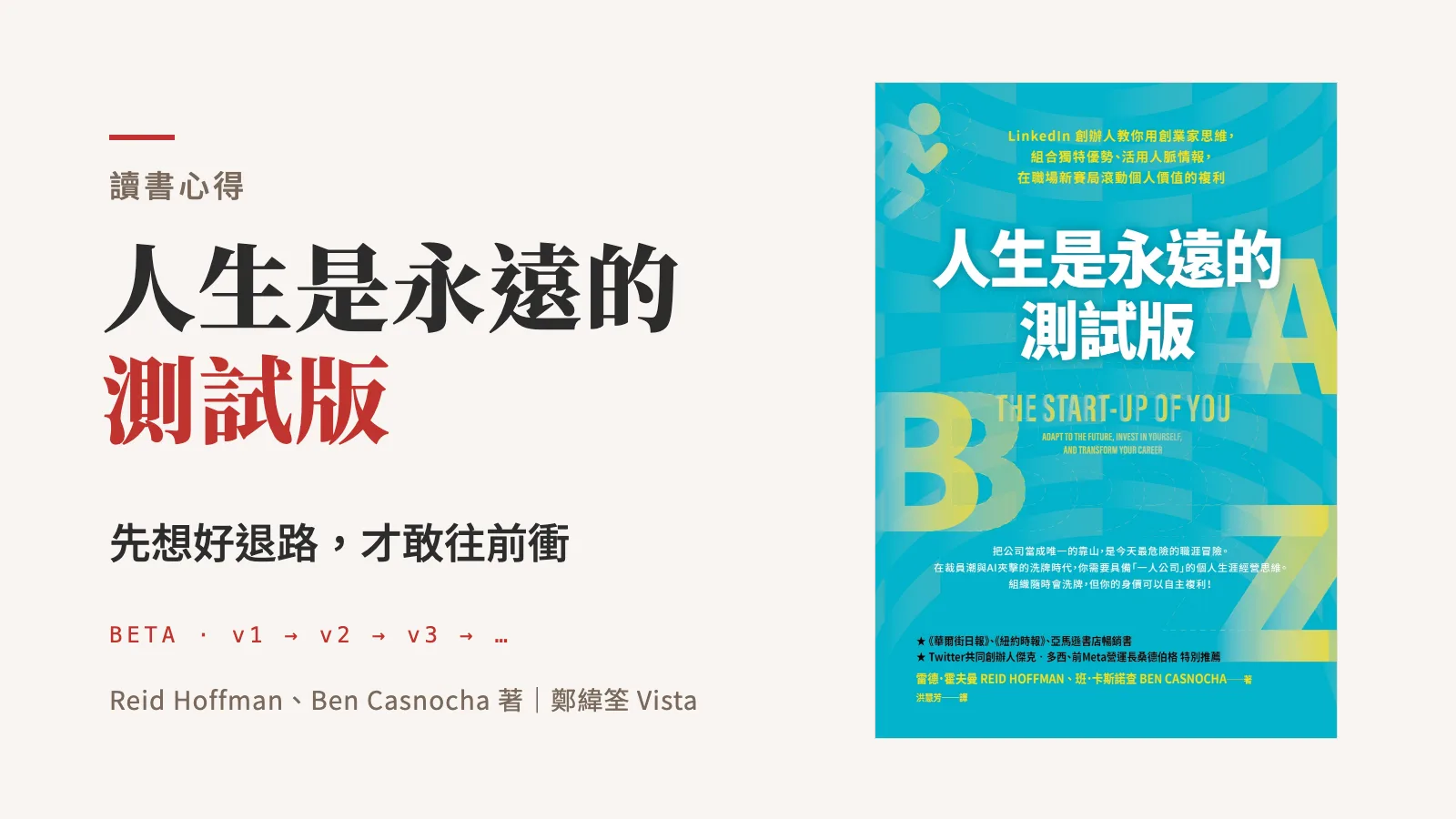
On the afternoon of October 2, I walked into the recording studio of CommonWealth Learning (opens in a new tab) on Nanjing East Road and recorded an episode of “Management Alumni Reunion” with Wu Yunyi, general manager of Tianxia Learning Business Group. This episode is about Reid Hoffman (opens in a new tab) and Ben Casnocha’s “The Start-up of You (opens in a new tab)”, which is a new and updated version of “You Should Know Your First Job”.
▲ “The Start-up of You”, published by Tianxia Magazine in October 2026 (click on the picture to go to the blog)
Looking at the microphone in front of me, I suddenly remembered a past incident: when this book was first published in Taiwan more than ten years ago, I wrote a Recommendation Preface for it. At that time, my professional title was co-founder of the Taiwan E-commerce Entrepreneurship Association, and I honestly wrote in the article that “although I have not yet started a business, I consider myself to be in the entrepreneurial circle.”
When I read the same book again more than ten years later, my identity has changed and the focus of my reading has also changed.
▲ Listen to this episode: [Management Alumni Association Ep.137] The wave of layoffs and AI attack! LinkedIn’s founder’s career classics teach you how to run yourself using beta concepts
Career is like a software that is always being revised.
Hoffman borrowed a parlance from the software industry: when a product is still improving, it will be labeled “Beta.” He believes that the same applies to people. We are all work-in-progress. For entrepreneurs, “finished” is a taboo word.
The book quoted a sentence that touched me very much: What many people call “20 years of experience” is actually just 1 year of experience repeated 20 times.
Looking back at my resume, I probably belong to the type of person whose version numbers jump a lot. I studied electronic engineering and worked in search engines, web maps, and online music. Later I entered the media, then switched to e-commerce, and now I focus on corporate training and AI content consulting. A year ago I was not very good at Vibe Coding, but half a year later I wrote a related book (opens in a new tab).
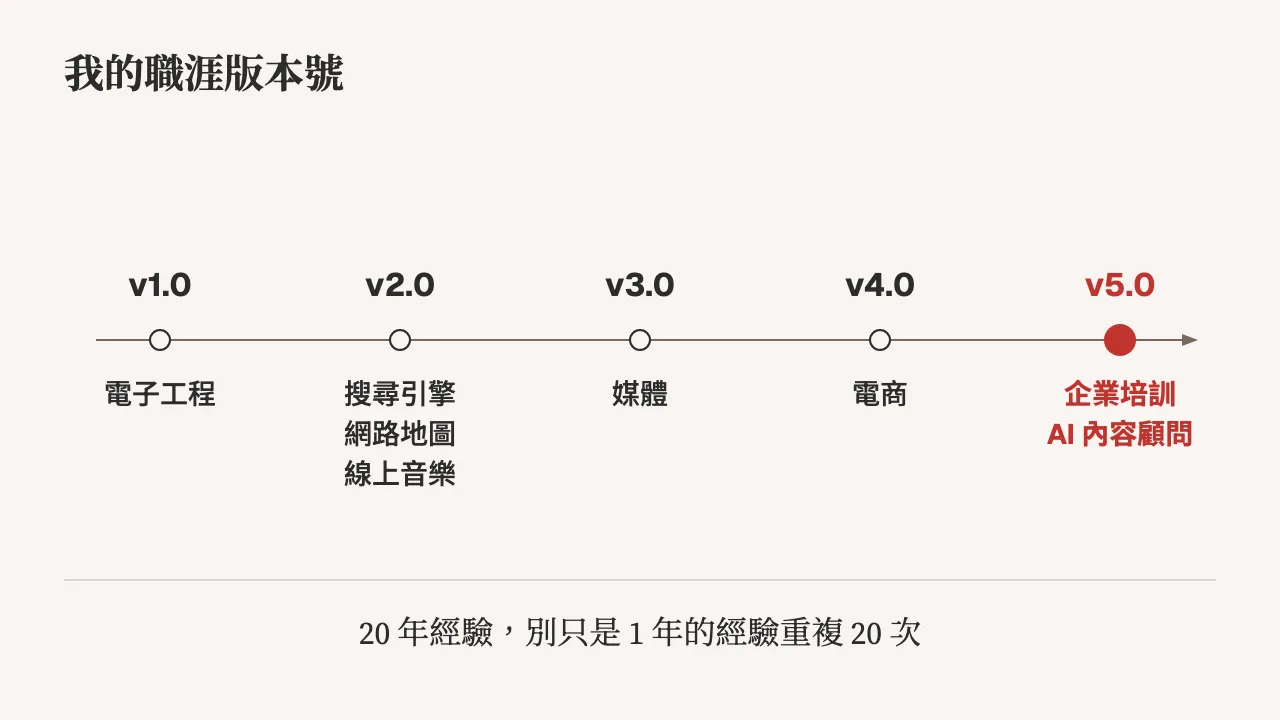
▲ Every conversion is a revision, the point is that each version really makes progress
During the recording, Wu Yunyi asked me what I thought of “Forever Beta”? My answer is: Don’t think of your current good results as something that will automatically continue. Amazon talks about Day 1, and every day is the first day for the company; when it comes to individuals, it means reminding themselves every day that the version of the work in hand is not the final version yet.
ABZ Plan: Think about your retreat first, then have the courage to move forward
The most common thing I share with my friends in the entire book is the ABZ project in Chapter 2:
- Plan A: What you are doing now, continue to accumulate competitive advantages
- Plan B: When A is blocked or a better opportunity arises, move to an adjacent field
- Plan Z: a worst-case scenario lifeboat to ensure you survive and regroup
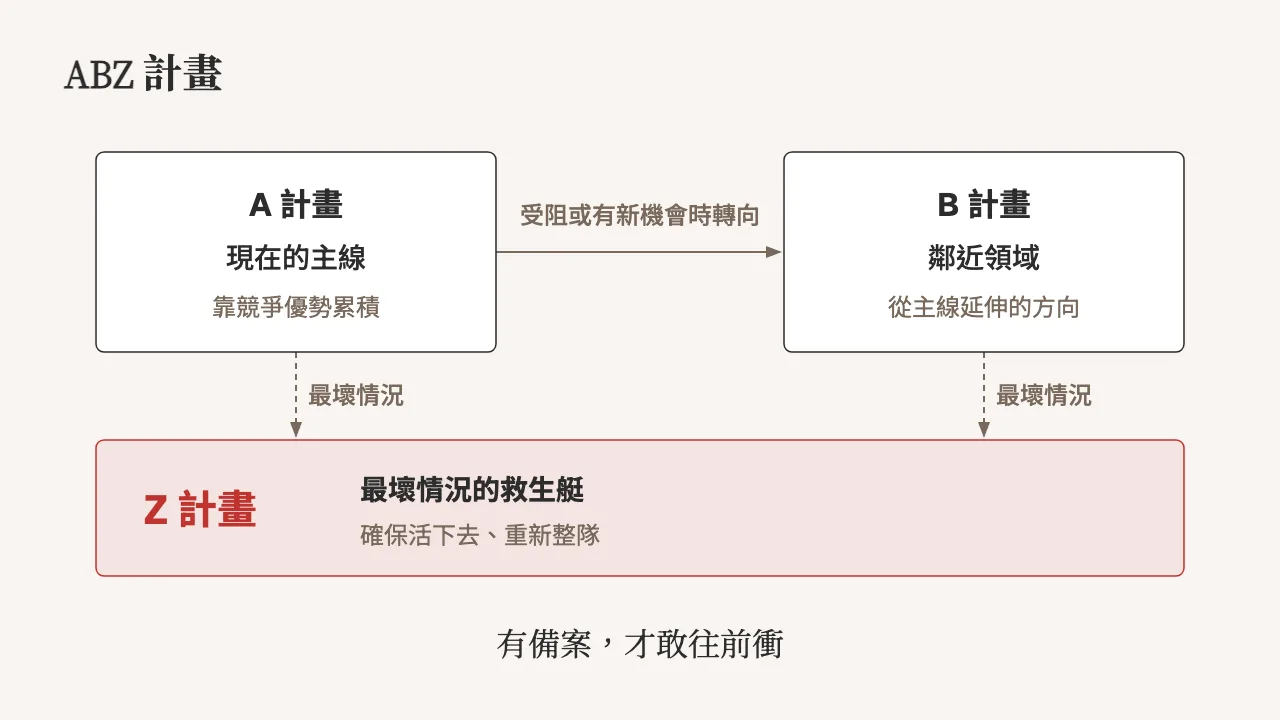
▲ A and B are responsible for moving forward, and Z is responsible for making you dare to move forward
Many people reading this will focus on A and B. Well, I think Z is the key to the whole method.
Hoffman’s own Plan Z was, to put it bluntly, simple. Before he started his first business, he asked his father: If the company fails and all the savings are spent, can he temporarily move back to the extra guest room at home? Father agreed. Just because he knew that in the worst case scenario, he would still have a place to live and find another job, he dared to go ahead and do it.
Honestly, this fits perfectly with my own experience. I switched from engineering to product development, and then to media. Before every switch, I thought about one thing: If I couldn’t do it, could I still go back to my profession? The answer is yes, I will jump.
I said something on the day of the recording, which was later selected as the golden sentence of this episode by the program: “When you have a record, you will have more courage to do the things ahead.”
Many people think that leaving a way out is conservative. My experience is exactly the opposite, retreat is the confidence that makes people dare to take risks. The book also makes it very straightforward: Of all the career opportunities in the world that are truly worth talking about, none are risk-free.
Three gears: Interest cannot be eaten as a meal
Chapter 1 talks about competitive advantage using “three gears”: your assets, your ambitions and values, and market reality. All three must work together to advance their career.
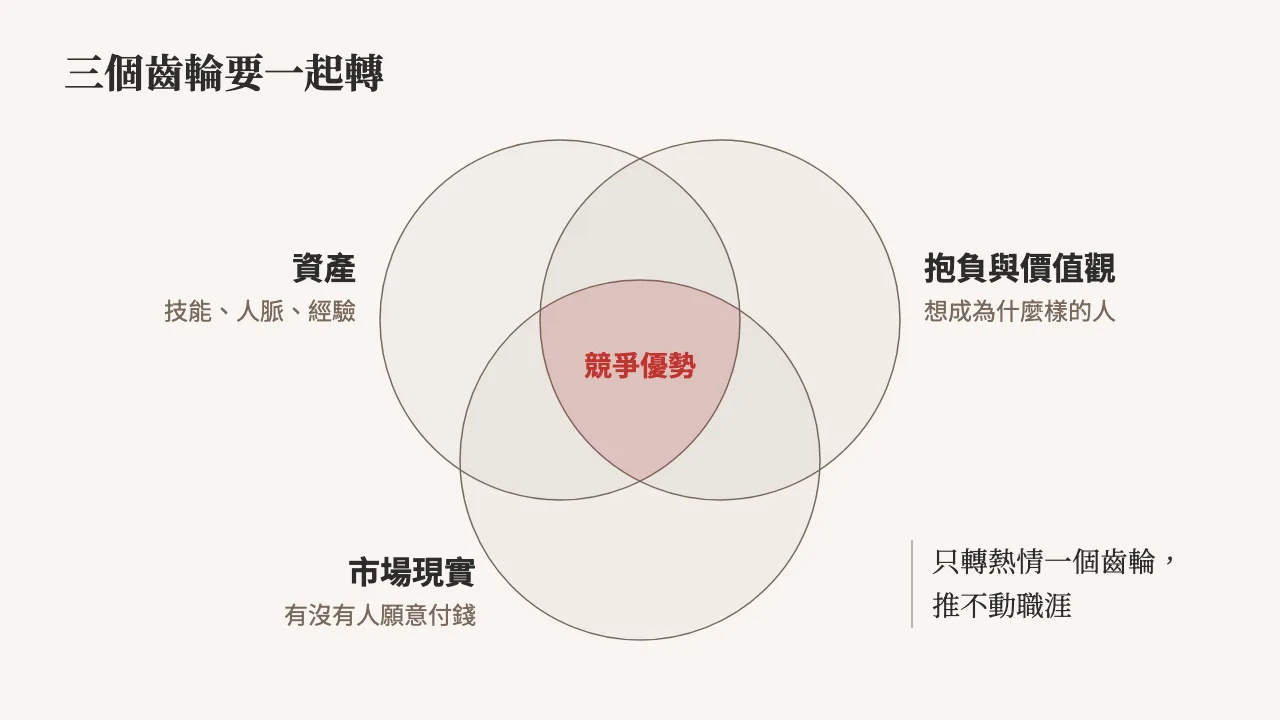
▲ Passion is just one of the gears, only three of them mesh together to move
People often come to me and ask me what to do if they want to change careers. Eight out of ten people only talk about passion. Passion is the gear of ambition. It is very important, but turning only one gear is useless. Before changing tracks, you should at least take stock of your resources and positioning, and then see if the market can afford reasonable remuneration.
There’s another concept in the book that I also like very much, called “skill stacking.” Rather than striving to be the best in the world in a single field, why not put yourself in the top 10% in two or three skills and then combine them. I have been writing for thirty years, plus I have invested in AI applications for the past two years. The combination of the two has led to my current position as an AI content consultant. Looking at any one aspect alone, I am not the strongest person.
Don’t rush to submit your resume when changing jobs.
In the program, Wu Yunyi asked, what is the first step for people who want to change jobs? My suggestion is very simple, that is, don’t rush to submit your resume. You can first take stock of yourself and position yourself in the market.
For example, before I entered the media, I first wrote articles for magazines; before I moved to the e-commerce circle, I first tried to get familiar with the e-commerce community. It is true that some knowledge cannot be found in books, but only grows in the heads of people in the industry. You have to enter that circle first and learn their jargon before you can understand what this industry really cares about.
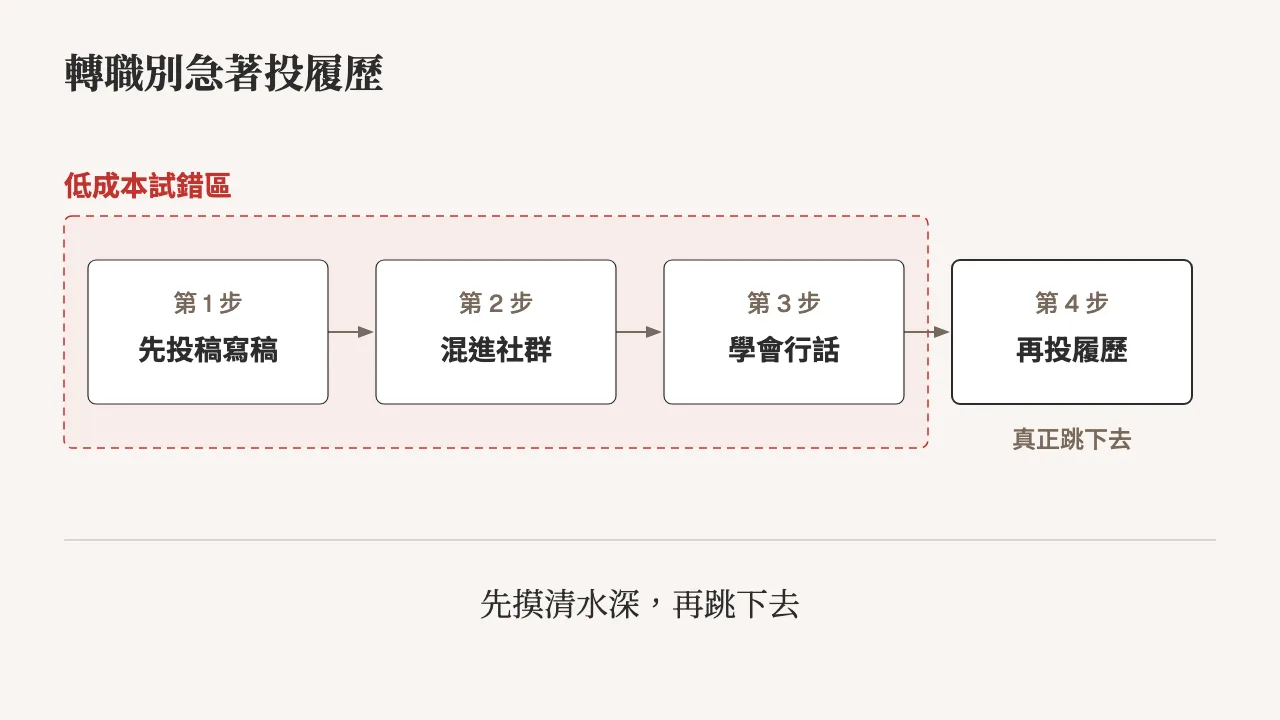
▲ The cost of the first three steps is not high, but it allows you to see this line clearly before you really jump
This is actually what the book calls a low-cost agile attempt. Submitting an article, joining a community, or working on a small project is not very expensive, but it can help you find out how deep the water is before you really jump in.
Friends are not the same as professional allies
Chapter 3 talks about connections. Hoffman divides relationships into highly trusted allies, generally friendly relationships, and social followers, and reminds that having a wide network of contacts does not mean that the connection is effective.
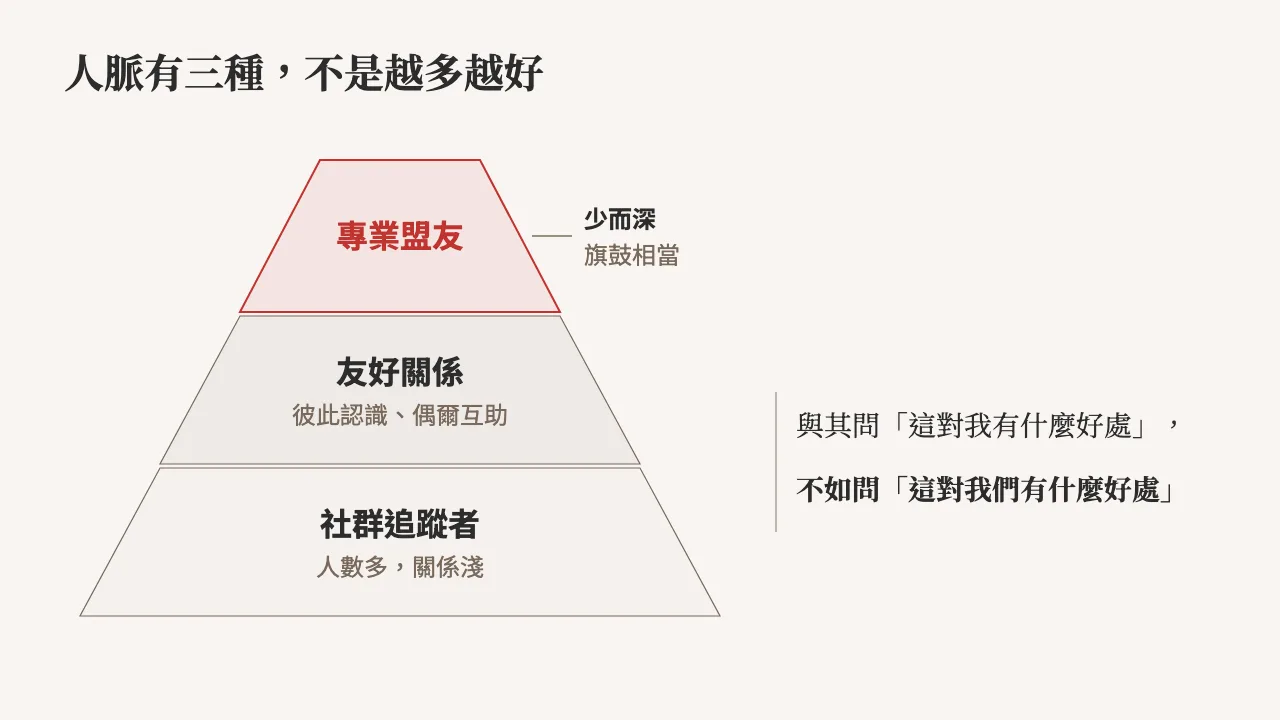
▲ Few allies but deep ones, many trackers but shallow ones, you need both, but don’t get confused
I added an observation of my own to the show: professional allies should be equally matched. Peers in the same industry can both compete and cooperate, but if the conditions between the two parties are too different, the relationship can easily turn into a transaction, with one party always giving and the other always taking.
Another feeling is that Taiwan’s industrial community is actually relatively small. Instead of waiting for someone else to set it up, do it yourself. When I participated in the founding of the Taiwan E-commerce Entrepreneurship Association, and in the past few years I have been running a writing companionship program and a one-person company community, I have always had the same idea: instead of asking “What’s in it for me?” I should ask “What’s in it for us?”
AI has greatly reduced the cost of trial and error, and the biggest impact is on white-collar workers
The first edition of this book was published in 2012, and in the preface to the new edition, Hoffman admits that they did not expect that this set of concepts would become more relevant ten years later. The new edition also clearly mentions that AI is replacing white-collar jobs that in the past relied on years of professional accumulation.
I shared my own example at the recording site: In the past six months, I have used AI to create a system for editing, recording lessons, and even advertising. I also demoed AI editing system on the spot that day for Wu Yunyi to see. AI can now do more than half of what used to be done by professional advertising pitchers.
To be honest, there are two sides to this story. For people who want to change careers, the cost of trial and error has never been so low. It takes half a year to do something that previously required a team; but for white-collar workers, this also means that their Plan A may be rewritten at any time. That’s why Plans B and Z deserve to be written down more seriously than they did a dozen years ago.
More than ten years later, my new annotation for this book
In the recommendation preface that year, I excerpted a sentence from the end of the book: “When life is an eternal beta version, the secret to success is to keep starting over.”
The copy of this updated version writes that “the secret to success lies in constant iteration.” From “starting over” to “iterating”, I think this change is quite appropriate. Starting over sounds like cutting things off and re-training, while iteration means retaining what was accumulated in the previous version and revising it to the next version.
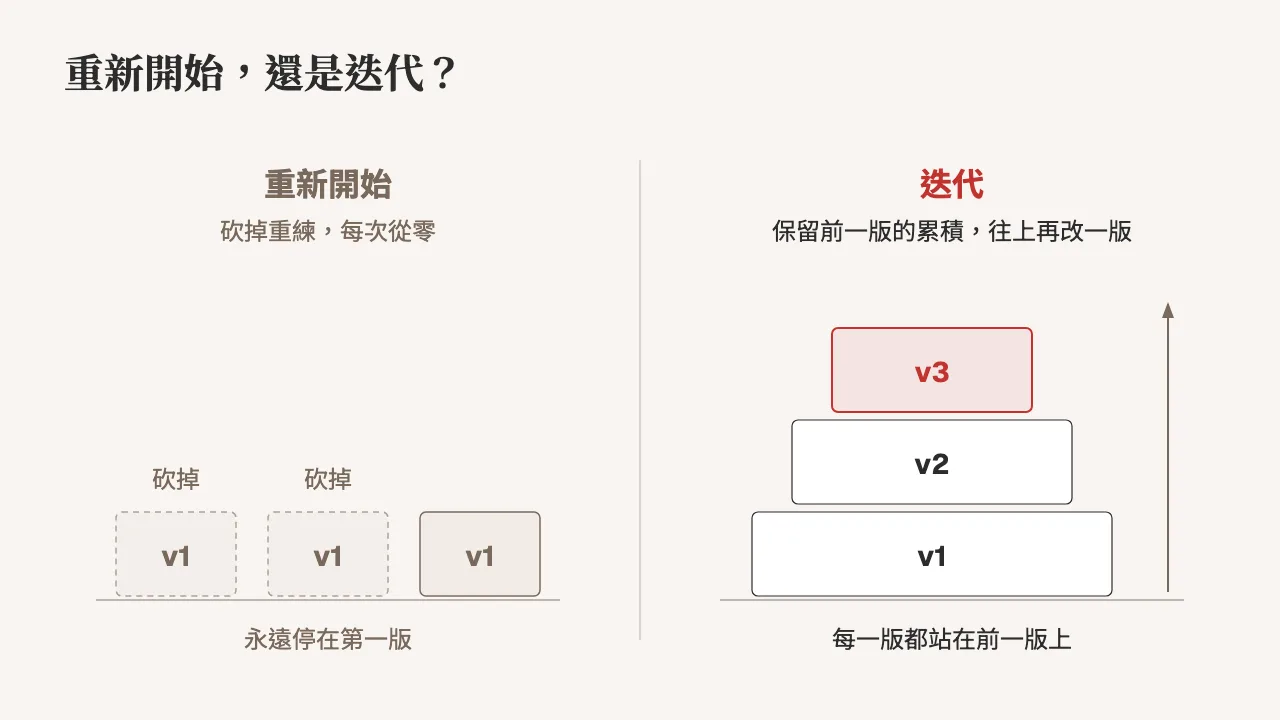
▲ Starting over means returning to zero, and iterating is stacking up on the basis of the previous version
I didn’t start a business more than ten years ago, but now I run my own one-person company. Looking back, no transformation started from scratch, each version was superimposed on the previous one.
If you are stuck in a place where you want to change careers but don’t know where to start, I suggest you do a small exercise at the end of Chapter 2 of the book: write down your Plan A and Plan Z today, and then list two or three possible Plan B directions. You don’t have to write it perfectly, just write it down.
With a way out, you will find that rushing forward is not as scary as you thought.
Further reading:
- Recommended Preface to “Self-created Thinking: “The Start-up of You”, New Work in a Changing World”: The secret to success is to keep starting over
- Use the ABZ program to improve your writing skills
- After AI makes answers cheap, what is really scarce is a sense of direction: read “Super Agent Effect”
- Read “High-Value Networking in the AI Era”: Live your life as a noble person of others, and your network will naturally come back to you
- Multiple interests are not distractions, they are careers you haven’t assembled yet: Dan Koe’s one-person company three-piece set
- From a pile of materials to eight promotional videos: It only took me half a day to turn the clips into an AI system
📚 Book purchase link: “Life is an eternal beta version (opens in a new tab)”
Next step
Bring this topic to your team
Vista Cheng speaks and runs workshops on AI workflows, writing and content systems for companies, schools and public agencies.